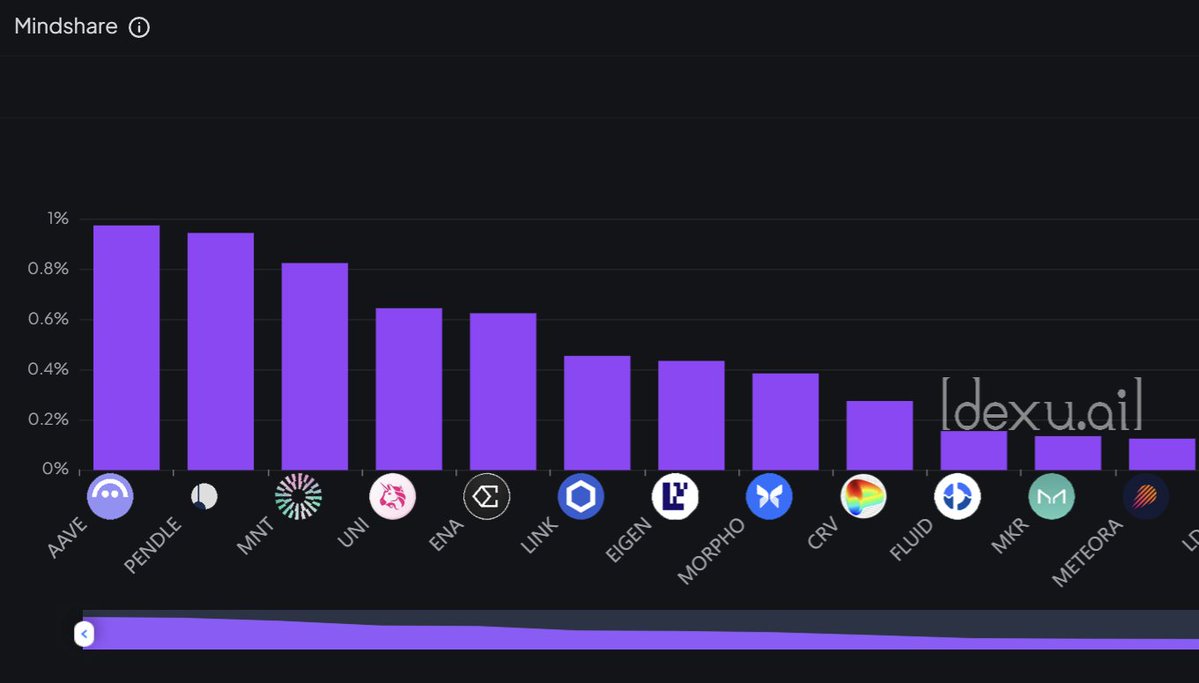
Aave, Pendle, and Mantle lead the DeFi spotlight, dominating mindshare in the race for user attention.
𝕏/@TheDeFinvestor •
Revision history
6 recorded changes
Want your article here?
Promote with Leviathan News6 recorded changes
Want your article here?
Promote with Leviathan NewsA recent post by pseudonymous DeFi commentator The DeFinvestor highlights how Aave, Pendle, and Mantle Network have become core focal points in decentralized finance, capturing significant user and developer attention through rapid growth in liquidity, new integrations, and yield strategies. Aave, already the dominant DeFi lending protocol by market share, has deepened its influence via a high‑velocity deployment of Aave v3 on Mantle, which surpassed $575 million in combined supply and borrow activity within two weeks, later crossing $800 million and then $1 billion in total market size in under three weeks. This growth has coincided with Mantle’s own total DeFi TVL rising to over $755 million and then beyond $1 billion, positioning Mantle among the fastest‑growing Ethereum Layer 2 networks and a key distribution layer for on‑chain liquidity. In parallel, Pendle Finance has become a leading protocol in the fixed‑income and yield‑trading segment of DeFi, drawing attention for its mechanism that tokenizes and splits yield from yield‑bearing assets, enabling sophisticated strategies such as fixed yields, leveraged yield exposure, and interest‑rate trading. Pendle has launched on Mantle Network as its first LST (liquid staking token) yield protocol, allowing Mantle users to access tokenized yield from assets like LSTs and integrate those strategies with broader DeFi primitives. Risk‑infrastructure providers such as Chaos Labs are also developing specialized oracles to make Pendle’s principal tokens easier to integrate into lending markets like Aave, which further tightens the connection between these protocols. Together, Aave, Pendle, and Mantle illustrate a broader shift in DeFi toward composable, institutionally oriented infrastructure that combines scalable L2 execution (Mantle), deep and battle‑tested liquidity markets (Aave), and advanced yield engineering (Pendle). Their rapid TVL growth, incentive programs, and cross‑protocol integrations have concentrated user mindshare, as traders and capital allocators look for venues that can support complex structured products, real‑world asset connections, and higher‑velocity liquidity flows, while still leveraging Ethereum security and established DeFi standards.
AI-generated background, compiled from web sources — not editorial content.
𝕏/@turnkeyhq ·
𝕏/@ethena ·

𝕏/@0xCster ·
𝕏/@aave ·
𝕏/@aave ·
𝕏/@LlamaRisk ·
𝕏/@turnkeyhq ·
𝕏/@ethena ·
𝕏/@0xCster ·
𝕏/@aave ·
𝕏/@aave ·
𝕏/@LlamaRisk ·
🚀 Love DeFi? Ready to dive in and start earning $SQUID while making an impact?