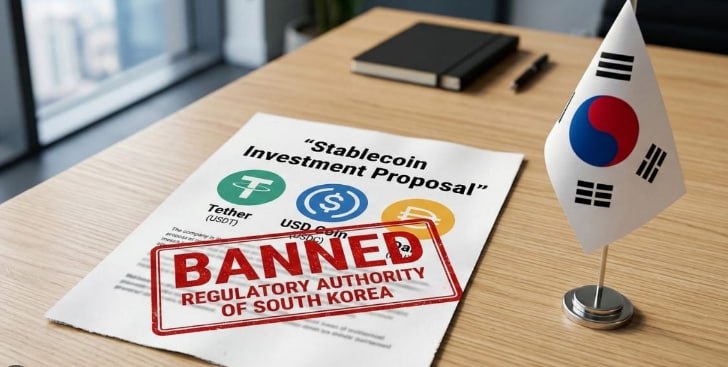
South Korea’s Financial Services Commission (FSC) is preparing to reopen listed companies’ access to crypto investments after nearly nine years, but it has decided to exclude major dollar stablecoins such as USDT and USDC from the assets that domestic firms can hold for treasuries or use in payments and trade settlement. According to local reports summarized by DL News and other industry outlets, the March 5, 2026 government meeting on new corporate crypto guidelines confirmed that only major non‑stablecoin assets (for example Bitcoin and Ethereum) will be allowed, frustrating export‑oriented listed firms that specifically wanted stablecoins as a flexible, on‑chain “digital dollar” tool for international trade and treasury management. Under the forthcoming FSC guidelines, around 3,500 listed companies and professional investors will be permitted to allocate a limited share of their equity (reported as up to 5%) into crypto assets, but those assets will be restricted to roughly the top 20 non‑stablecoin cryptocurrencies by market capitalization and must be traded via regulated domestic exchanges such as Upbit and Bithumb. The FSC and other regulators argue that allowing companies to directly hold or use fiat‑pegged stablecoins would conflict with the country’s Foreign Exchange Transactions Act, which requires cross‑border payments to go through designated foreign‑exchange banks and does not recognize stablecoins as an approved external payment instrument. Authorities also cite concerns over money laundering, capital flight, and “reckless investment,” and signal a preference to keep cross‑border flows inside the traditional banking FX infrastructure rather than letting corporates pay overseas partners directly in USDT or USDC. This policy choice creates a split in Korea’s crypto strategy: regulators are moving to normalize institutional exposure to major cryptocurrencies while deliberately sidelining dollar‑pegged tokens that many corporates view as the most practical tool for on‑chain trade finance and treasury. In parallel, the Lee Jae‑myung administration and the FSC are working on a framework for KRW‑pegged stablecoins, including debates over who should be allowed to issue won‑linked tokens and how to keep such instruments “risk‑free” while remaining competitive with developments in the US and Japan. A bill introduced in 2025 to formally recognize stablecoins as a means of payment is still pending, amid institutional disagreements between the Bank of Korea and the FSC, so for now companies that want stablecoin exposure must resort to personal wallets or offshore venues, outside the domestic regulatory perimeter that the FSC is trying to build. {"entities":["Financial Services Commission (FSC)","South Korea","USDT","Tether","USDC","USD Coin","DL News","Upbit","Bithumb","Lee Jae-myung","Bank of Korea","Foreign Exchange Transactions Act","KRW-pegged stablecoins","Bitcoin","Ethereum"]}

AI-generated background, compiled from web sources — not editorial content.

More coverage

Explore the topic

More on Treasury

Comments