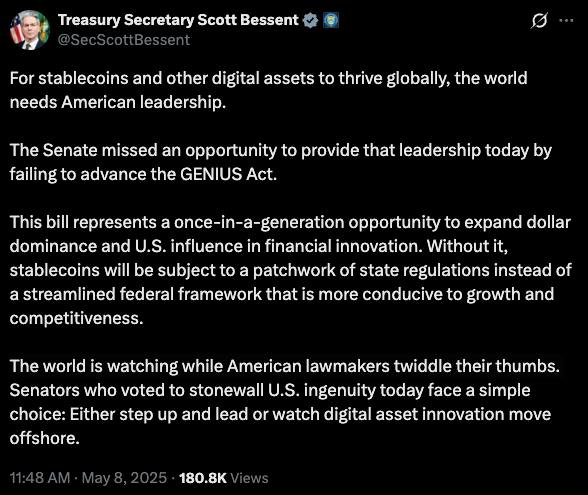
Treasury Secretary Scott Bessent used a public statement on X to criticize the U.S. Senate for failing to advance the GENIUS Act, framing the setback as a signal to global markets that the United States is hesitating on core digital-asset infrastructure. His comments came after the Senate fell short of the 60 votes needed on a key procedural vote to move the Guiding and Establishing National Innovation for U.S. Stablecoins (GENIUS) Act (S.1582) toward final passage, stalling a bill that would create the first comprehensive federal framework for payment stablecoin issuers. Bessent’s warning that “the world is watching” reflects concern that delays in U.S. rulemaking could cede regulatory leadership to other jurisdictions that are moving faster on stablecoin oversight. The GENIUS Act is designed to classify certain fiat-redeemable “payment stablecoins” as a distinct category separate from securities and commodities, and to subject their issuers—including banks, fintechs, and large nonbank firms—to tailored reserve, disclosure, and anti–money laundering requirements. Earlier Senate votes had shown growing bipartisan support for advancing the bill, and the measure is paired with related House efforts such as the STABLE Act and broader digital-asset market structure legislation. The failure to clear this latest Senate hurdle injects new uncertainty into the U.S. regulatory timeline for stablecoins at a moment when other markets are rolling out their own frameworks, heightening policy concerns like those voiced by Bessent about competitiveness, consumer protection, and financial stability.

AI-generated background, compiled from web sources — not editorial content.

More coverage

Explore the topic

More on GENIUS Act

Comments