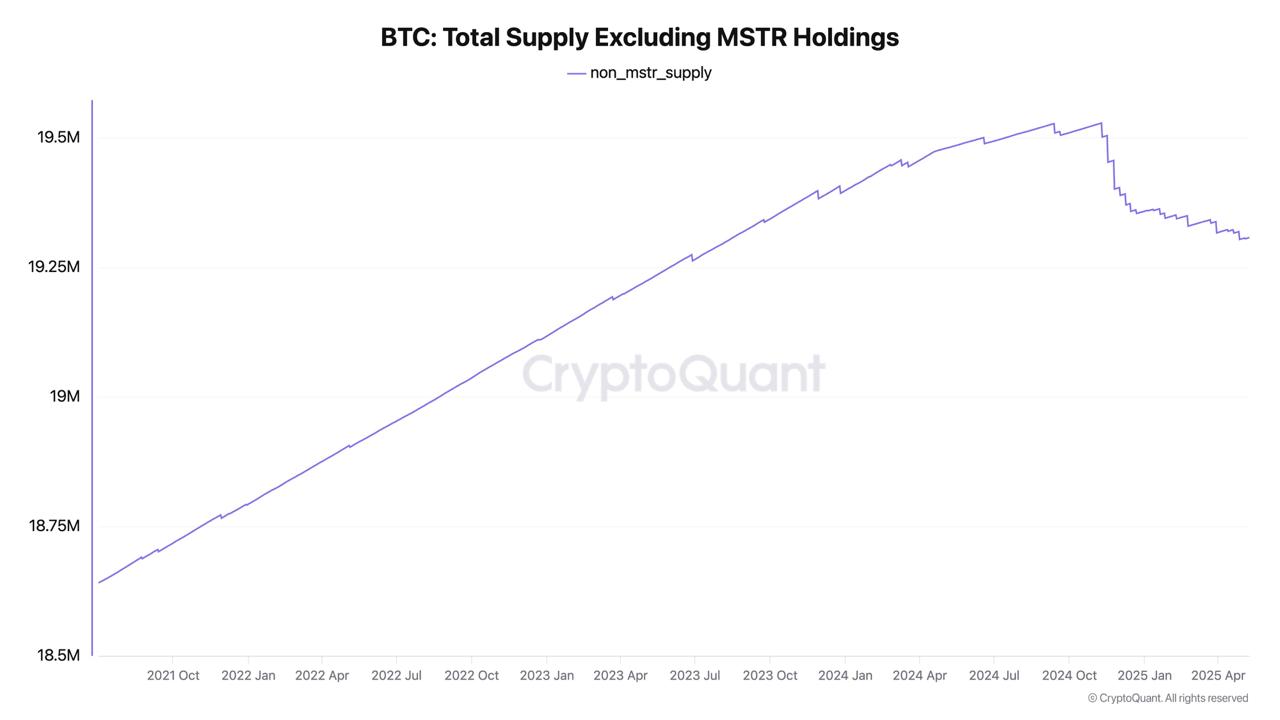
CryptoQuant CEO Ki Young Ju has argued that Bitcoin has become effectively deflationary on a realized/float basis due to the scale and behavior of large institutional holders, focusing in particular on MicroStrategy’s accumulation strategy. According to his and related analyses, MicroStrategy (sometimes referred to in secondary write‑ups as “Strategy”) has acquired roughly 555,000 BTC that it treats as a long‑term, non‑selling treasury position, meaning those coins are effectively removed from the liquid circulating supply. When this illiquid stash, together with other long‑term institutional holdings, is compared with the post‑halving miner issuance (around 450 BTC per day), the net effect is described as a synthetic deflation in tradable supply, with an estimated annualized rate of about ‑2.2% to ‑2.3%. The argument matters because it reframes Bitcoin’s scarcity narrative beyond the protocol’s 21 million cap and scheduled halvings, toward the behavior of large corporate and institutional balance‑sheet holders. Analysts cited in coverage say MicroStrategy’s average daily buying pace (around 2,000 BTC in recent data) has at times exceeded new miner output, effectively “outpacing” supply and tightening order‑book liquidity. This is presented as a potential driver of upward price pressure and reduced available float, while also raising debate about market concentration and whether a few large actors can materially shape Bitcoin’s supply–demand dynamics over time.

AI-generated background, compiled from web sources — not editorial content.

More coverage

Explore the topic

More on $BTC

Comments