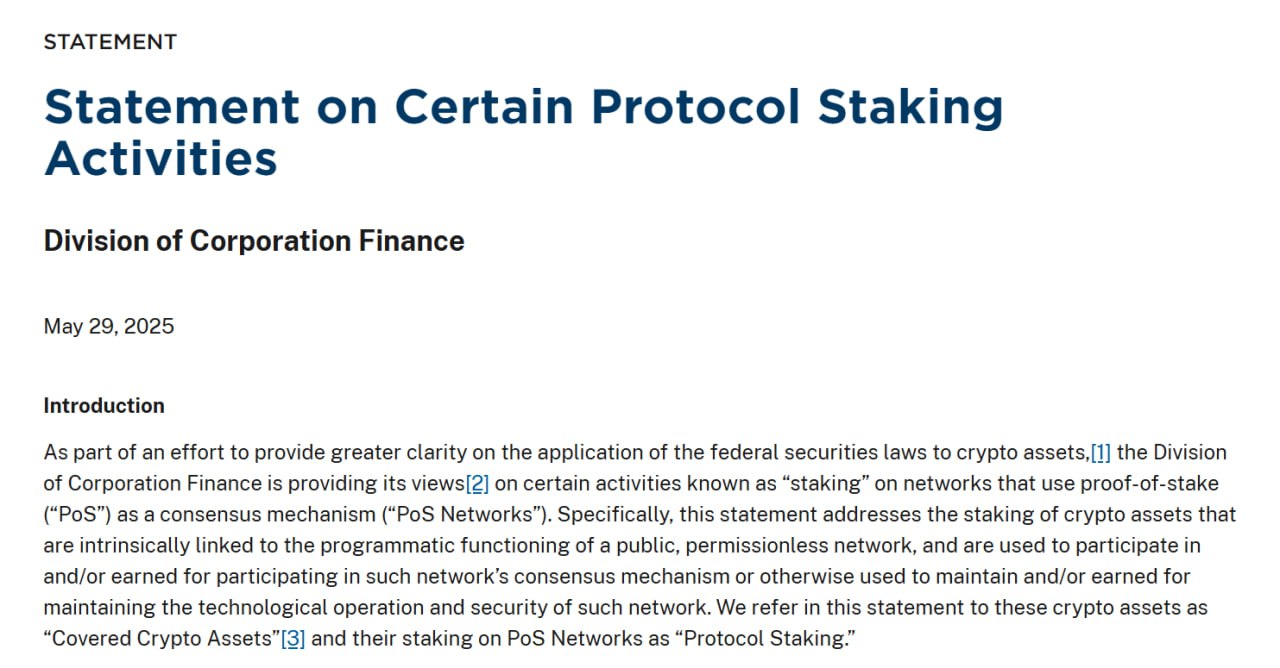
The U.S. Securities and Exchange Commission’s Division of Corporation Finance (Corp Fin) issued a staff statement on May 29, 2025, clarifying that certain proof‑of‑stake (PoS) blockchain protocol “staking” activities are, in its view, not securities transactions and therefore do not require registration under the federal securities laws. The statement covers “protocol staking” of specific “covered crypto assets” on public, permissionless networks, and applies both to individuals who self‑stake and to non‑custodial or custodial staking‑as‑a‑service providers that facilitate staking on behalf of others.
Corp Fin’s analysis turns on the Howey investment contract test, particularly the “efforts of others” prong. The staff characterizes protocol staking activities—including validating transactions, running nodes, delegating to validators, and related operational steps—as administrative or ministerial, rather than entrepreneurial or managerial efforts of a promoter whose work drives profit for passive investors. Because rewards are determined by the protocol’s rules and the validator’s own performance in securing the network, the staff concludes that the essential elements of an investment contract are not present for these narrowly defined activities. The statement also indicates that bundling certain ancillary services—such as slashing coverage, flexible reward payment schedules, early return of staked assets before the end of an unbonding period, or aggregation of multiple stakers’ assets to meet minimum staking thresholds—does not, in the staff’s view, transform the offering of staking services into a securities transaction, so long as the services remain operational and non‑managerial in nature.
The guidance is non‑binding staff interpretation, not a rule or formal Commission action, and it is explicitly fact‑dependent and limited in scope. It applies only to “covered crypto assets,” defined as tokens that are intrinsically linked to the functioning and security of a public, permissionless network’s consensus mechanism and that are not themselves securities or previously offered as investment contract securities. The statement does not address other models such as liquid staking, restaking, or arrangements where a provider sets, guarantees, or actively manages returns, which may still raise securities law concerns. The move has been described by practitioners as a significant, though narrow, step toward regulatory clarity for PoS networks, staking service providers, and token holders, and it follows an earlier staff statement reaching a similar conclusion for certain proof‑of‑work mining activities. The position also prompted public responses within the Commission, including a critical statement from Commissioner Caroline Crenshaw and a supportive one from Commissioner Hester Peirce, underscoring that staking’s regulatory treatment remains a live policy and enforcement issue.
✨ AI-generated background, compiled from web sources — not editorial content.