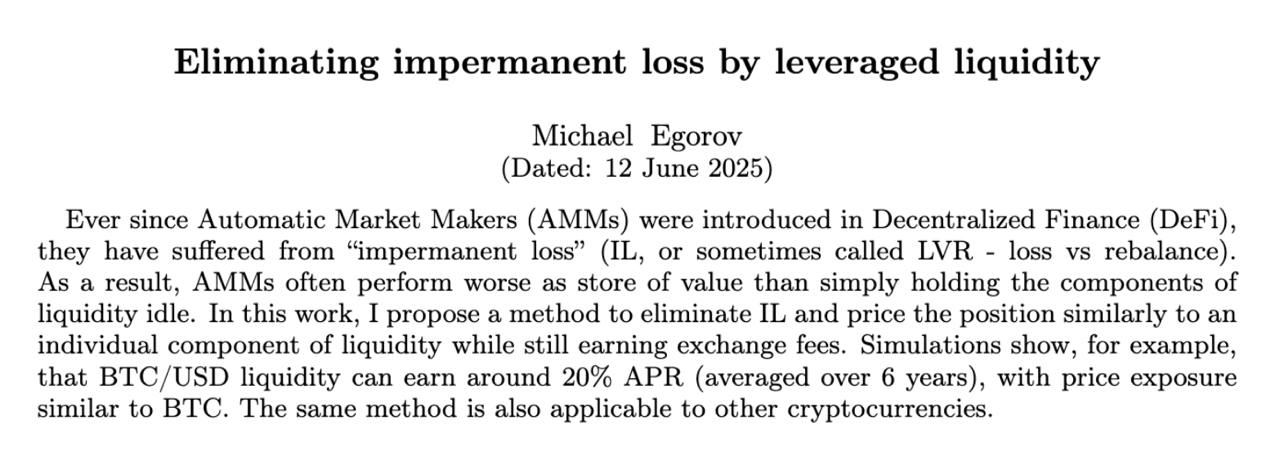
Curve Finance founder Michael Egorov has published a new technical white paper for Yield Basis, his leveraged-liquidity AMM design that aims to eliminate impermanent loss (IL) for liquidity providers while still earning trading fees. The paper formalizes a mechanism where a user’s position can be priced and treated similarly to holding a single asset (such as BTC or ETH) while the protocol uses leverage and rebalancing to provide two-sided liquidity in AMM pools. According to prior public descriptions of Yield Basis, the protocol lets users deposit wrapped BTC (and later other assets) and maintain 1:1 spot exposure to that asset, while the system borrows the counter-asset (typically crvUSD) to form a 2× leveraged LP position in Curve-style AMM pools. Automated rebalancing and a specific payoff structure are designed so that, as prices move, the LP does not suffer the usual divergence between “HODL vs LP” value that defines impermanent loss, yet still collects exchange fees and potentially higher yields due to leverage. The white paper posted to GitHub provides the mathematical and economic foundation for this “leveraged liquidity” approach, including how a leveraged LP position can be made to behave economically like an individual component of the pool (e.g., pure BTC exposure) while internalizing trading fees. This publication matters because impermanent loss is one of the primary structural risks that has limited participation and capital efficiency in AMM-based DeFi. By proposing an AMM design that is “IL-free by construction” for blue-chip assets like BTC and ETH, Yield Basis seeks to create a scalable, non-subsidized source of on-chain yield and deepen decentralized spot liquidity. The formal white paper gives developers, auditors, and sophisticated users the technical detail needed to scrutinize the mechanism, assess risk (including leverage and borrowing risks), and evaluate whether this design can be safely deployed at scale.

AI-generated background, compiled from web sources — not editorial content.

More coverage

Explore the topic

More on Fees

Comments