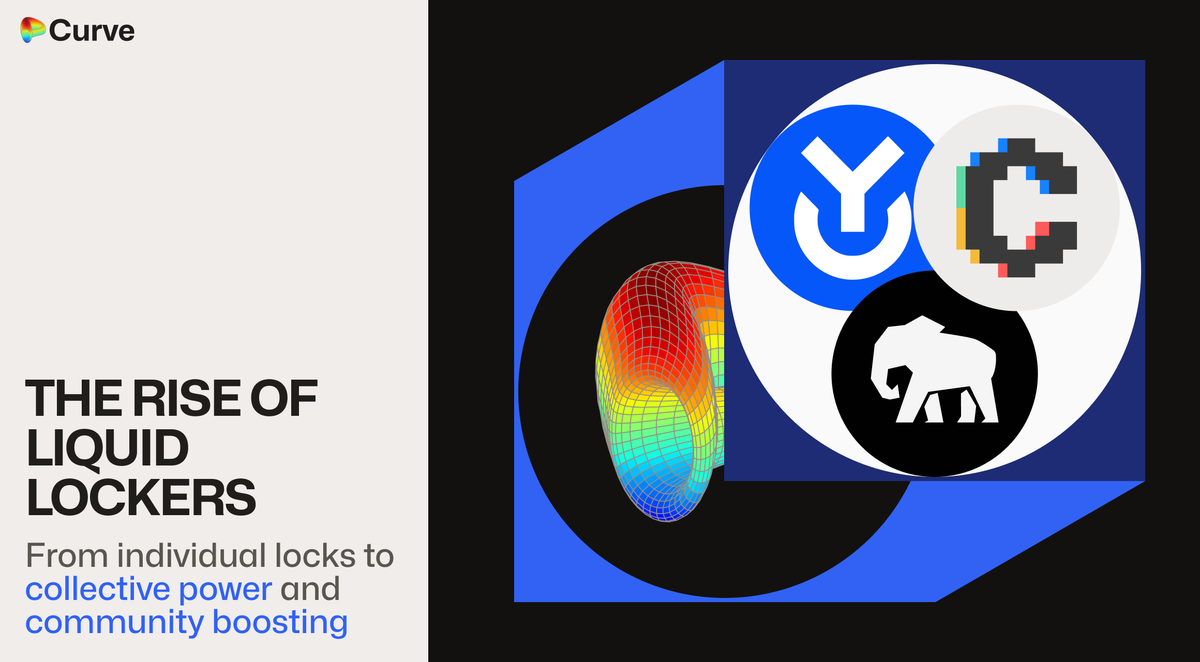
Curve’s new explainer outlines how “liquid lockers” such as Convex, Yearn, and StakeDAO have become the dominant way users access veCRV benefits, replacing direct, individual CRV locking for most participants. These protocols pool users’ CRV, lock it permanently as veCRV, and issue liquid derivative tokens (like cvxCRV, yCRV, sdCRV) that give holders exposure to boosted yields, protocol fees, and governance incentives without committing to a personal four‑year lock.
Under Curve’s vote‑escrow model, users normally must lock CRV for up to four years to obtain veCRV, which is non‑transferable and cannot be unlocked early, but enables voting power, a share of trading fees, and up to 2.5x boosted CRV rewards on liquidity positions. For smaller users, accumulating enough veCRV to meaningfully boost rewards is impractical, so liquid lockers aggregate CRV into large communal veCRV positions and then stake users’ Curve LP tokens under that pooled boost, redistributing the enhanced CRV rewards pro rata to depositors. In exchange, users cede direct governance control and accept protocol fees, while the locker tokens remain tradable but are not redeemable for the underlying CRV—once CRV enters these lockers it is permanently locked as veCRV, effectively acting as a supply sink and requiring exits via secondary markets that may trade at a premium or discount.
Curve’s article emphasizes that this design has reshaped Curve governance and incentives: liquid lockers now control large veCRV blocks and therefore concentrate voting power and gauge‑emission influence in a handful of aggregators. This has helped democratize access to boosted yields and bribe markets for smaller users but also created new power centers and markets around vote incentives, as protocols and DAOs compete to direct veCRV voting toward their preferred pools. Direct veCRV locking remains relevant primarily for large or long‑term actors that want maximum governance control and are willing to accept illiquidity, while most users interact with Curve’s reward system indirectly through these communal boosting platforms.
✨ AI-generated background, compiled from web sources — not editorial content.