Ethena founder Guy Young attributes the USDe depeg on Binance to an issue with the exchange's oracle, not due to any fault of the protocol
CoinTelegraph •
Revision history
7 recorded changes
Want your article here?
Promote with Leviathan News7 recorded changes
Want your article here?
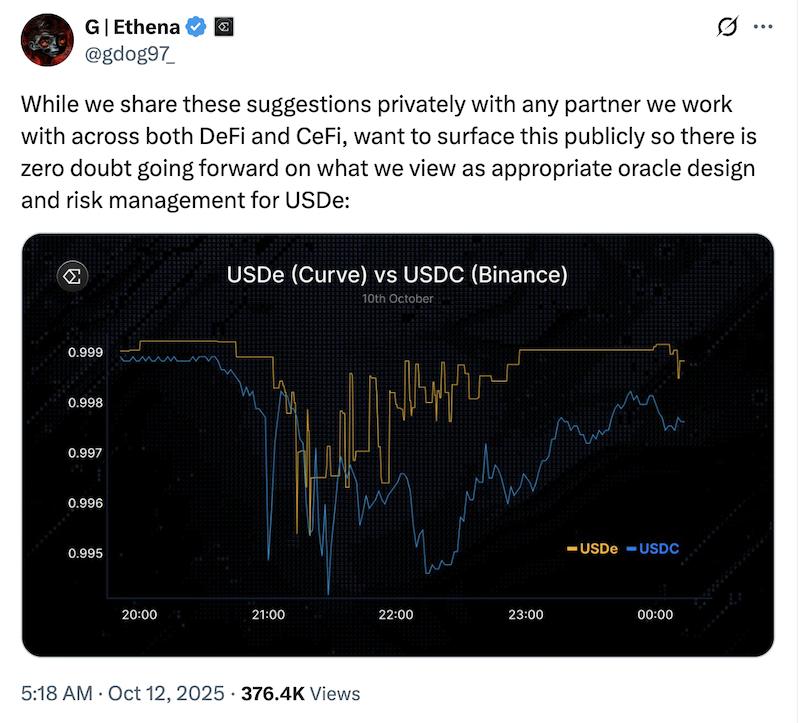
Promote with Leviathan NewsEthena Labs founder Guy Young has argued that the dramatic drop in the price of its synthetic dollar USDe on Binance was caused by a Binance-specific oracle and market-structure problem, not by any failure of the USDe protocol itself. On October 10–11, USDe briefly traded as low as around $0.65 on Binance’s spot market during a period of sharp market-wide volatility, triggering forced liquidations and giving the appearance of a major depeg. At the same time, USDe traded close to its intended $1 value on on-chain venues such as Curve and on other centralized exchanges, and Chainlink’s USDe/USD oracle feed remained in the $0.99–$1.00 range. This divergence suggested that the stress was localized to Binance’s internal order books and pricing systems. Young and other analysts attribute the episode to how Binance handled pricing and risk, particularly its reliance on its own order book and a misconfigured internal oracle for liquidations instead of referencing deeper external liquidity for USDe. According to post-mortems, thin liquidity on Binance, aggressive forced liquidations, and oracle behavior that responded to the local crash rather than broader market prices amplified selling pressure and caused a temporary “flash crash” in USDe on that venue. Ethena’s core mechanisms, including its delta-neutral hedging strategy and on-chain mint–redeem flows, reportedly continued to function normally, processing large redemptions without delays and maintaining full collateralization throughout the event. Binance has since acknowledged anomalies around the incident and introduced risk-control and pricing changes, as well as a compensation plan for affected users. The episode is now widely framed as an exchange-specific dislocation that exposed centralized exchange oracle and liquidation design weaknesses rather than a structural failure of USDe or the Ethena protocol.
AI-generated background, compiled from web sources — not editorial content.
Loading related coverage…
Loading comments…
🚀 Love DeFi? Ready to dive in and start earning $SQUID while making an impact?
Related coverage is temporarily unavailable.
Danicjade
Lol, lies we tell to deceive crypto users.
Restoring your session before loading comments…
Danicjade
Lol, lies we tell to deceive crypto users.