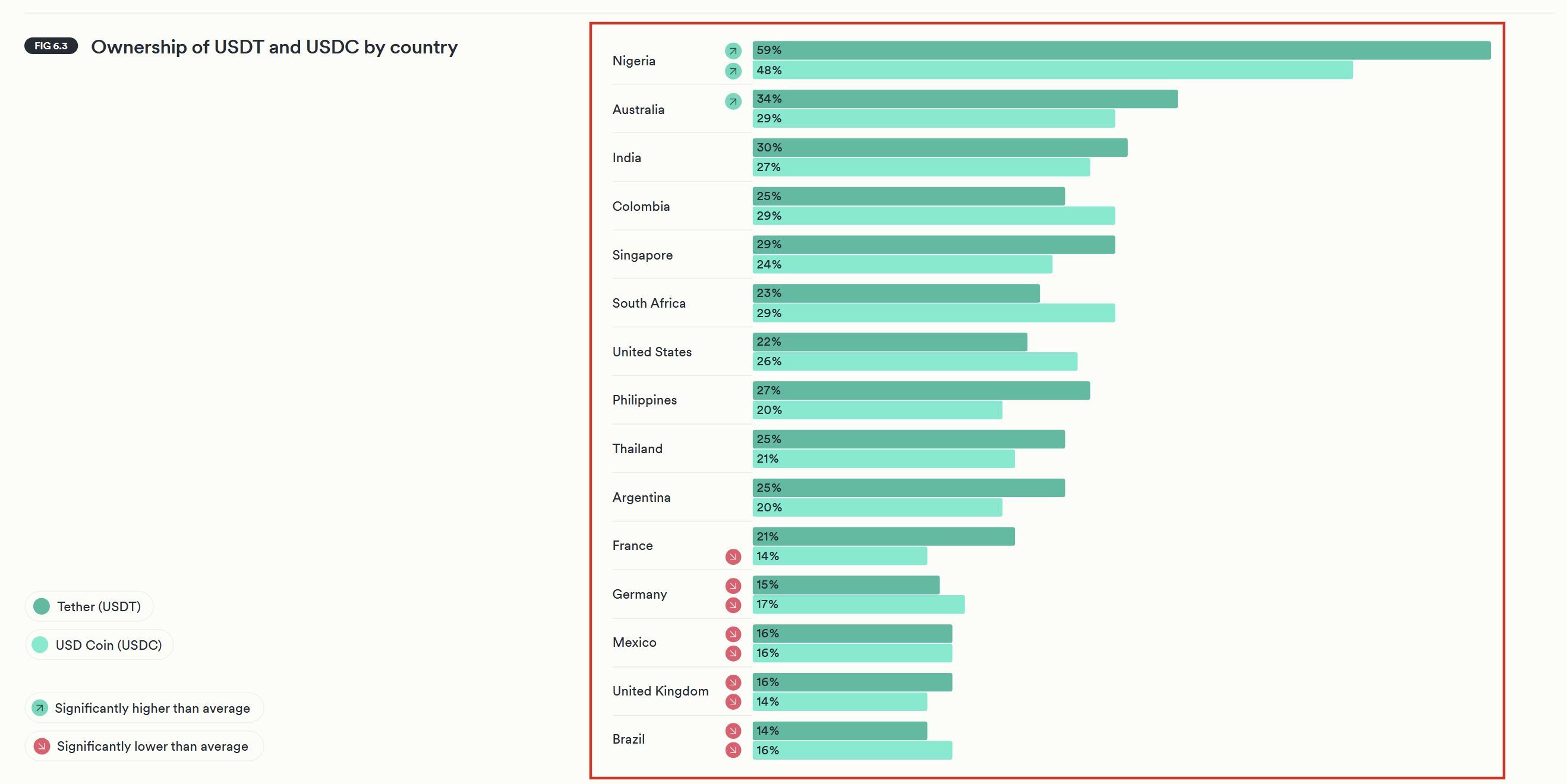
Recent data shared by market analyst Leon Waidmann highlights that Tether’s USDT still dominates global stablecoin ownership overall, but Circle’s USDC is gaining relative share in several key regulated markets, notably the United States, Germany and Brazil. The figures, drawn from Kavout’s stablecoin usage analysis, suggest that while USDT continues to lead on aggregate market cap and liquidity, USDC is strengthening its position where regulatory scrutiny, institutional participation and compliance standards are stronger.
According to Kavout’s breakdown, USDT maintains a substantially larger global market capitalization—around three times USDC’s—yet ownership and transaction patterns diverge at the country level. In jurisdictions with more developed regulatory frameworks and closer integration with traditional finance, such as the U.S. and major EU economies, USDC adoption is expanding as a “regulated” stablecoin backed by fully disclosed reserves and issued by U.S.-based Circle, which is pursuing MiCA compliance in Europe and registration in multiple U.S. states. In Brazil, growing use of stablecoins for payments and remittances is also coinciding with increased USDC penetration alongside USDT, reflecting demand from fintechs and exchanges that prioritize transparent reserves and clearer regulatory posture.
This evolving split matters because it points to a structural shift in how and where different stablecoins are used. USDT continues to dominate trading venues, emerging markets and offshore activity thanks to its deep liquidity and ubiquity, while USDC is increasingly used by institutional players, fintech platforms and users operating under stricter regulatory expectations. If this trajectory continues, the global stablecoin landscape could bifurcate: USDT as the primary liquidity instrument in high-volume, cross-border crypto markets, and USDC (and similar regulated stablecoins) as the preferred rails for compliant payments, tokenized assets and integration with banked and regulated financial infrastructure.
✨ AI-generated background, compiled from web sources — not editorial content.