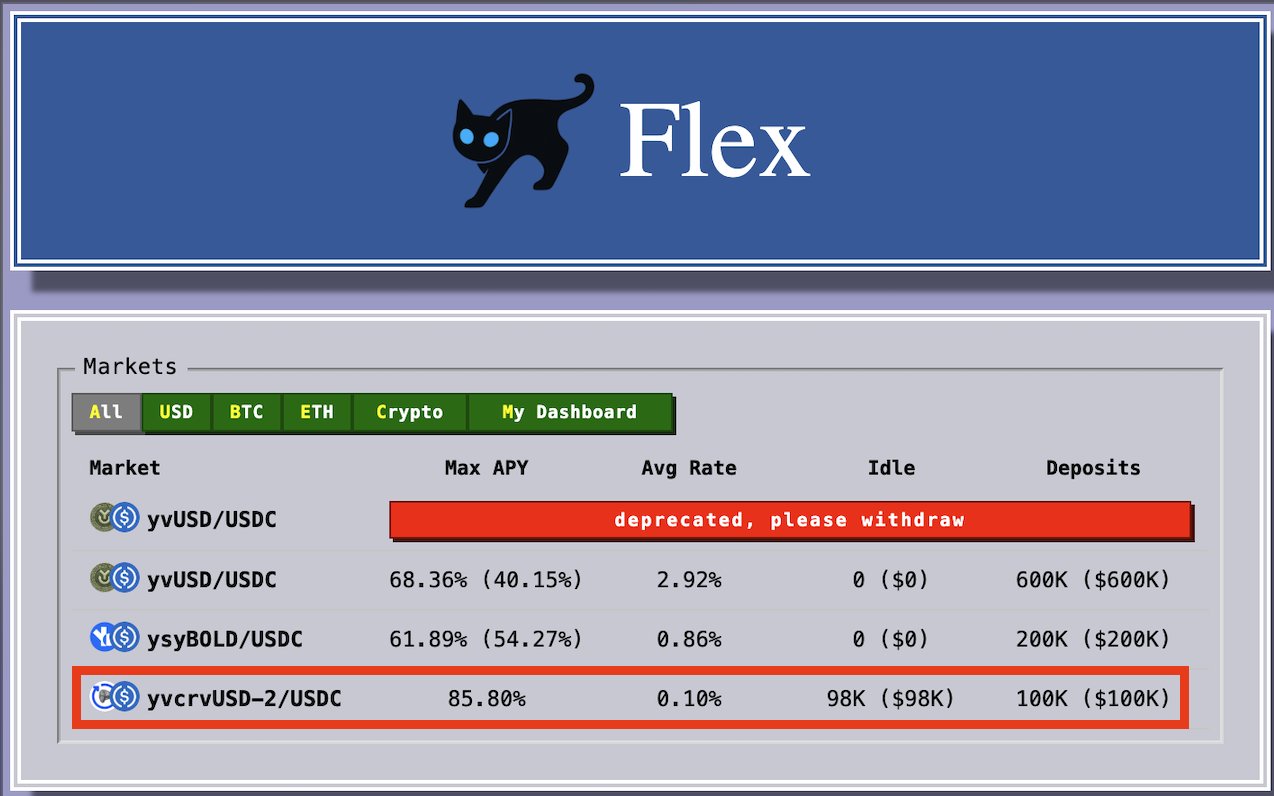
This is a final call to exit the Flex unaudited markets

𝕏/@johnnyonline_ •
Revision history
7 recorded changes
Want your article here?
Promote with Leviathan News7 recorded changes
Want your article here?
Promote with Leviathan NewsOn 12 June 2026, the pseudonymous on-chain researcher and trader @johnnyonline issued a public warning on X advising users to exit the Flex Finance (often referred to as “Flex”) unaudited markets, citing escalating smart contract and counterparty risks after a series of concerning on‑chain and operational signals. The warning specifically targets Flex’s higher‑yield “unaudited” vaults/markets, which rely on smart contracts that have not undergone formal third‑party security audits, and where risk is concentrated in relatively illiquid positions and complex cross‑margin mechanics. In his thread, @johnnyonline characterizes these markets as having an “asymmetric” risk/return profile that, in his view, no longer justifies remaining capital deployed. Context for the alert is the broader DeFi lending and margin‑trading environment, where a number of protocols have recently faced governance turmoil, liquidity deterioration, or smart‑contract incidents that exposed users of leveraged and exotic markets to losses. Flex’s unaudited markets, which reportedly offer leveraged/perps‑style exposure and higher yields than its main audited markets, sit at the riskier end of this spectrum due to their dependence on complex liquidation logic, oracle feeds, and cross‑collateralization between markets. In such designs, a failure in one contract, misconfigured risk parameters, or thin liquidity during market stress can cascade across markets and impair solvent users. The call to exit is therefore framed less as a claim that an exploit is already underway, and more as a risk‑management move in light of worsening “tail‑risk” conditions and the availability of safer, audited alternatives in DeFi. The warning also matters reputationally for Flex Finance because @johnnyonline is followed by a segment of on‑chain analysts, DeFi power‑users, and risk‑focused traders who treat his alerts as early‑warning signals. High‑profile exit calls can accelerate outflows from specific pools, worsen liquidity, and potentially force protocol governance to respond by de‑risking parameters, pausing markets, or commissioning formal audits. More broadly, the episode underscores a persistent structural issue in DeFi: users often chase yield in unaudited or lightly reviewed contracts without fully pricing in smart‑contract and liquidation‑mechanism risk, leaving protocols vulnerable to sudden shifts in sentiment when credible researchers publicly reassess those risks.
AI-generated background, compiled from web sources — not editorial content.

𝕏/@zaidrmn ·
𝕏/@flexmeow ·

flex.one ·

𝕏/@flexmeow ·
𝕏/@johnnyonline_ ·

Youtube ·
𝕏/@zaidrmn ·
𝕏/@flexmeow ·
flex.one ·
𝕏/@flexmeow ·
𝕏/@johnnyonline_ ·
Youtube ·
🚀 Love DeFi? Ready to dive in and start earning $SQUID while making an impact?