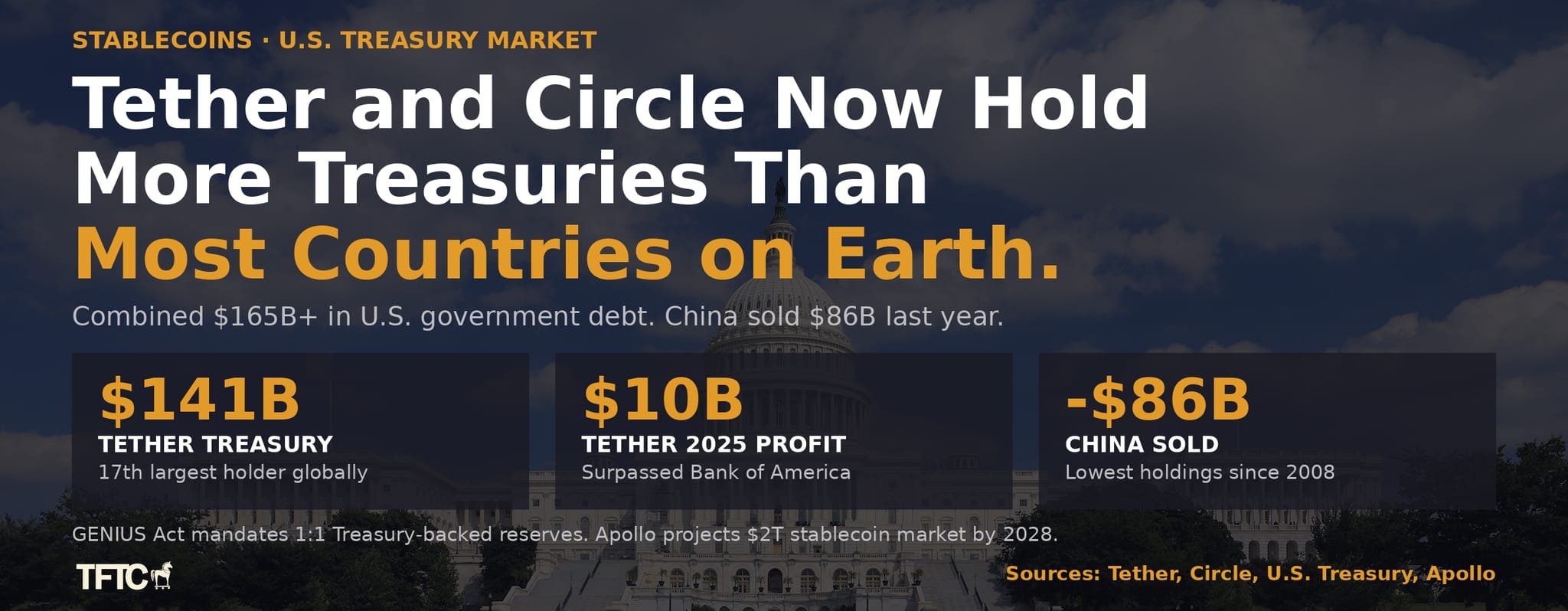
Tether and Circle hold over $160 billion in U.S. Treasuries, surpassing South Korea, Germany, and Saudi Arabia, due to GENIUS Act reserve rules.
𝕏/@TFTC21 •
Revision history
5 recorded changes
Want your article here?
Promote with Leviathan News5 recorded changes
Want your article here?
Promote with Leviathan NewsTether and Circle have quietly become some of the largest single buyers of U.S. government debt, largely because the United States’ new GENIUS Act forces regulated dollar stablecoins to be backed almost entirely by cash and short‑term U.S. government securities. Combined, their reserves now hold over $160 billion in U.S. Treasury exposure, a level that places the two issuers ahead of several mid‑tier sovereign holders such as South Korea, Germany, and Saudi Arabia in terms of Treasury holdings. A decade ago, neither Tether nor Circle had meaningful presence in global finance; today, they function as structurally important “captive” buyers of U.S. Treasuries because every new dollar of stablecoin issuance must be matched by qualifying reserve assets. The GENIUS Act (Guiding and Establishing National Innovation for U.S. Stablecoins Act), enacted in 2025, created a federal framework for payment stablecoins that, among other requirements, mandates 1:1 backing with high‑quality liquid assets, primarily cash, U.S. Treasury bills, and similar short‑duration instruments, with full reserve segregation and ongoing oversight. This has effectively turned large stablecoin issuers into a new structural investor base for U.S. government debt, as highlighted in both policy analysis and industry research. Tether currently reports about $141 billion in U.S. Treasury exposure (around $122 billion in direct T‑bills and the rest in overnight reverse repos), while Circle’s USDC adds roughly $24–25 billion in Treasuries and short‑term government repos, pushing their combined total above $160 billion. Analysts note that, if the stablecoin market grows toward the multi‑trillion‑dollar scale projected by firms like Apollo, aggregate stablecoin reserves could rival or exceed the Treasury holdings of top sovereign creditors such as Japan in coming years. This shift matters for both crypto and macro‑finance. For U.S. policymakers, regulated stablecoins now support demand for Treasuries and potentially reinforce the dollar’s global role, but they also introduce new channels of liquidity and run risk tied to the stablecoin sector’s health. For crypto markets, the GENIUS Act framework formalizes a direct link between stablecoin supply and the size and composition of reserve portfolios, making U.S. monetary and regulatory decisions more tightly intertwined with stablecoin growth. Legal commentators additionally warn that the Act’s changes to bankruptcy treatment and its relatively narrow definitions could pose systemic and consumer‑protection challenges if a major issuer were to fail. "entities":["Tether","USDT","Circle","USD Coin (USDC)","United States Department of the Treasury","GENIUS Act (Guiding and Establishing National Innovation for U.S. Stablecoins Act)","U.S. Treasury securities / U.S. Treasury bills","South Korea","Germany","Saudi Arabia","Apollo (investment / research firm referenced in analysis)","Galaxy Digital Research","United States Congress","Office of the Comptroller of the Currency (OCC)"]}`
AI-generated background, compiled from web sources — not editorial content.

Coindesk ·

𝕏/@nayibbukele ·

archive.ph ·
Financefeeds ·
Crowdfundinsider ·

𝕏/CryptoTimes_io ·
Coindesk ·
𝕏/@nayibbukele ·
archive.ph ·
Financefeeds ·
Crowdfundinsider ·
𝕏/CryptoTimes_io ·
🚀 Love DeFi? Ready to dive in and start earning $SQUID while making an impact?