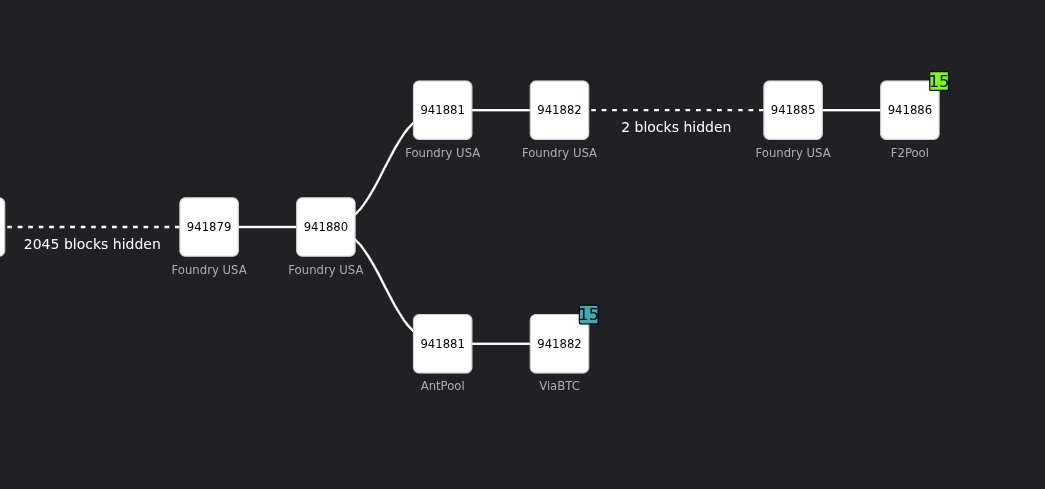
Foundry USA mines 7 consecutive Bitcoin blocks, triggers rare 2-block reorg amid centralization fears
𝕏/@0xB10C •
Revision history
3 recorded changes
Want your article here?
Promote with Leviathan News3 recorded changes
Want your article here?
Promote with Leviathan NewsBitcoin mining pool Foundry USA briefly mined seven consecutive Bitcoin blocks in late January 2025, an unusual streak that also coincided with a rare two‑block chain reorganization (reorg) and reignited debate over mining centralization. According to mempool and pool-tracking data referenced in coverage of the event, Foundry’s streak amounted to roughly 70 minutes of continuous block production, during which it temporarily controlled which transactions were confirmed. A two‑block reorg occurs when an alternative chain of two blocks overtakes the previously accepted chain, causing those earlier blocks to be discarded and their transactions to be re-included in later blocks, a normal but infrequent outcome of Bitcoin’s probabilistic consensus. Context from recent mining statistics shows why the episode attracted attention: in the same week, Foundry USA was responsible for over 34% of all Bitcoin blocks mined, with an estimated hashrate around 233–280 EH/s, while AntPool controlled roughly 17–18%, meaning the top two pools together accounted for more than 50% of network block production. Analysts and community commentators note that while a seven‑ or eight‑block streak is statistically unlikely, it is still plausible for a pool with roughly one‑third of network hashrate and does not, by itself, indicate malicious behavior. However, such streaks highlight the structural risk that a small number of dominant pools—currently led by Foundry and AntPool—could, in principle, censor transactions or coordinate attacks, reinforcing longstanding concerns about mining pool centralization and its implications for Bitcoin’s security and censorship resistance.
AI-generated background, compiled from web sources — not editorial content.
Coindesk ·
The Block ·

𝕏/@swissbitcoinpay ·
𝕏/@_ALCPB ·

Coindesk ·

The Block ·
Coindesk ·
The Block ·
𝕏/@swissbitcoinpay ·
𝕏/@_ALCPB ·
Coindesk ·
The Block ·
🚀 Love DeFi? Ready to dive in and start earning $SQUID while making an impact?