Borrowers raise rate rigging flags on Morpho as hard kink model allows deposit-withdraw loops, sparking curve redesign review
𝕏/@flipdazed •
Revision history
9 recorded changes
Want your article here?
Promote with Leviathan News9 recorded changes
Want your article here?
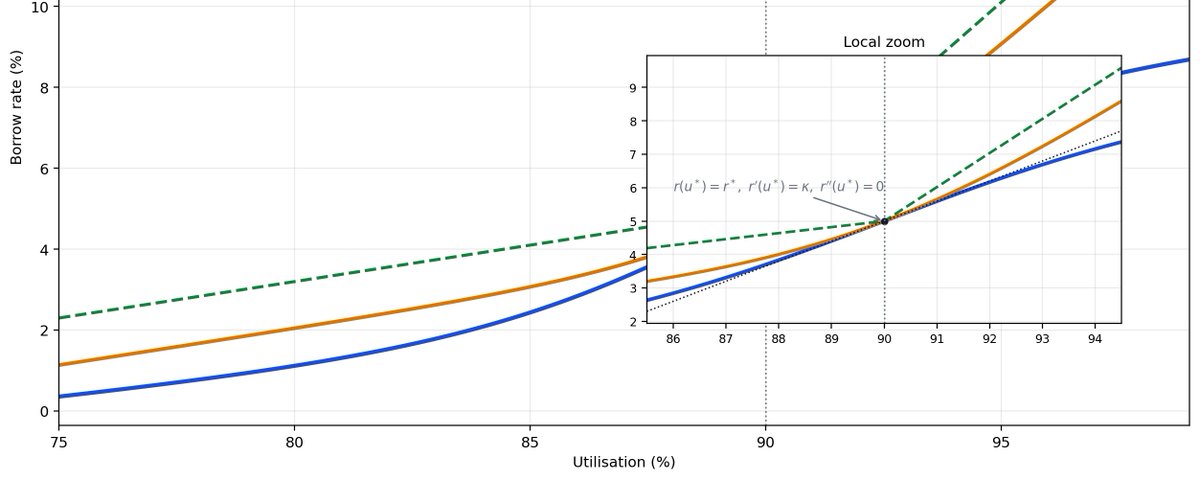
Promote with Leviathan NewsA discussion on X has raised concerns that Morpho’s “hard kink” interest rate model may allow a small group of users to manipulate borrowing rates by looping deposits and withdrawals, prompting Morpho to review and potentially redesign its curve. Morpho is a modular DeFi lending protocol that lets anyone create isolated markets with custom collateral, loan assets, and interest rate curves, with rates determined algorithmically and governed by the MORPHO token. In some Morpho Blue markets, interest is set by a kinked rate curve: below a target utilization, rates move slowly; once a “kink” utilization is crossed, the rate jumps sharply. This structure is intended to protect lenders and clear markets under stress, but can create discontinuities at the kink. According to posts from DeFi commentators on X, certain borrowers have highlighted that this “hard kink” can be exploited via rapid deposit‑withdrawal loops (often using the same or related addresses), temporarily pushing utilization just over or under the kink to force rates sharply higher or lower and then capturing the resulting spread. This behavior is being framed by critics as a form of on‑chain “rate rigging,” especially in thinner or more concentrated markets where a few actors control a large share of liquidity. Following these reports, core contributors and community members have begun openly debating the curve design and whether the current kink implementation gives too much power to large, active accounts relative to passive lenders and smaller borrowers. Options under discussion include smoothing the kink into a softer, more continuous curve, adding guardrails to limit rapid utilization swings, or introducing alternative interest models for specific markets. The issue matters because Morpho has grown into a significant DeFi lending venue by offering customizable markets and optimized vaults, so any systemic incentive for rate manipulation could affect loan pricing, user trust, and how protocols and DAOs integrate Morpho as an underlying yield source.
AI-generated background, compiled from web sources — not editorial content.
Loading related coverage…
🚀 Love DeFi? Ready to dive in and start earning $SQUID while making an impact?
𝕏/@cryptographicas ·

𝕏/@PaulFrambot ·
The Block ·
𝕏/@Morpho ·
The Block ·
𝕏/@NetNetCap ·
𝕏/@cryptographicas ·
𝕏/@PaulFrambot ·
The Block ·
𝕏/@Morpho ·
The Block ·
𝕏/@NetNetCap ·