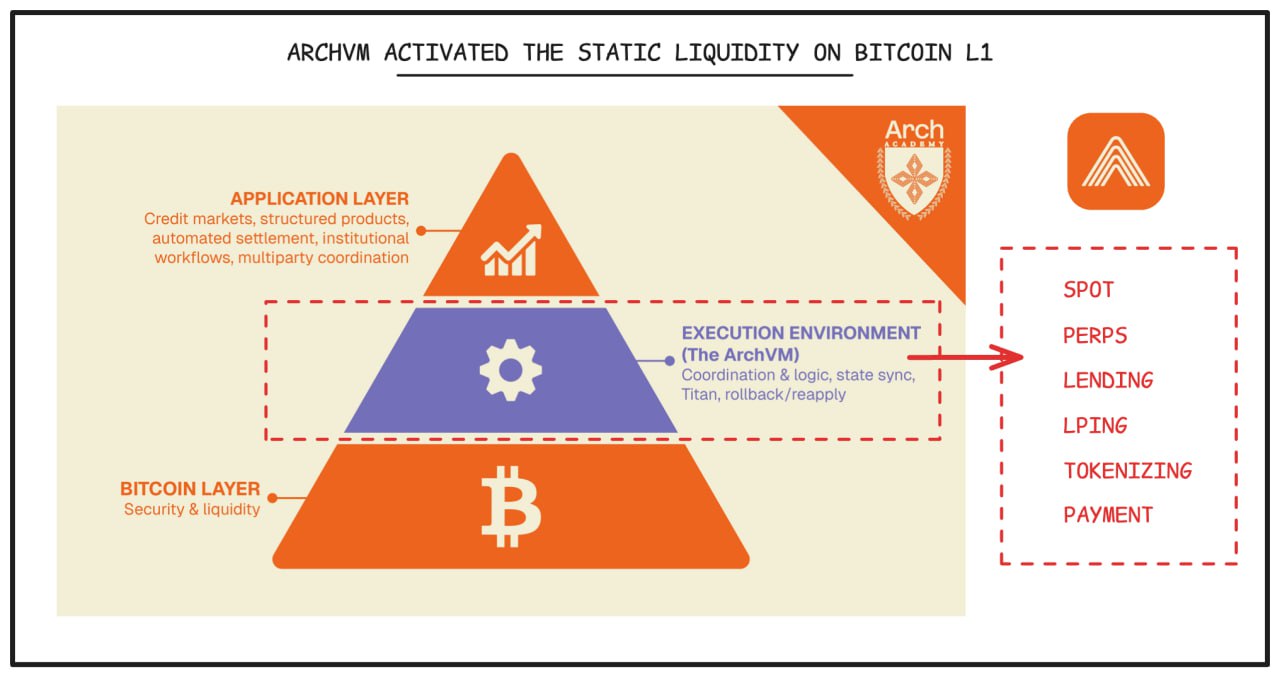
Arch Network is positioning its ArchVM as a Bitcoin‑native “logic layer” that brings smart‑contract style programmability—such as lending, credit, payouts, and multi‑party coordination—directly to Bitcoin without bridges, wrapped assets, or changes to Bitcoin’s base protocol. According to its documentation and public materials, Arch is not a traditional layer‑2 or metaprotocol; instead, it combines a specialized virtual machine with a validator network and a threshold signature scheme (FROST + ROAST) to execute financial instructions off-chain while settling the resulting standard transactions on Bitcoin, so that complex workflows remain anchored to the base layer.
In practice, ArchVM is intended to let developers build Bitcoin‑native DeFi primitives—such as programmable multisigs, lending markets, automated market makers, stablecoins, structured yield products, and credit markets—where collateral, settlement, and state changes are expressed as normal Bitcoin transactions rather than on a separate smart‑contract chain. Arch emphasizes that its design does not require new opcodes or a soft fork, and that execution is trust‑minimized via its threshold signature and proof‑of‑stake validator model layered over Bitcoin, aiming to preserve self‑custody and Bitcoin’s security assumptions while enabling Turing‑complete programmability.
Strategically, this positions Arch within the broader push for Bitcoin programmability, in competition or contrast with Bitcoin L2s, sidechains, and inscription‑ or covenant‑based metaprotocols. By arguing that complex, multi‑party financial logic can be executed in ArchVM and then realized as standard Bitcoin transactions, Arch is pitching Bitcoin as “dynamic capital” suitable for native credit, yield, and institutional‑grade capital markets—without moving BTC to other ecosystems.
✨ AI-generated background, compiled from web sources — not editorial content.