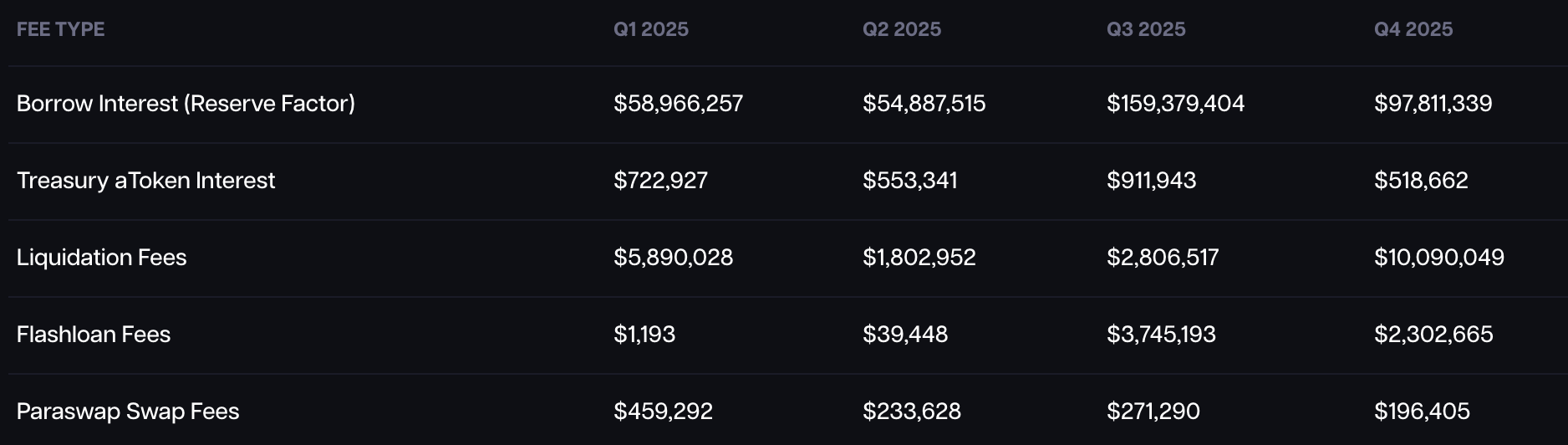
The Aave Chan Initiative (ACI), a major Aave governance delegate and service provider, has published a detailed challenge on Aave’s governance forum accusing Aave Labs of diverting DAO revenues and effectively privatizing parts of the protocol’s economics through recent and historical design choices. The post, authored by ACI founder Marc Zeller, focuses on several concrete issues: the economics of the CoW Swap (CowSwap) integration, fee flows and revenue splits from new “vault” products and the Horizon product line, and incentive structures for the upcoming Aave v4 liquidation engine, all of which ACI says lack transparent alignment with AAVE tokenholders and the DAO treasury. ACI also reiterates earlier claims that Aave Labs has captured roughly $5.5 million in “unauthorized swap fees” via the CoW Swap integration, arguing that these flows circumvent DAO control and contradict the principle that core protocol revenues should accrue to the DAO rather than to a private entity.
ACI’s challenge lands amid a broader, escalating power struggle over who controls Aave’s economic design and funding. ACI had already published a separate governance critique alleging that Aave Labs has received around $86 million in total funding (ICO, VC, and DAO payments) while delivering a mixed track record, including what ACI characterizes as unprofitable initiatives such as Horizon, which it claims cost the DAO roughly $24 for every $1 earned. The CowSwap and vault-fee questions are presented by ACI as part of the same pattern: protocol components and integrations where revenues, yield, or “product inflows” can be redirected at Aave Labs’ discretion into private or off-DAO channels, including user incentives, instead of being governed transparently on-chain by tokenholders. ACI is demanding explicit documentation on who receives what share of fees from CowSwap routing, vault yields, Horizon deals, and v4 liquidation engine incentives, and a clear statement of whether those streams are contractually or technically under DAO control.
The dispute matters because it goes to the heart of DAO governance vs. core-team control in one of DeFi’s largest lending protocols. The same tensions are visible in the contemporaneous battle over Aave Labs’ requested $40–50 million+ funding package (“Aave Will Win”), which ACI opposed as overly large and politically conflicted, and in ACI’s subsequent decision to wind down its role and leave the Aave DAO after that budget advanced with decisive support from addresses ACI describes as “Labs-linked.” Together, the revenue-diversion accusations and the exit of both ACI and earlier contributor BGD Labs highlight concerns that key protocol economics and governance power may be consolidating around Aave Labs, even as the system is nominally governed by a decentralized DAO. For other DAOs and DeFi projects, the episode is a high-profile case study in how fee routing, product structuring, and off-chain control over voting power can determine whether a protocol’s economics remain genuinely public and tokenholder-driven or drift toward de facto privatization.
✨ AI-generated background, compiled from web sources — not editorial content.