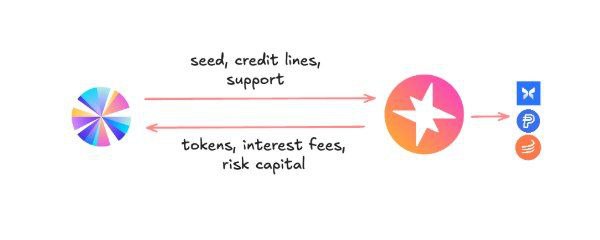
The post highlights a growing design shift in DeFi lending away from two dominant models—"monolithic" lending markets like Aave/Compound and fully isolated, app‑specific credit pools—toward SubDAO‑based lending architectures exemplified by the Sky ecosystem and its lending arm Spark. In this model, a parent protocol maintains unified liquidity and brand (Sky/USDS/sUSDS), while specialized lending and credit decisions are executed by semi‑autonomous sub‑DAOs such as Spark, which can pursue distinct strategies and risk profiles.
Sky (formerly MakerDAO) has been building this structure through its Endgame roadmap, where Spark is the first and largest lending SubDAO, operating as a non‑custodial liquidity layer offering SparkLend, the USDS stablecoin, and the Sky Savings Rate (SSR) for sUSDS depositors. Spark has grown to represent the largest share of Sky’s lending activity and has been deploying large, targeted positions—such as allocating up to $1.1 billion of its liquidity‑layer assets into Ethena’s USDe and sUSDe to enhance yield and capital efficiency for the Sky ecosystem. This approach allows Sky to keep liquidity unified around core assets (USDS/sUSDS/SKY) while segmenting execution, risk management, and product specialization into sub‑DAOs like Spark, which are already generating material revenue contributions and outgrowing legacy, monolithic vaults.
This “third way” matters because it offers an alternative blueprint for scaling DeFi credit: protocols can avoid the fragmentation of isolated markets while also sidestepping the governance and risk‑management bottlenecks of single, all‑purpose lending platforms. SubDAO‑based structures can iterate faster on partner integrations (e.g., Ethena), strategies, and fee models, yet still feed value back to a unified base of savers and token holders via mechanisms like the Sky Savings Rate. As more lending volume and revenues flow through Spark relative to Sky’s legacy core vaults, the model is emerging as a live test of whether modular, SubDAO‑driven lending can deliver better margins and capital efficiency than the earlier generations of DeFi lending design.
✨ AI-generated background, compiled from web sources — not editorial content.