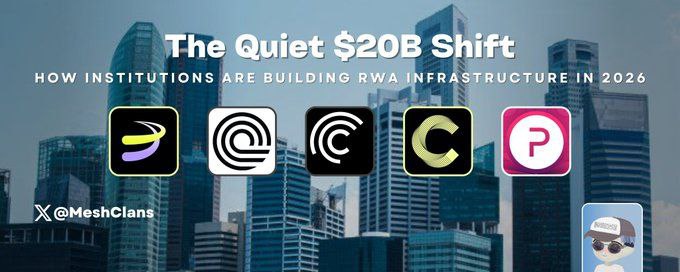
Institutional real‑world‑asset (RWA) tokenization has moved from a retail‑heavy niche to a fast‑growing institutional market, with multiple data providers now placing non‑stablecoin tokenized RWAs in the ~$18–20B range by early 2026, led by tokenized Treasuries, private credit, and tokenized equity and fund products. Platforms referenced in the post—such as Ondo, Centrifuge, and institutional networks like Canton and Polymesh—are among the main venues where these instruments are being issued, custodied, and traded as on‑chain securities for professional investors.
According to Securitize and analytics providers tracking tokenized securities, the market value of tokenized RWAs (excluding stablecoins) grew from roughly $5–6B at the start of 2024–2025 to about $18–21B by late 2025 and early 2026, implying a several‑fold increase in two years. A large share of that growth comes from tokenized U.S. Treasuries and money‑market style funds, which expanded from around $4B to roughly $9B over 2025 alone, as investors sought yield and instant settlement in a regulated wrapper. In parallel, private credit and tokenized equity/fund interests—including on platforms like Centrifuge for credit pools and on permissioned chains and specialized security token networks—have steadily added institutional AUM, with most positions held through regulated custodians such as Anchorage Digital, BitGo, Coinbase Custody, Fireblocks, and Komainu. These custodians provide qualified‑custodian status, key management, and reporting that meet fund administrator and auditor standards, which is critical for RIAs, funds, and corporates allocating to on‑chain products.
This backdrop explains why commentators frame a $20B institutional tokenized RWA segment by early 2026 as a realistic milestone rather than a distant projection: multiple datasets now show tokenized fund AUM crossing or nearing that level, and institutional infrastructure (custody, transfer agents, permissioned chains) is in place to support further growth. Platforms and networks mentioned in the post reflect the breadth of this build‑out: Ondo in tokenized Treasuries and yield products, Centrifuge in on‑chain private credit, and institutional rails like Canton (for bank‑grade tokenization and settlement), Polymesh (a permissioned securities‑optimized L1), and similar enterprise networks are positioning to service regulated issuers and buy‑side firms rather than retail traders. For a crypto/Web3 audience, the significance is that real, interest‑bearing financial assets—Treasuries, private loans, and equity‑like claims—are increasingly being issued and held on public or permissioned blockchains, creating an emerging bridge between traditional capital markets and on‑chain liquidity.
"entities":["Tokenized real‑world assets (RWAs)","Securitize","Ondo","Centrifuge","Canton Network","Polymesh","Rayls (likely an institutional RWA/tokenization platform referenced in commentary)","Anchorage Digital Bank","BitGo","Fireblocks","Coinbase Custody","Komainu","U.S. Treasuries","Private credit","Tokenized equities and funds","rwa.xyz"]}`
✨ AI-generated background, compiled from web sources — not editorial content.