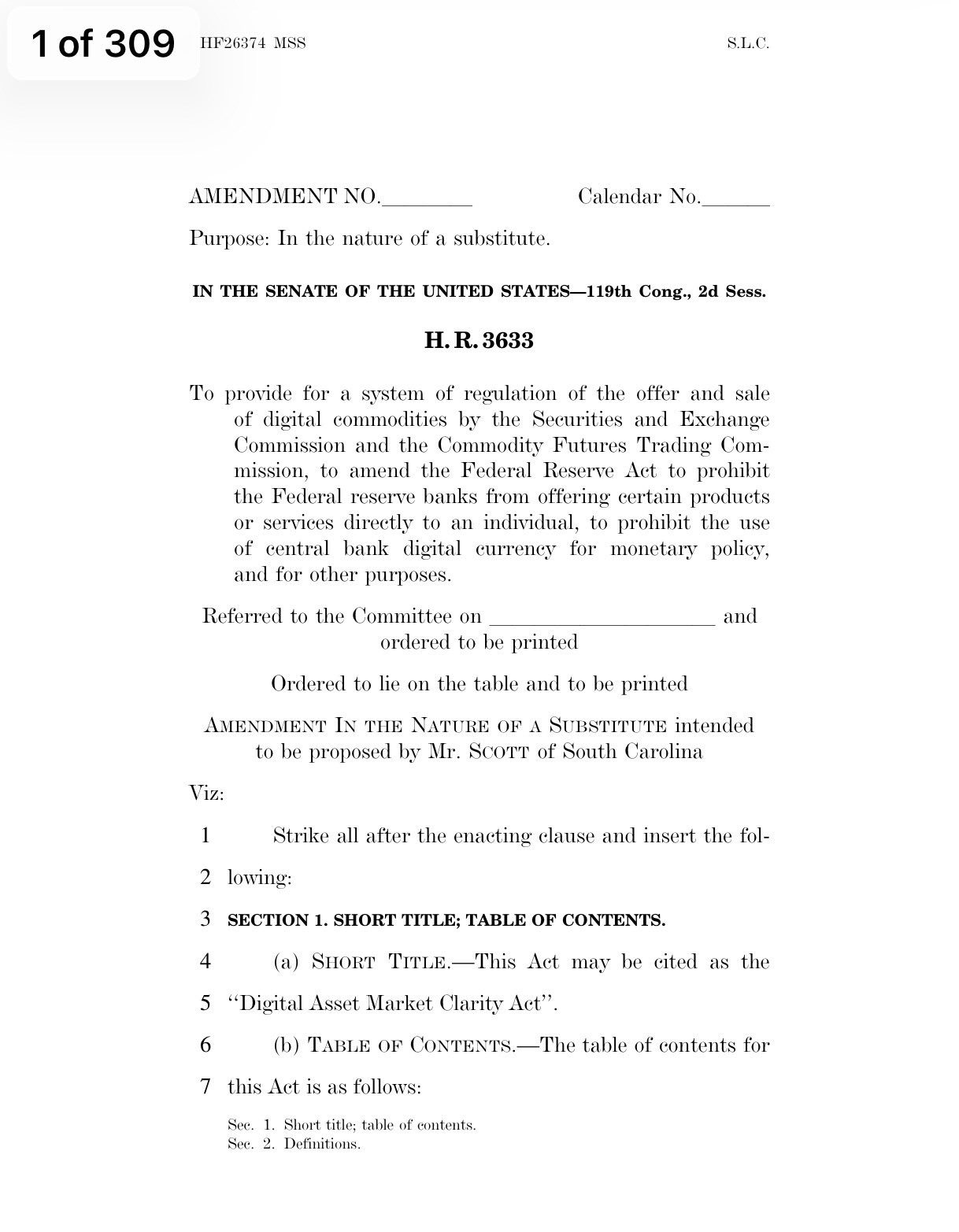
New crypto Clarity Act draft locks in spot ETP tokens as non-securities, expands bank services for digital assets
𝕏/@dangambardello •
Revision history
2 recorded changes
Want your article here?
Promote with Leviathan News2 recorded changes
Want your article here?
Promote with Leviathan NewsA newly released draft of the U.S. crypto CLARITY / Digital Asset Market Clarity Act would hard‑code that any crypto asset serving as the principal asset of a U.S. spot exchange‑traded product (ETP) by January 1, 2026 must be treated as a non‑security, and it would significantly broaden the ability of banks and credit unions to offer digital‑asset services. The draft is part of the Senate Banking Committee’s wider digital‑asset market structure package and is moving toward markup, with amendments being taken ahead of a scheduled committee vote. According to reporting on the 309‑page draft, one of the most consequential provisions is that any token that is the underlying asset of a spot ETP as of Jan. 1, 2026 is “permanently treated as a non‑security,” locking in commodities‑style treatment regardless of later changes in SEC or CFTC leadership. In practice, that would cement regulatory status for assets such as bitcoin, ether, and any other crypto that has a spot ETP approved by the end of 2025, limiting the SEC’s ability to later reclassify them as securities. This sits against the backdrop of the SEC’s previous stance that the approval of spot bitcoin ETPs did not signal broader willingness to treat other crypto assets as non‑securities. The draft also carves out staking and opens the door for traditional banks to enter digital assets at scale. It explicitly classifies several staking models—including self‑staking, third‑party node arrangements, liquid staking via receipt tokens, and custodial staking offered by exchanges—as non‑securities, framing them as administrative or ministerial services rather than investment contracts. On the banking side, national and state banks and credit unions would be allowed, without prior regulatory approval, to offer custody, staking, lending against digital assets, payment processing, market‑making, and underwriting related to digital assets as incidental to their normal business. Combined with separate sections that restrict passive interest‑like yield on stablecoin balances while allowing activity‑based rewards, the package is designed to provide clearer regulatory lines for market structure, token classification, and the role of regulated financial institutions in U.S. crypto markets.
AI-generated background, compiled from web sources — not editorial content.

𝕏/@SenLummis ·

Coindesk ·

𝕏/@TheBlockCo ·

Coindesk ·

The Block ·

The Block ·
𝕏/@SenLummis ·
Coindesk ·
𝕏/@TheBlockCo ·
Coindesk ·
The Block ·
The Block ·
🚀 Love DeFi? Ready to dive in and start earning $SQUID while making an impact?