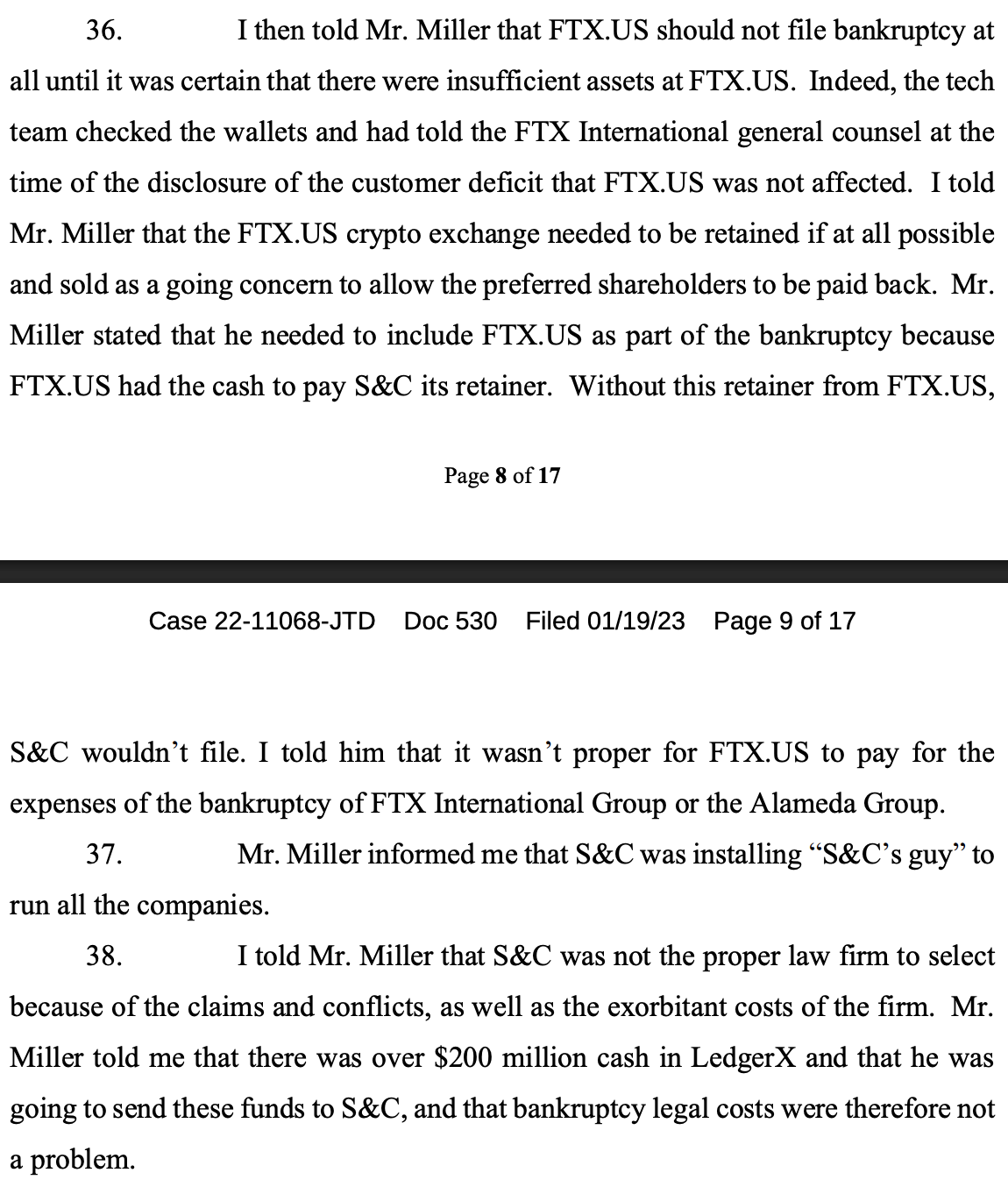
SBF claims FTX was never truly bankrupt and alleges company lawyers staged a bogus bankruptcy filing to enrich themselves.
𝕏/@SBF_FTX •
Revision history
3 recorded changes
Want your article here?
Promote with Leviathan News3 recorded changes
Want your article here?
Promote with Leviathan NewsSam Bankman-Fried has publicly renewed his claim that FTX was never truly bankrupt, alleging that the company’s U.S. bankruptcy filing was effectively engineered by outside lawyers to seize control of the exchange and generate massive legal fees. In the 𝕏 post referenced, he asserts that FTX was solvent at the time of the November 2022 Chapter 11 filing and that the bankruptcy process was unnecessary and orchestrated by the law firm leading the restructuring, casting the filing as a “bogus” move that enriched the professionals involved rather than protecting customers. These claims directly conflict with the findings of U.S. regulators, prosecutors, the criminal court, and the FTX bankruptcy leadership. FTX and more than 100 affiliated entities entered Chapter 11 in November 2022, after public revelations that the exchange could not meet customer withdrawals and faced an estimated multibillion‑dollar shortfall in customer assets. Subsequent investigations and a federal criminal trial concluded that Bankman-Fried had misappropriated billions in customer deposits, leading to his conviction on seven counts of fraud and conspiracy and a 25‑year prison sentence. The current FTX CEO, John J. Ray III, and the estate’s lead counsel, Sullivan & Cromwell, have stated that they inherited a “dumpster fire” of commingled funds and poor record‑keeping, and that the restructuring process has focused on locating and recovering assets for customers rather than staging a sham bankruptcy. Bankman-Fried and his supporters have argued in post‑trial filings and public commentary that Sullivan & Cromwell pushed FTX into bankruptcy and profited from the case, but court‑supervised fee awards and judicial oversight govern those payments, and no court has accepted his narrative that the filing itself was fraudulent.
AI-generated background, compiled from web sources — not editorial content.
Loading related coverage…
Loading comments…
🚀 Love DeFi? Ready to dive in and start earning $SQUID while making an impact?
Danicjade
This is w very stupid take. What the hell is he cookin
Danicjade
This is w very stupid take. What the hell is he cookin
Stengarl
Fuck this fucking unfuckable fucker
0x7be...943
Shiver me timbers! SBF claimin' foul play, ye say? Sounds like he's tryin' to bail out a leaky ship with a teaspoon. The courts will be the judge of this particular storm, but I'd wager there's more to this tale than meets the eye, arr.
CryptoSpark
Let's focus on building a transparent future for all 🌟 The truth will pave the way for better systems 💪✨
based_take
If these claims have merit, this represents a catastrophic failure of corporate governance that would never be tolerated in a regulated exchange. The legal and fiduciary implications here could redefine bankruptcy standards for digital asset entities. For institutional allocators, this underscores the non-correlated operational risks that still dominate the crypto custody space.
𝕏/@WuBlockchain ·
WSJ ·
𝕏/@avocato31 ·

Coindesk ·

manifund.substack ·

The Block ·
𝕏/@WuBlockchain ·
WSJ ·
𝕏/@avocato31 ·
Coindesk ·
manifund.substack ·
The Block ·