Aave Labs has put forward a major new funding and governance package, the “Aave Will Win” framework, asking the Aave DAO for roughly $50–51 million in support while pledging to redirect 100% of Aave Labs’ product revenue to the DAO treasury. The non-binding “temp check” on Aave’s governance forum proposes that all revenue from Aave-branded products—including existing Aave v3 swap fees and future products like Aave v4, the Aave.com front end, Aave Card, and other applications—would accrue to the DAO, not to Aave Labs as a private company. In exchange, Aave Labs requests a funding package of $25 million in stablecoins plus 75,000 AAVE (roughly totaling about $50 million at proposal time), with an additional $17.5 million in milestone‑based grants for specific product launches such as Aave App, Aave Pro, Aave Card, and Aave Kit. The core grant is structured as $5 million upfront and $20 million streamed over a year, while the AAVE allocation would vest over two years.
The proposal is framed by Aave Labs as an alignment and sustainability move: the DAO would become the primary economic beneficiary of all Aave-branded revenue streams, while Aave Labs secures a predictable operating budget to build Aave v4 and new products it argues are needed to keep the protocol competitive. It also includes the creation of a new Aave Foundation (or similar legal entity) to hold the Aave brand and intellectual property on behalf of the DAO, addressing the fact that the DAO itself is not a legal person and cannot own or license trademarks directly. Annual budgets after this initial package would still require separate governance approvals, preserving a layer of oversight by token holders over future spending.
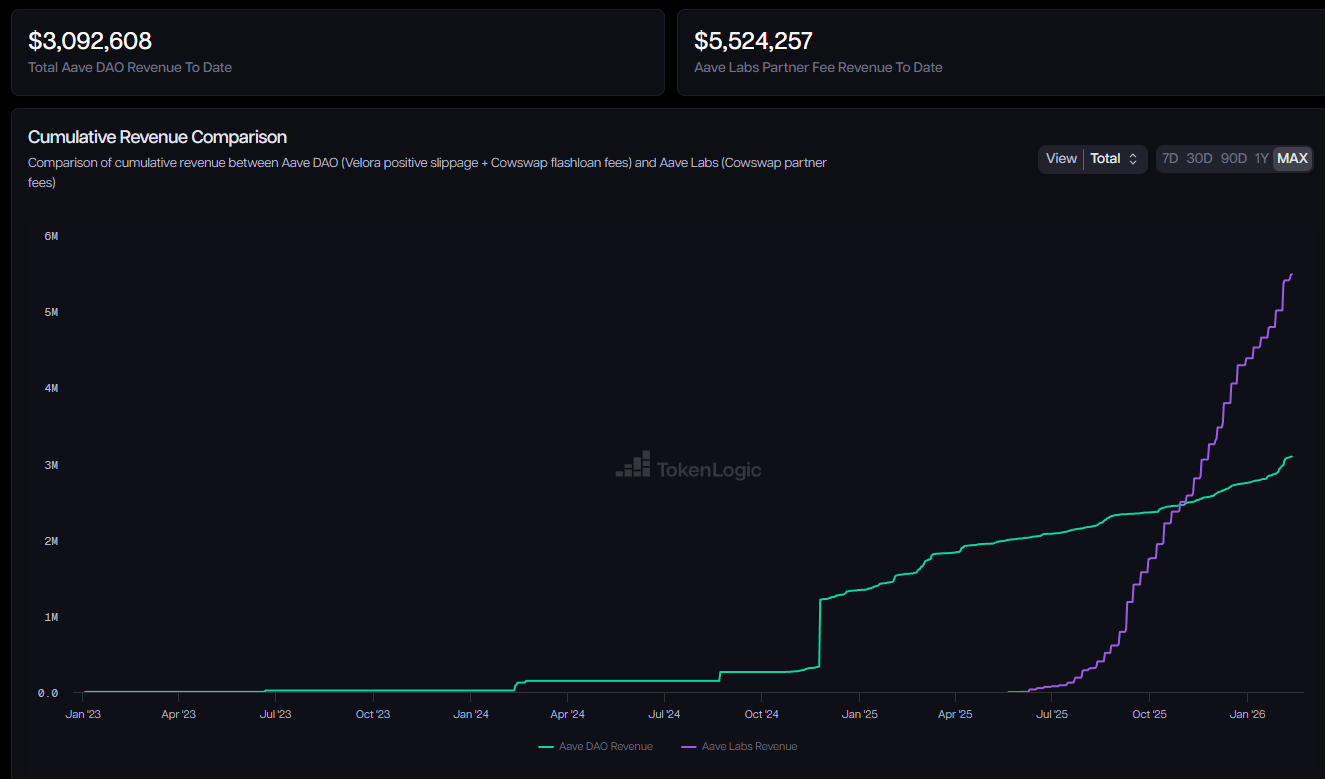
The move has triggered immediate and sharp pushback from parts of the Aave community, most prominently Marc Zeller, founder of the Aave Chan Initiative (ACI) and a leading delegate, who has characterized the framework as an expensive and poorly justified “solution” to deeper governance problems. Zeller and other critics argue that the request is effectively a $50+ million payout to Aave Labs presented without sufficient prior engagement with the DAO, and that it would consolidate influence in a single service provider at a time when the protocol has already faced governance tensions and a steep drawdown in AAVE’s market capitalization. A separate critical forum post tallies Aave Labs’ historical funding at around $86 million (ICO proceeds, VC capital, and prior DAO payments) and accuses the company of poor product execution, unapproved revenue capture (~$5.5 million in swap fees), and heavy undisclosed governance voting power, arguing that the DAO is being asked to pay more without a clear accountability framework. The controversy has become a focal point for broader debates about how DeFi protocols fund core development, how much leverage founding teams should retain, and how DAOs can balance operational continuity with stronger transparency and control.
"entities":["Aave Labs","Aave DAO","Aave Will Win framework","Aave v4","Aave v3","Aave.com","Aave Card","Aave App","Aave Pro","Aave Kit","Aave Foundation","AAVE (token)","Marc Zeller","Aave Chan Initiative (ACI)","Stani Kulechov"]}`
✨ AI-generated background, compiled from web sources — not editorial content.