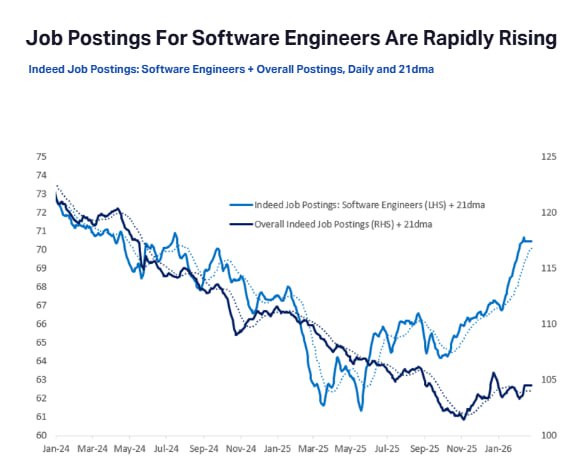
Citadel Securities’ piece “The 2026 Global Intelligence Crisis” is a direct, data‑driven rebuttal to Citrini Research’s viral “Global Intelligence Crisis” memo, which painted a scenario of rapid AI adoption causing severe white‑collar job losses, demand destruction, and macroeconomic instability by the late 2020s. Citadel Securities argues that, based on current labor, adoption, and investment indicators, fears of imminent mass AI‑driven unemployment and macro collapse are not supported by the evidence. Authored by global macro analyst Frank Flight, the essay frames the AI question in terms of observable data and historically grounded macro dynamics rather than speculative worst‑case narratives.
The note highlights that as of 2026, U.S. unemployment is around 4.28%, AI capital expenditure is roughly 2% of GDP (about $650 billion), “AI‑adjacent” commodities have risen about 65% since January 2023, and roughly 2,800 data centers are planned for construction in the U.S. Despite public concern about displacement, job postings for software engineers are reportedly up about 11% year‑over‑year, which Citadel treats as inconsistent with an ongoing collapse in white‑collar demand. Using data such as the St. Louis Fed’s Real Time Population Survey, the firm also notes that daily use of generative AI for work, while growing, has not shown the sharp inflection that would be expected if broad swaths of labor were on the verge of being automated away. Instead, Citadel sees little evidence of AI‑driven disruption in current labor‑market indicators and even links AI data‑center build‑out to a pickup in construction hiring.
At the macro level, the rebuttal argues that for AI to trigger a sustained negative demand shock on the scale described by Citrini, multiple extreme conditions would need to occur simultaneously: very rapid AI adoption, near‑total labor substitution, minimal fiscal or regulatory response, limited absorption of AI investment, and unconstrained scaling of compute. Citadel questions this stack of assumptions, emphasizing that past technological waves have neither eliminated labor nor produced runaway growth, but instead left long‑run trend growth near ~2%. The piece stresses that economies are composed of many task types—physical, relational, regulatory, and supervisory—where automation is costly or difficult, making it more plausible that AI complements labor in many domains rather than erasing it. The firm also underscores that democratic governments facing visible displacement pressures would likely respond with policy tools that further constrain how far and how fast AI can substitute for human workers. Overall, Citadel positions its view as a counterweight to “AI doomsday” macro narratives, arguing the near‑term debate should focus less on collapse scenarios and more on substitution elasticities, institutional responses, and how human demand continually reconfigures around new technologies.
✨ AI-generated background, compiled from web sources — not editorial content.