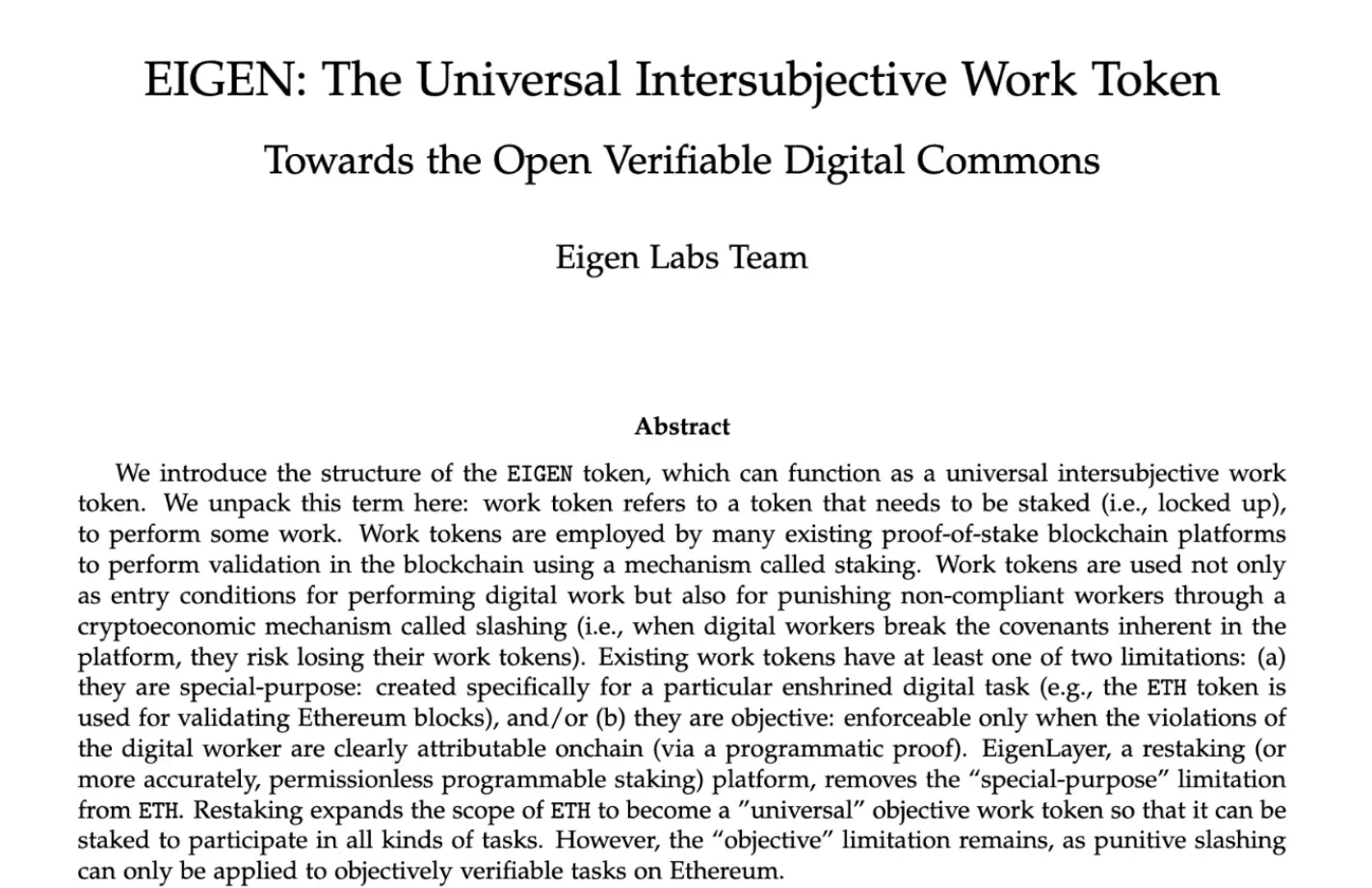
EigenLayer publishes white paper for EIGEN Token, a "universal intersubjunctive work token"
github/@Layr-Labs •
Revision history
4 recorded changes
Want your article here?
Promote with Leviathan News4 recorded changes
Want your article here?
Promote with Leviathan NewsEthereum restaking protocol EigenLayer has released the formal white paper for EIGEN, a new token it describes as a “universal intersubjective work token” designed to complement ETH restaking rather than replace it. The paper, published via Layr Labs/Eigen Labs and the Eigen Foundation, specifies how EIGEN is meant to secure a new class of “intersubjective” faults—cases where correctness cannot be proven purely on-chain and instead relies on social consensus, such as prediction markets, storage services, cloud microservices, and other off-chain or subjective services. EigenLayer today uses staked ETH to provide cryptoeconomic security for objective faults—things that can be verified on-chain, like block validity or data availability—but the team argues this model cannot safely cover failures where attribution of fault is inherently subjective or socially determined. The EIGEN white paper proposes a complementary staking and forking mechanism: EIGEN is staked to Actively Validated Services (AVSs) and can be slashed in the event of intersubjective faults, with “intersubjective forking” used to coordinate social consensus and isolate contentious outcomes or DeFi positions across forks. Building on prior ideas such as Augur’s REP token while generalizing beyond prediction markets, EIGEN is positioned as a general-purpose work token for a broad range of services that need cryptoeconomic security but cannot rely solely on fully objective slashing conditions. The Eigen Foundation will be responsible for distributing EIGEN, with an initial supply of about 1.67 billion tokens and a token economics structure that reserves 45%+inflation for the community, 15% for “stakedrop” and future seasons, 15% for R&D and ecosystem development, 29.5% for investors, and 25.5% for early contributors, subject to multi‑year lockups for investors and contributors. In line with the white paper’s emphasis on social consensus and forking behavior, the token launches initially non-transferable and non-forkable, with a phased “Season 1” stakedrop targeting EigenLayer restakers and LRT users, and additional seasons planned. The design matters for Ethereum and the broader crypto infrastructure stack because it introduces a formal mechanism to price, secure, and coordinate work around tasks that sit between purely on-chain verifiable computation and purely off-chain trust, potentially expanding what kinds of services can safely be bootstrapped on top of Ethereum’s economic security.
AI-generated background, compiled from web sources — not editorial content.

𝕏/@0xcatalysis ·

Blockworks ·

The Block ·

Coindesk ·
astar.network ·

blog.uma.xyz ·
𝕏/@0xcatalysis ·
Blockworks ·
The Block ·
Coindesk ·
astar.network ·
blog.uma.xyz ·
🚀 Love DeFi? Ready to dive in and start earning $SQUID while making an impact?