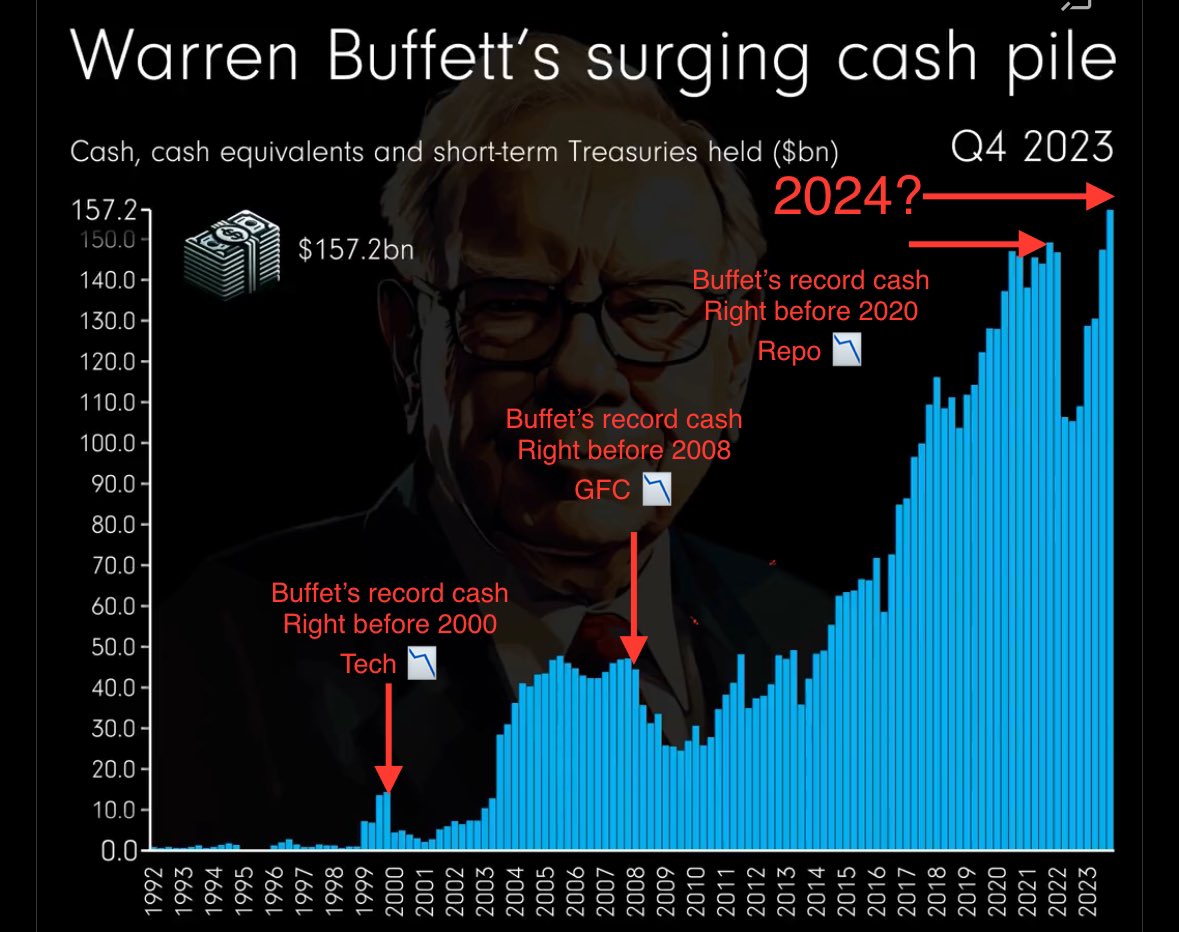
Buffett is hoarding $188 billion in cash in short term U.S. T-bills collecting 5.4% rate.
𝕏/@GregCrennan •
Revision history
2 recorded changes
Want your article here?
Promote with Leviathan News2 recorded changes
Want your article here?
Promote with Leviathan NewsWarren Buffett’s Berkshire Hathaway has built a record cash pile of around $188 billion, largely invested in short‑term U.S. Treasury bills yielding roughly 5.4%, reflecting both the current interest‑rate environment and Buffett’s reluctance to deploy capital at today’s asset valuations. This positioning became highly visible around Berkshire’s 2024 annual meeting, where Buffett addressed shareholder questions about why the conglomerate is “sitting on” so much cash instead of making large acquisitions or equity investments. According to Berkshire’s 2024 results coverage, the conglomerate’s operating earnings rose sharply while its cash hoard grew to a then‑record $188 billion, much of it parked in short‑duration Treasuries that benefit from the U.S. Federal Reserve’s higher policy rates. Buffett has indicated in interviews and at the annual meeting that Berkshire will only commit capital when it finds “elephants” (large deals) at attractive prices, and that in the meantime T‑bills provide a safe, liquid place to earn a mid‑single‑digit yield. Commentators note that Berkshire’s rising cash and T‑bill position—later reported to exceed $300 billion and then nearly $400 billion under his successor Greg Abel—has become one of the largest private holdings of U.S. government debt and is being interpreted by some as a sign of caution about equity and deal valuations. This cash‑heavy stance matters for markets because Berkshire is one of the world’s most closely watched institutional investors, and its decision to favor T‑bills over large equity or M&A bets is seen as a barometer of perceived opportunity and risk. The elevated yield on short‑term Treasuries (around 5%–5.5% through 2023–2024) makes cash more competitive versus stocks, reinforcing Buffett’s willingness to wait for dislocations rather than chase assets at rich valuations. Analysts and market commentators have therefore framed Berkshire’s T‑bill hoard as both a response to high interest rates and an expression of skepticism about the prices of major public companies and private deals in the current cycle.
AI-generated background, compiled from web sources — not editorial content.

𝕏/@StaniKulechov ·

Cryptonews ·
𝕏/@apoorvanand99 ·
Coindesk ·
𝕏/@firstdigitalhq ·

Prnewswire ·
𝕏/@StaniKulechov ·
Cryptonews ·
𝕏/@apoorvanand99 ·
Coindesk ·
𝕏/@firstdigitalhq ·
Prnewswire ·
🚀 Love DeFi? Ready to dive in and start earning $SQUID while making an impact?