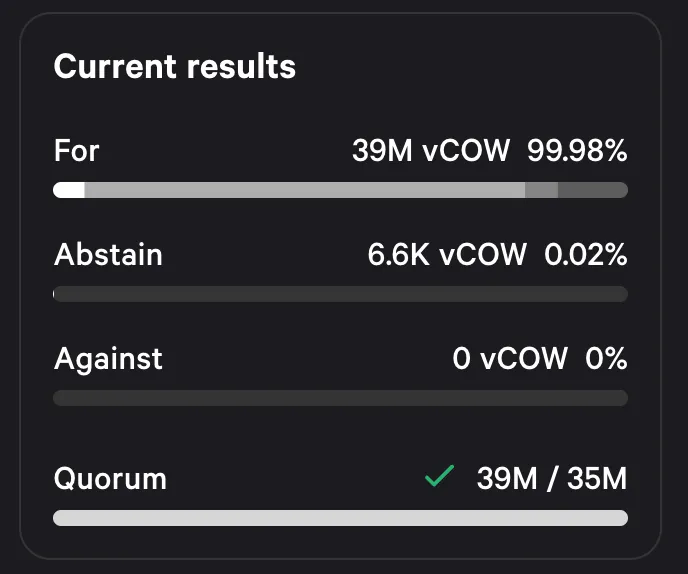
CoW Protocol on track to pass CIP-44 after hitting quorum, which would promote decentralization by decreasing reliance on bonding pools for solvers
𝕏/@CoWSwap •
Revision history
17 recorded changes
Want your article here?
Promote with Leviathan News17 recorded changes
Want your article here?
Promote with Leviathan NewsCoW Protocol’s governance proposal CIP‑44: “Reduced bonding requirements” has reached quorum on Snapshot and is on track to pass, according to the CoW Protocol team’s announcement on X. CIP‑44 was introduced in May 2024 by CoW Protocol co-founder Felix Leupold (“fleupold”) to change how “solvers” – the off-chain actors that compete to settle user trades – are bonded, with the aim of lowering entry barriers and reducing reliance on a few large bonding pools. The proposal has since progressed through CoW DAO’s established governance process, which requires forum discussion and then a 7‑day token-holder vote on Snapshot once criteria are met. Under the current setup defined by earlier governance (notably CIP‑7), solvers must be backed by “bonding pools” that post significant collateral (around $500,000 in stablecoins and 1.5 million COW tokens) and can be slashed by CoW DAO if a solver misbehaves. Despite there being around 20 active solvers, they are almost entirely covered by just two bonding pools: one sponsored by Gnosis DAO and one by CoW DAO itself, with the Gnosis pool currently closed to new external solvers. CIP‑44 introduces a new, more permissionless path where solvers can bond using their own resources with reduced requirements – a minimal initial deposit of roughly $50,000 in yield-bearing stablecoins or ETH plus 500,000 COW, growing toward a target of $100,000 plus 1,000,000 COW over time. Solvers starting with the minimal deposit must route solutions via the MEV Blocker RPC and have protocol refunds and half of their COW rewards auto-directed to grow their bond until the target is reached within a year. If fully approved and implemented, CIP‑44 is intended to improve decentralization and resilience of CoW Protocol’s solver network by enabling more entities to become bonded solvers without depending on the existing Gnosis and CoW DAO bonding pools. The proposal keeps slashing-based security guarantees while letting solvers manage their own settlement keys and compete on more advanced aspects of the auction mechanism, which CoW DAO contributors describe as a milestone toward deploying CoW Protocol on more networks and increasing competition and innovation among solvers. Forum discussion shows ecosystem participants, such as cherry.xyz, publicly supporting the change as a step toward a more open and scalable solver architecture.
AI-generated background, compiled from web sources — not editorial content.

𝕏/@dotkrueger ·
𝕏/@dominic_w ·

bis.org ·
𝕏/@tiger_research_ ·

𝕏/@const_reborn ·
𝕏/@j0e_cooks ·
𝕏/@dotkrueger ·
𝕏/@dominic_w ·
bis.org ·
𝕏/@tiger_research_ ·
𝕏/@const_reborn ·
𝕏/@j0e_cooks ·
🚀 Love DeFi? Ready to dive in and start earning $SQUID while making an impact?