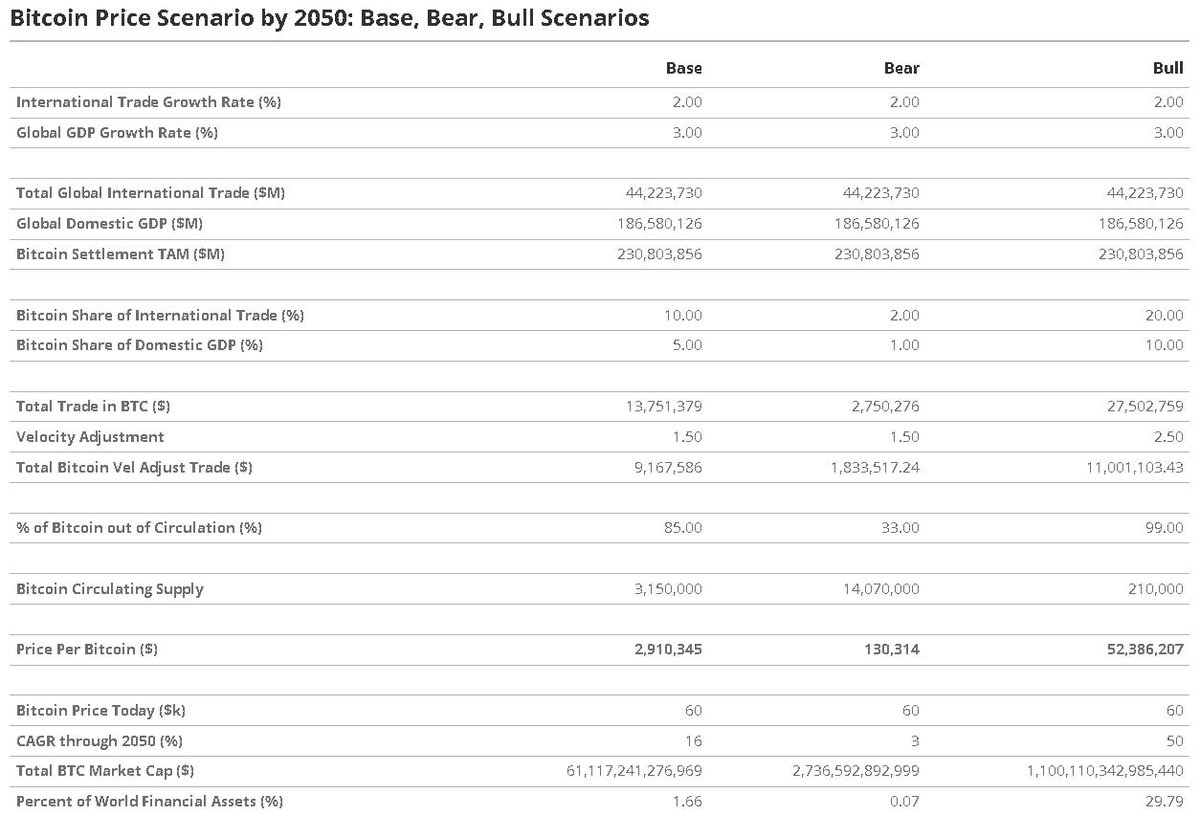
VanEck has released a long‑term Bitcoin valuation framework projecting that by 2050 the asset could trade anywhere between about $130,000 and $53.4 million per coin, with a base‑case target of $2.9 million. The analysis, led by Matthew Sigel and VanEck’s digital assets research team, treats Bitcoin as a potential global medium of exchange and reserve asset and feeds those assumptions into a velocity‑of‑money style model to derive implied prices. In the conservative “bear” case, Bitcoin grows only modestly and reaches roughly $130,000 by 2050, implying about a 2% annualized return from current levels. The base case assumes Bitcoin settles around 5–10% of global international trade, is used in roughly 5% of domestic trade, and reaches about 2.5% of global central bank balance sheets as a reserve asset, which VanEck argues could justify a valuation of about $2.9 million per BTC by 2050, or a 15% long‑term compound annual growth rate. The bull or “hyper‑bitcoinization” case pushes these assumptions further, modeling Bitcoin as settling about 20% of international trade and 10% of domestic GDP and becoming a dominant reserve asset, which yields a theoretical price near $53.4 million per coin and a 29% CAGR. VanEck emphasizes that these are scenario analyses rather than predictions, and that the upside cases depend on very substantial changes in global trade settlement and reserve management practices. The report matters because it shows a large, traditional asset manager trying to formalize Bitcoin’s long‑term role in institutional portfolios using the same capital‑market‑assumption style modeling applied to equities and bonds. VanEck uses the scenarios to argue for a 1–3% strategic allocation to Bitcoin in diversified portfolios, citing its potential as a “convex, low‑correlation reserve asset,” while also disclosing that the firm already has Bitcoin exposure and highlighting the significant risks and uncertainty around these long‑dated projections. The outsized bull figures have attracted attention and skepticism in crypto media and social channels, but they are framed by VanEck as contingent outcomes in a framework that is primarily aimed at long‑horizon institutional allocators.

AI-generated background, compiled from web sources — not editorial content.

More coverage

Explore the topic

More on Bitcoin

Comments