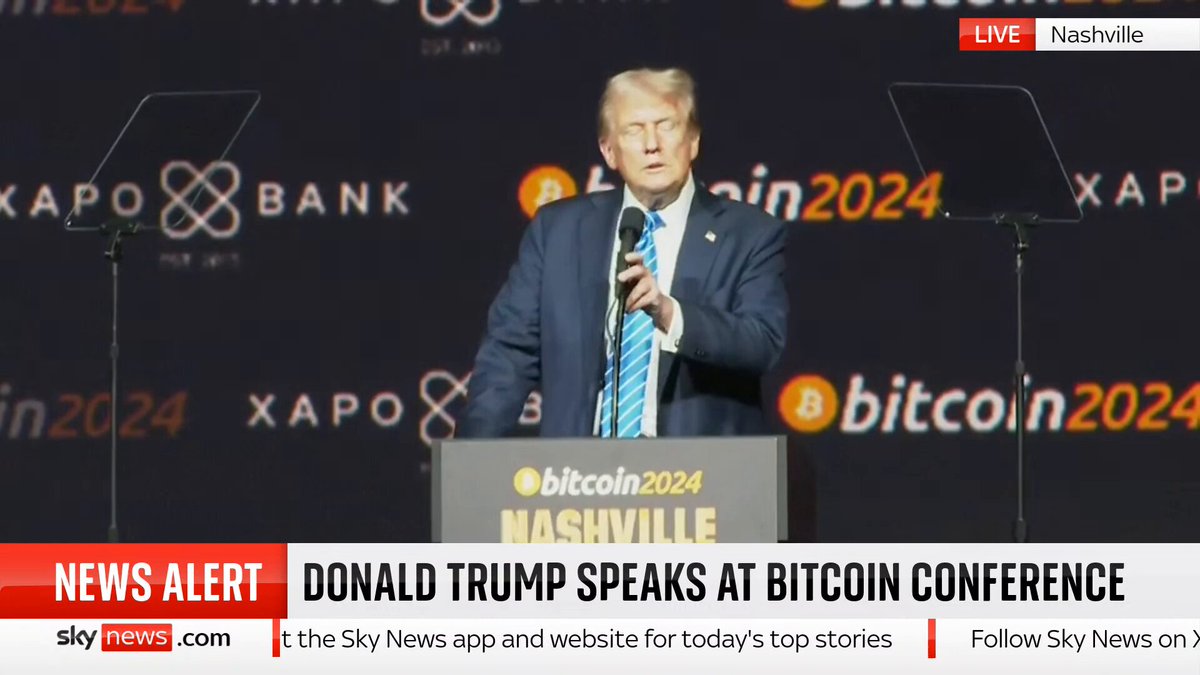
Trump speech at the Bitcoin Conference addresses creating a national stockpile, firing Gary Gensler, and commuting the sentence of Ross Ulbricht
𝕏/@balajis •
Revision history
2 recorded changes
Want your article here?
Promote with Leviathan News2 recorded changes
Want your article here?
Promote with Leviathan NewsAt the Bitcoin 2024 conference in Nashville in late July 2024, Donald Trump used a campaign-style speech to court the crypto industry with a series of explicit policy promises. Speaking to a largely pro‑Bitcoin audience, he pledged to turn the U.S. into a “Bitcoin superpower,” make America the “crypto capital of the planet,” and reverse what he described as the Biden–Harris administration’s “war on crypto.” A central pledge was to treat Bitcoin as a strategic asset: Trump said that, if elected, his administration would create a “strategic national Bitcoin stockpile” by retaining 100% of the Bitcoin currently held by the U.S. government, much of it seized in law‑enforcement actions, and not selling it off. He cited estimates that federal agencies collectively hold roughly 200,000–210,000 BTC, about 1% of Bitcoin’s eventual supply, and argued that “never sell your Bitcoin” should guide U.S. policy. Trump coupled the stockpile proposal with broader regulatory and personnel promises aimed squarely at the crypto sector. He vowed to fire SEC Chair Gary Gensler “on day one” of a new administration, a line that drew sustained applause from an industry that has frequently criticized Gensler’s enforcement‑heavy approach to crypto. Trump also promised to halt efforts to develop a U.S. central bank digital currency (CBDC), stating that “there will never be a CBDC while I’m president,” and to protect self‑custody of digital assets. He said he would establish a Bitcoin and crypto presidential advisory council to help design regulatory guidance, and would direct Treasury and other agencies to provide clearer rules and a friendlier environment for Bitcoin mining and stablecoin development, framing stablecoins as a way to reinforce U.S. dollar dominance. The speech is significant because it marks one of the clearest attempts by a major U.S. presidential candidate to turn crypto policy into a campaign wedge issue and to offer concrete concessions to the Bitcoin community. By tying commitments on a national Bitcoin reserve, personnel changes at the SEC, and an explicit anti‑CBDC stance into his broader criticism of existing financial regulation, Trump positioned crypto policy within larger debates about executive power, financial surveillance, and U.S. economic strategy. The proposals, if implemented, would have direct implications for how the U.S. manages seized digital assets, the future of federal securities enforcement in crypto markets, and the global positioning of the U.S. in Bitcoin mining and digital asset innovation.
AI-generated background, compiled from web sources — not editorial content.
Loading related coverage…

𝕏/@THORChain ·

The Block ·
starkware.co ·

Coindesk ·

𝕏/@citrea_xyz ·

𝕏/@CashApp ·
𝕏/@THORChain ·
The Block ·
starkware.co ·
Coindesk ·
𝕏/@citrea_xyz ·
𝕏/@CashApp ·
🚀 Love DeFi? Ready to dive in and start earning $SQUID while making an impact?