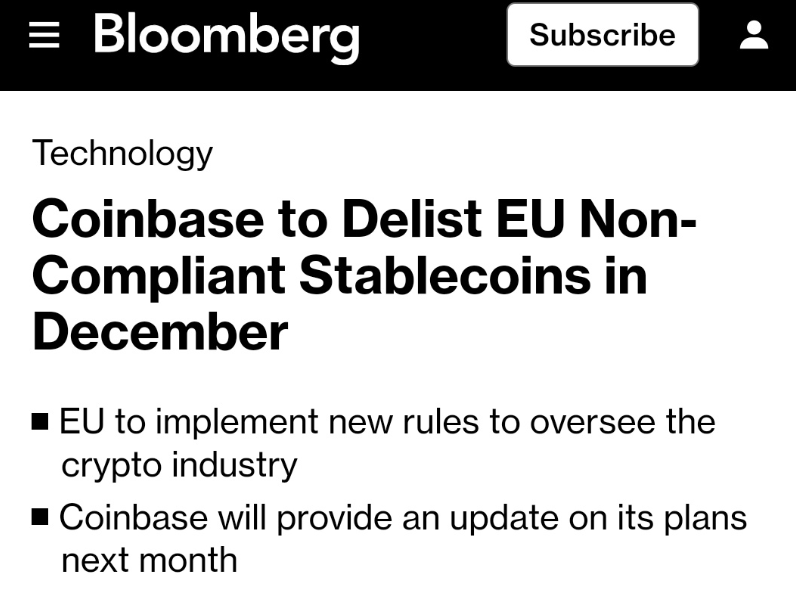
Coinbase, Binance, and other EU Crypto Asset Service Providers are phasing out and delisting stablecoins not regulated under MiCA
𝕏/@paddi_hansen •
Revision history
3 recorded changes
Want your article here?
Promote with Leviathan News3 recorded changes
Want your article here?
Promote with Leviathan NewsMajor crypto exchanges operating in the European Economic Area (EEA) – including Coinbase, Binance, and others – are beginning to phase out and delist stablecoins that are not compliant with the EU’s Markets in Crypto‑Assets (MiCA) regulation, ahead of key MiCA enforcement deadlines. This mainly affects widely used dollar-pegged stablecoins such as USDT, DAI, and several others that do not (yet) have an EU e‑money license and are therefore considered “non‑MiCA‑compliant.” Under MiCA’s stablecoin rules, which started applying from late 2024 with a transition period into 2025, any stablecoin offered to the public in the EEA must be issued by a regulated entity (typically with an e‑money or similar license) and meet strict reserve, governance, and disclosure requirements. In response, Coinbase has removed a set of non‑compliant stablecoins – including USDT, PAX, PYUSD, GUSD, GYEN, and DAI – from its European platforms, while continuing to support MiCA‑aligned assets like USDC and EURC, and urging users to convert into these compliant coins or into fiat. Other exchanges such as Kraken and Crypto.com have also announced or executed similar USDT delistings, and Binance has set a deadline of 31 March 2025 in the EEA to delist multiple non‑MiCA‑compliant stablecoins (including USDT, DAI, FDUSD, TUSD, USDP, AEUR, UST, USTC, and PAXG) from trading pairs, while still allowing custody, deposits, and withdrawals for now. This coordinated shift matters because it reshapes the stablecoin landscape in Europe: liquidity and usage are moving away from the largest global but unregulated stablecoins towards MiCA‑compliant alternatives such as USDC and euro‑denominated tokens. For issuers, it raises the pressure to obtain EU authorization if they want their stablecoins to remain listed; for European users and DeFi protocols, it means changes in trading pairs, market depth, and potentially in which stablecoins become “default” collateral or settlement assets in the region.
AI-generated background, compiled from web sources — not editorial content.

𝕏/@coinbase ·

𝕏/@nftechie_ ·

ꘜ/@BenthicNews ·

The Block ·
𝕏/@coinbase ·

𝕏/@cbventures ·
𝕏/@coinbase ·
𝕏/@nftechie_ ·
ꘜ/@BenthicNews ·
The Block ·
𝕏/@coinbase ·
𝕏/@cbventures ·
🚀 Love DeFi? Ready to dive in and start earning $SQUID while making an impact?