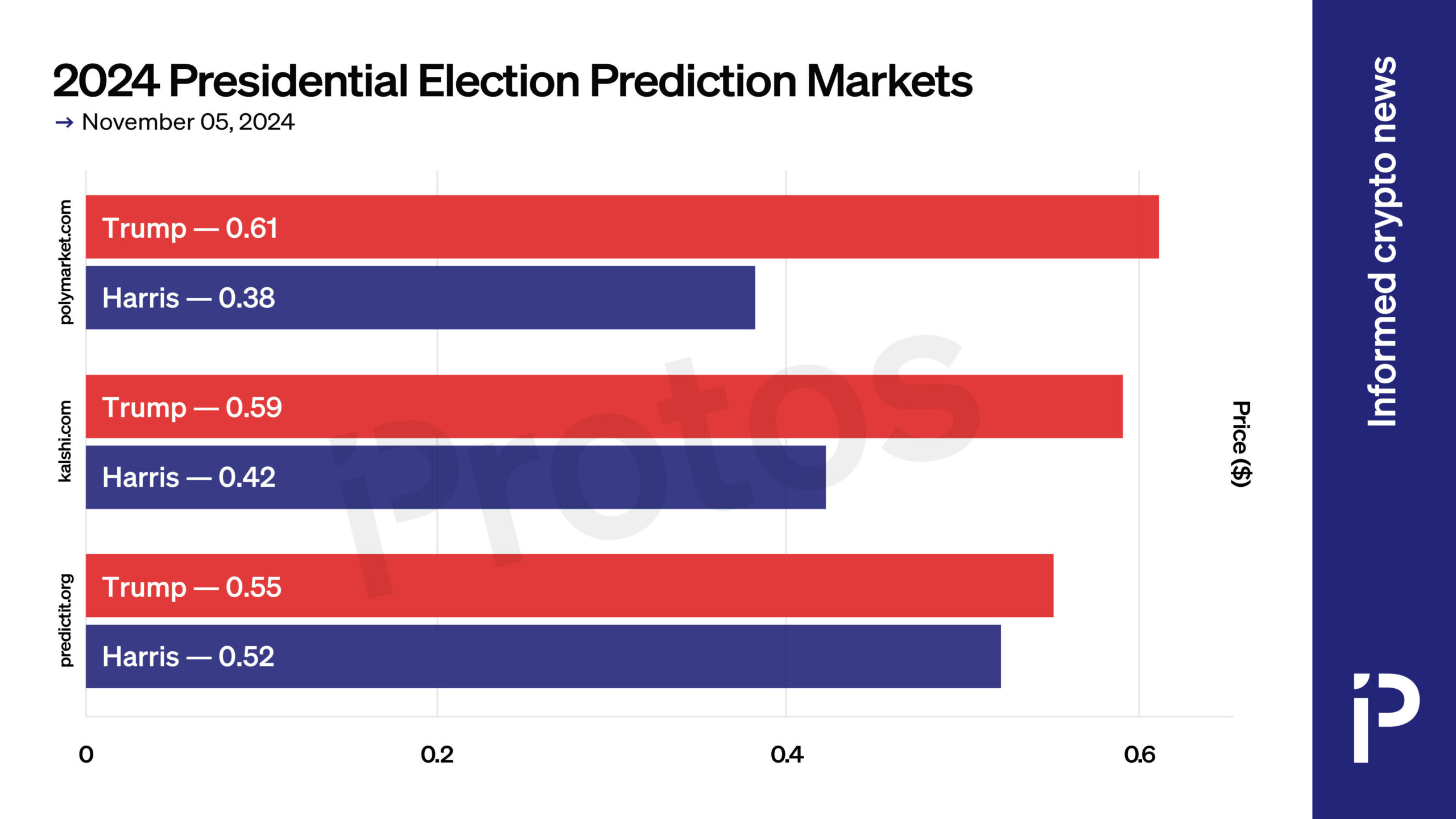
Prediction markets such as Polymarket, Kalshi, and PredictIt, have Donald Trump inching ahead as the race for the White House nears its end.
Protos •
Revision history
3 recorded changes
Want your article here?
Promote with Leviathan News3 recorded changes
Want your article here?
Promote with Leviathan NewsOn the final day of the 2024 U.S. presidential election, major prediction and betting markets, including Polymarket, Kalshi, and PredictIt, showed Donald Trump as a narrow but clear favorite over Kamala Harris to win the White House. On Polymarket, Trump’s implied win probability rebounded into the low 60% range after a sharp drop over the preceding weekend, while Harris traded in the high 30% range. Kalshi, a CFTC-regulated U.S. exchange, showed a similar pro‑Trump edge, and PredictIt’s markets likewise priced Trump contracts above those for Harris as voting began. These prices came against a backdrop of national and battleground-state polling that indicated a much tighter race, often close to a statistical tie. The late surge in Trump’s market odds followed several days of volatility in which his perceived chances fell from roughly two‑thirds on Polymarket to near‑even before recovering as Election Day approached. Analysts and market participants attributed the swings to changing expectations around turnout, last‑minute news, and large traders repositioning or exiting bets, rather than any single fundamental event. At the same time, blockchain analytics firms raised concerns that a significant share of Polymarket’s massive 2024 election volume—estimated in the billions of dollars—was driven by wash trading, complicating claims that its odds perfectly reflect genuine crowd expectations. The divergence between prediction markets and traditional polling highlighted an ongoing debate over how informative these markets really are. Supporters argue that, by aggregating the views of informed traders who risk real money, platforms like Polymarket, Kalshi, and PredictIt can synthesize information faster than polls and may offer a more up‑to‑the‑minute read on the race. Critics counter that election markets can be thin, subject to manipulation, and strongly influenced by the partisan skew of their user bases, meaning prices are better understood as betting lines than objective probabilities. The 2024 cycle intensified regulatory scrutiny as well, with the CFTC moving to restrict election contracts even as a court ruling opened space for legalized election betting, underscoring how politically sensitive and yet increasingly influential these markets have become in shaping perceptions of the contest.
AI-generated background, compiled from web sources — not editorial content.

𝕏/@OpenWorldsAI ·

The Block ·

The Block ·

𝕏/@sharexyz ·

𝕏/@TheBlockCo ·

Shayne Coplan ·
𝕏/@OpenWorldsAI ·
The Block ·
The Block ·
𝕏/@sharexyz ·
𝕏/@TheBlockCo ·
Shayne Coplan ·
🚀 Love DeFi? Ready to dive in and start earning $SQUID while making an impact?