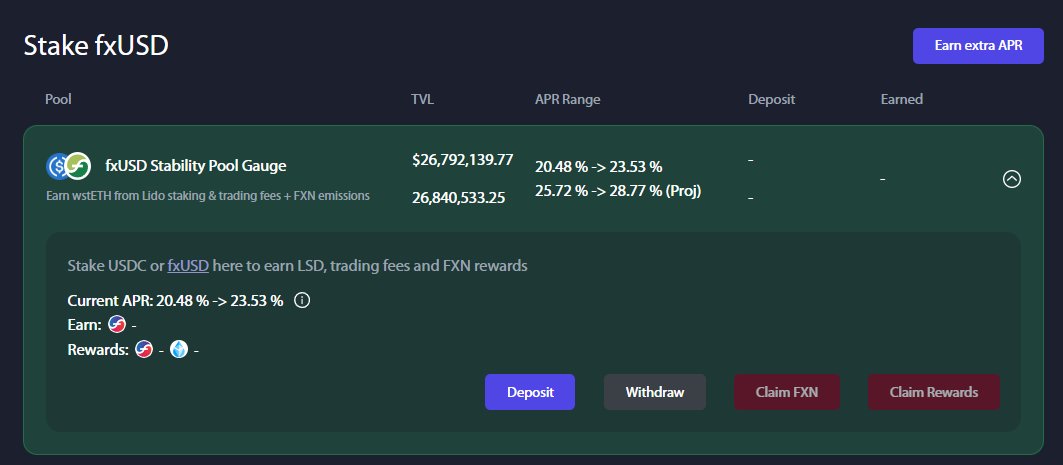
From our sponsor f(x) Earn 28% APR in the Stability Pool: $26M earning rewards, with over 20% paid in $wstETH from trading and staking fees!
𝕏/@protocol_fx •
Revision history
1 recorded changes
Want your article here?
Promote with Leviathan News1 recorded changes
Want your article here?
Promote with Leviathan Newsf(x) Protocol, a DeFi stablecoin and leverage platform built by Aladdin DAO, is promoting an advertised 28% APR on deposits in its Stability Pool, with around $26 million reportedly already deposited and earning rewards, a substantial portion of which is paid in wstETH from trading and staking‑related fees. The promotion emphasizes that rewards are sourced from protocol fees and reserve yield rather than purely from token emissions, and that users can participate via fxUSD/USDC deposits or via the fxSAVE yield-bearing stablecoin vault. According to the f(x) Protocol documentation, the Stability Pool is a core mechanism designed to absorb liquidations and maintain the solvency of the fxUSD system, conceptually similar to Liquity’s Stability Pool model. Users deposit fxUSD or USDC into the pool and, in return, earn wstETH (and WBTC converted to wstETH) funded by fees from leveraged “xPOSITION” products and the protocol’s reserve yield, as well as optional FXN emissions. The associated fxSAVE vault, built by Concentrator (another Aladdin DAO product), tokenizes Stability Pool positions into a yield-bearing stablecoin that auto-compounds earned wstETH/WBTC back into more fxUSD/USDC, making the yield more accessible to users who do not want to manage rewards manually. This matters because it illustrates how newer DeFi stablecoin systems are using liquid staking derivatives (LSDs) like wstETH and liquidation-based designs to offer relatively high on-chain yields while tying them directly to protocol activity and risk. As with similar systems such as Liquity, Stability Pool depositors effectively underwrite liquidation risk in exchange for rewards: they provide capital up front to backstop the system, may see their stablecoin balances change due to liquidations, and are exposed to the price behavior of the collateral they earn (here, primarily wstETH). The scale of deposits (tens of millions of dollars) and the use of fee-based wstETH rewards highlight both the current demand for yield-bearing stable instruments and the importance of understanding protocol-specific risks, including smart contract risk, liquidation dynamics, and exposure to staked ETH markets.
AI-generated background, compiled from web sources — not editorial content.

blog.lido.fi ·

𝕏/@LidoFinance ·

𝕏/@chainlink ·
𝕏/@yieldsandmore ·

𝕏/@LidoFinance ·

𝕏/@GearboxProtocol ·
blog.lido.fi ·
𝕏/@LidoFinance ·
𝕏/@chainlink ·
𝕏/@yieldsandmore ·
𝕏/@LidoFinance ·
𝕏/@GearboxProtocol ·
🚀 Love DeFi? Ready to dive in and start earning $SQUID while making an impact?