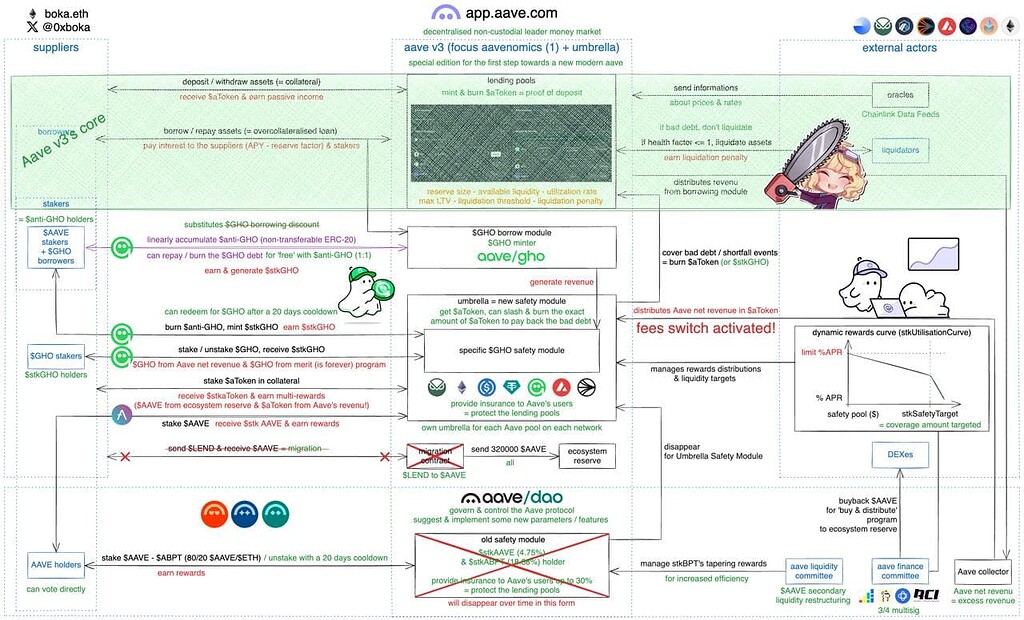
Aave governance contributors have introduced an “[ARFC] Aavenomics implementation: Part one” proposal that begins rolling out a major redesign of the protocol’s tokenomics, following an earlier “Aavenomics” temp-check and design discussion. The package seeks DAO approval to update how Aave’s excess revenue is used, how risk protection is structured, and how incentives are distributed, with a focus on sustainable fee-based rewards rather than inflationary emissions. It is framed as the first implementation step of a broader Aavenomics overhaul and will proceed through normal Aave governance (Snapshot and then on-chain AIP) if the community signals support. Core elements include a new revenue redistribution model and governance-controlled buyback program, a new “Umbrella” safety system, and the introduction of a non‑transferable “Anti‑GHO” token that can be used to offset GHO borrowing costs. Under the design, Aave’s DAO would direct a portion of excess protocol revenue to an Aave Finance Committee to buy back AAVE from the market and distribute it to the ecosystem reserve, while a revamped safety architecture (Umbrella) would use staked aTokens instead of exposing AAVE stakers to slashing, aiming to improve bad‑debt coverage and reduce bank‑run risk. Anti‑GHO would be generated for AAVE and StkBPT stakers and could be burned 1:1 against GHO interest or converted into StkGHO via the existing Merit program, effectively turning protocol revenues into a non-transferable discount and reward asset for committed participants. The proposal also integrates with Aave’s GHO revenue streams and existing Merit incentives, positioning the revamp as both a risk‑management upgrade and a shift toward fee‑driven value distribution at the DAO level.

AI-generated background, compiled from web sources — not editorial content.

More coverage

Explore the topic

More on $GHO

Comments