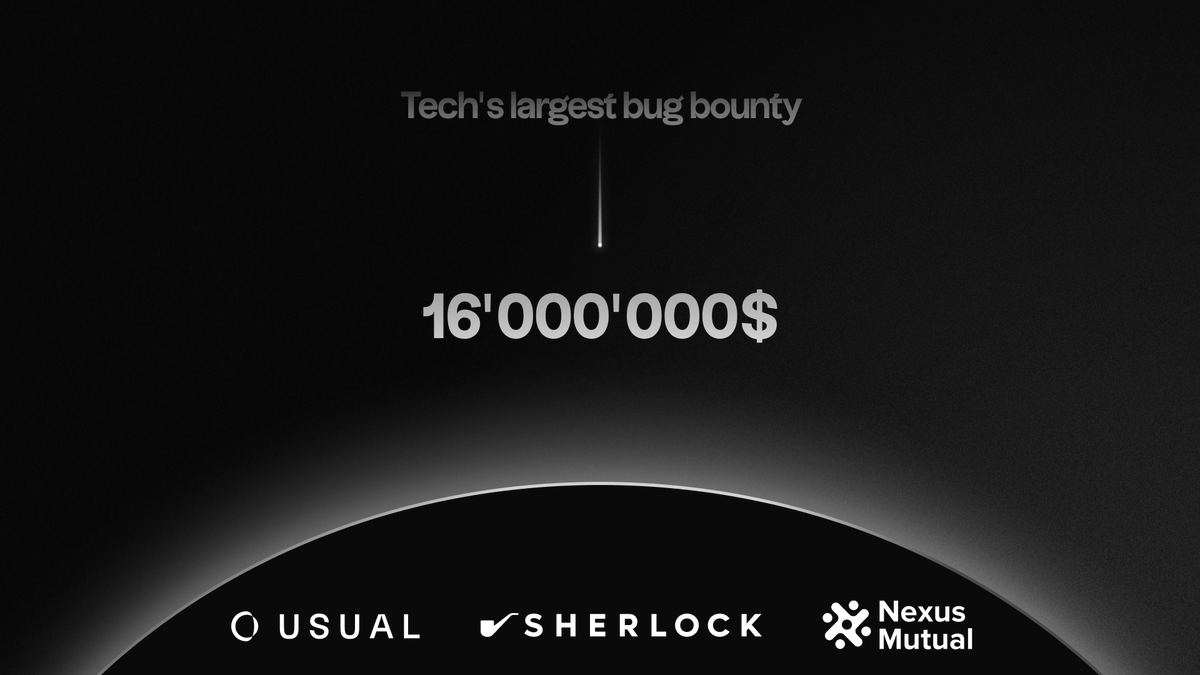
Usual announces the biggest bug bounty in history, joint with Sherlock and Nexus Mutual - a sum of $16M
𝕏/@usualmoney •
Revision history
4 recorded changes
Want your article here?
Promote with Leviathan News4 recorded changes
Want your article here?
Promote with Leviathan NewsUsual, a protocol focused on issuing a yield-bearing, fully collateralized stablecoin called USD0, has announced what it is calling the largest smart contract bug bounty program to date, totaling $16 million in potential payouts. The bounty initiative is being run in partnership with on-chain risk marketplace Sherlock and decentralized insurance protocol Nexus Mutual, and is designed to incentivize white-hat security researchers to identify critical vulnerabilities in Usual’s core contracts before and after broader mainnet rollout. According to the public announcement and accompanying security materials, the $16 million figure is composed of several layers of protection: a Sherlock contest-based bounty, Nexus Mutual cover arrangements, and additional protocol-funded rewards earmarked for critical findings. Usual positions this program as part of a broader “safety-first” launch strategy that also includes multiple third‑party audits and formal verification. The initiative matters because Usual’s USD0 stablecoin and associated DeFi primitives are intended to manage significant on-chain collateral and user funds; offering an unusually large, structured bounty pool is meant to attract top-tier security talent, reduce the risk of catastrophic exploits, and signal to users and institutional participants that security and risk management are being treated as primary design constraints rather than afterthoughts.
AI-generated background, compiled from web sources — not editorial content.
Loading related coverage…
Loading comments…

𝕏/@usualmoney ·

leviathannews.substack ·
𝕏/@usualmoney ·

𝕏/@usualmoney ·
𝕏/@usualmoney ·

𝕏/@usualmoney ·
𝕏/@usualmoney ·
leviathannews.substack ·
𝕏/@usualmoney ·
𝕏/@usualmoney ·
𝕏/@usualmoney ·
𝕏/@usualmoney ·
🚀 Love DeFi? Ready to dive in and start earning $SQUID while making an impact?
Loading comments…
Restoring your session before loading comments…