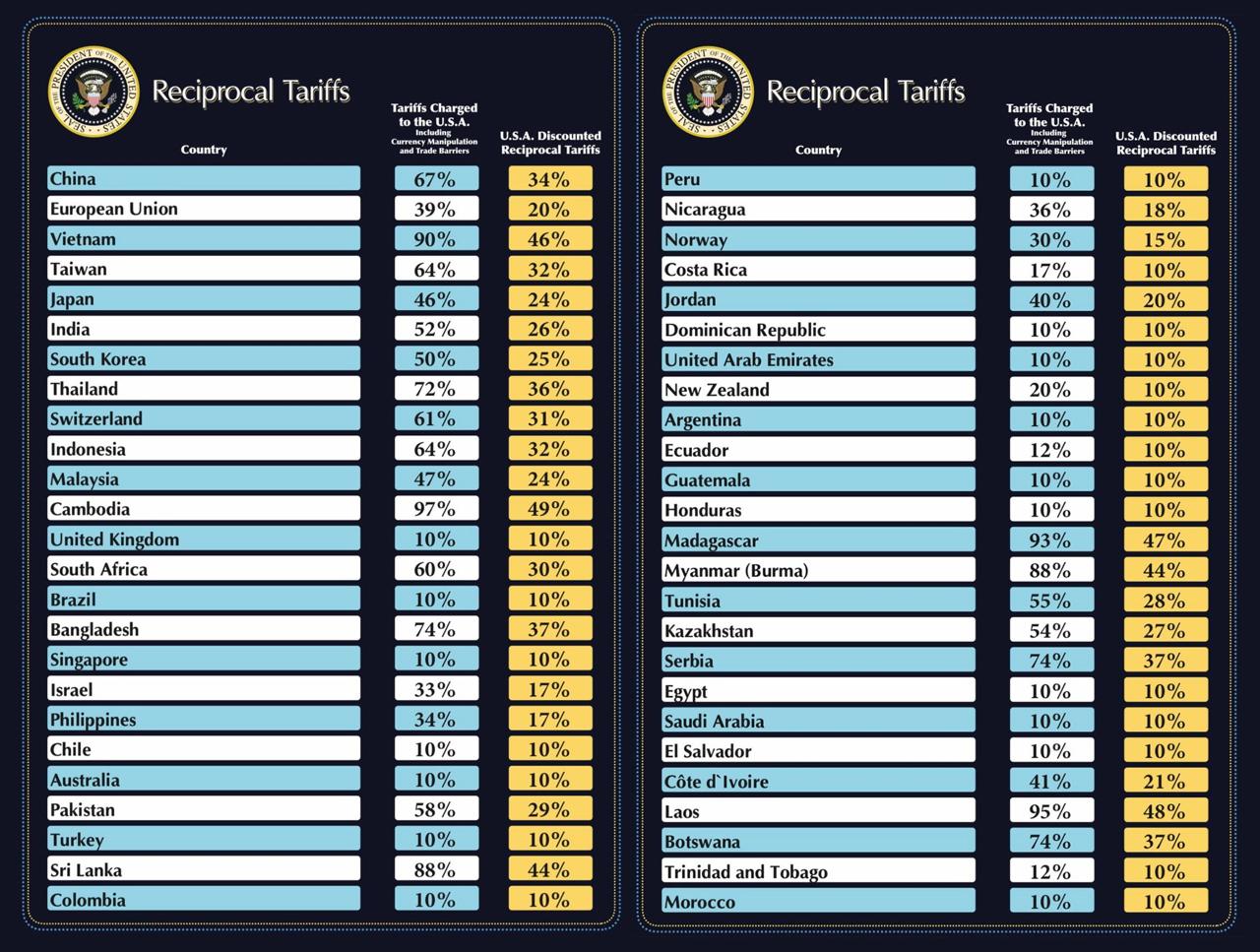
Live now - President Trump announces reciprocal tariffs, a 20% tariff on EU, 34% on China, 25% on all foreign made cars

Replay
Click to load the YouTube player. YouTube will set its own cookies once loaded.

Youtube
Revision history

4 recorded changes

Want your article here?

Promote with Leviathan News


Former President Donald Trump has announced new "reciprocal" tariff levels in a live address, including headline figures of a 20% tariff on imports from the European Union, 34% on imports from China, and 25% on all foreign-made cars. This move fits into the broader tariff architecture of his second administration, which has relied heavily on emergency and trade authorities to ratchet up import duties across a wide range of goods, often on top of existing thematic measures targeting metals, vehicles, and China-specific trade actions. The announcement builds on the reciprocal tariff regime Trump first implemented in April 2025 under the International Emergency Economic Powers Act (IEEPA), which created a universal 10% baseline tariff and higher country-specific rates designed to mirror or offset perceived foreign trade barriers. Under that framework, China’s reciprocal tariff rate had previously been set at 34%—and temporarily raised as high as 125% during an escalation—before being reduced to 10% for a 90‑day period and then scheduled to revert to 34%. For the European Union, legal and advisory analyses of the reciprocal tariff schedule have cited a 20% rate for EU-origin goods in the context of that system, separate from existing sectoral measures and any agreed ceilings under the EU‑US trade deal. The newly highlighted 25% tariff on all foreign-made cars is consistent with Trump’s use of national security tariffs under Section 232 and related authorities to impose 25% duties on passenger vehicles, light trucks, auto parts, steel, and aluminum, measures that have been central to his trade and industrial policy. This package matters because it tightens an already restrictive U.S. trade stance and intensifies pressure on major partners, especially the EU and China. Analysts estimate that Trump’s second-term tariff actions drove the overall average effective U.S. tariff rate as high as 27% in early 2025—its highest in more than a century—before partial rollbacks and court interventions brought it down to around 11.8% by April 2026. Higher across-the-board tariffs on large partners and on autos, in particular, have potential implications for global supply chains, consumer prices, and ongoing negotiations over reciprocal market access. The EU and China have previously responded to U.S. tariff escalations with their own countermeasures and legal challenges, and recent policy updates from both sides indicate they are prepared to adjust or suspend their responses depending on how Washington implements and times its reciprocal tariff schedule.

AI-generated background, compiled from web sources — not editorial content.

More coverage

Explore the topic

More on Trump

Comments