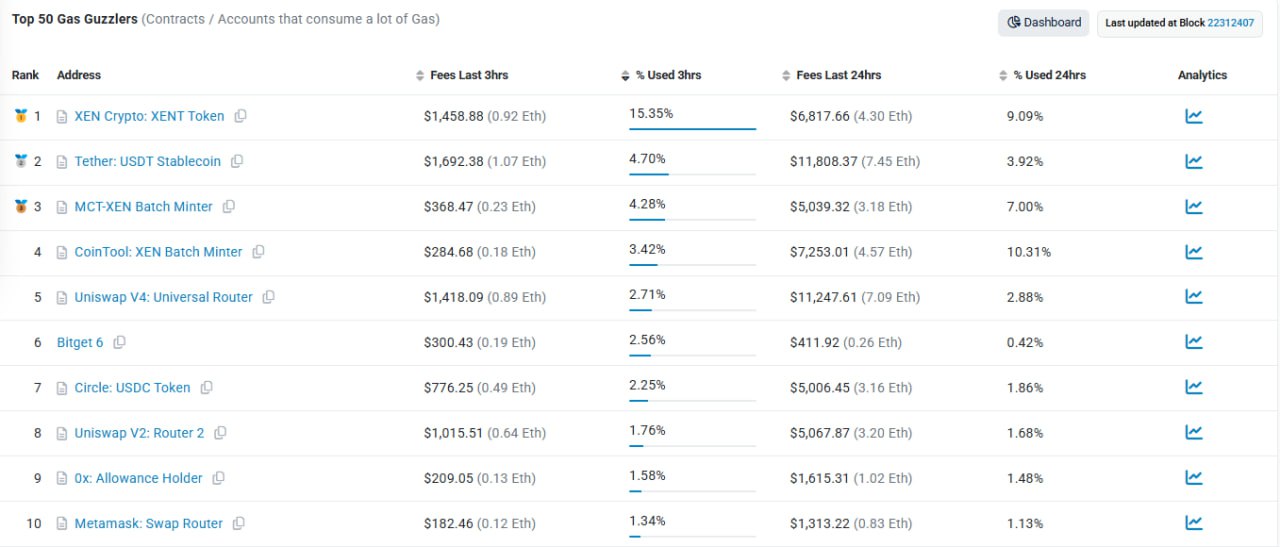
Recent on-chain data from Ethereum gas trackers shows that the largest consumers of Layer 1 (L1) gas are predominantly high-volume dApps and MEV bots, not Layer 2 (L2) rollups. This pattern has reignited an intra-Ethereum debate over whether the ecosystem is over‑indexing on rollup- and blob-based scaling, instead of more aggressively scaling the base layer itself.
Gas usage rankings on Ethereum consistently feature decentralized exchanges, liquid staking and restaking protocols, NFT marketplaces, and other high-throughput dApps near the top, alongside specialized MEV (Maximal Extractable Value) bots that perform arbitrage, liquidations, and sandwich attacks. MEV searchers routinely bid very high gas prices to win priority in block inclusion, and individual bots can consume gas equivalent to multiple full blocks per day, sometimes spending tens of millions of dollars in gas over short periods when memecoin or DeFi activity spikes. This behavior has a material impact on fee levels for ordinary users and can crowd out other transaction types, even as L2 rollups offload some user activity from L1.
The fact that L2s are not, in aggregate, the dominant gas spenders has become an argument for those who favor scaling Ethereum’s base layer throughput (for example, via further execution-layer optimizations) instead of relying primarily on blobs and a growing set of rollups. Critics argue that as long as L1 remains the coordination layer for high-value MEV and core protocol interactions, dApps and MEV searchers will continue to pay for—and consume—a disproportionate share of L1 blockspace, limiting how much end-user cost relief L2s alone can provide. Others counter that rollup-centric scaling plus MEV-aware designs (such as encrypted mempools and new auction mechanisms) are still the most robust path, and that L1 scaling must be balanced against decentralization and verification costs.
"entities":["Ethereum","Etherscan","MEV bots","Maximal Extractable Value (MEV)","Layer 1 (L1)","Layer 2 (L2) rollups","dApps","Uniswap and other DEXs","Flashbots","Ethereum Foundation"]}`
✨ AI-generated background, compiled from web sources — not editorial content.