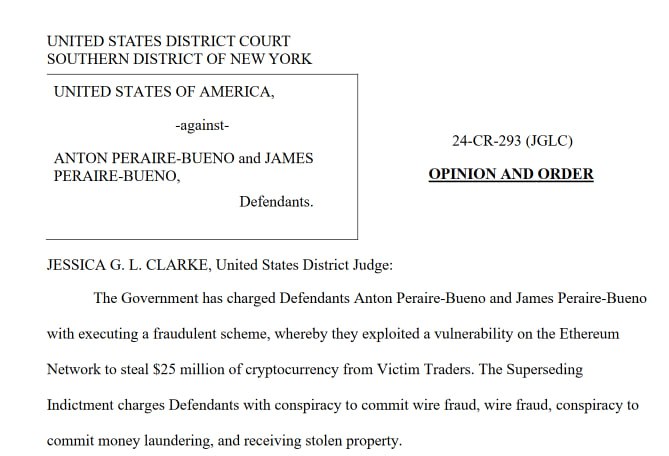
A federal judge in the Southern District of New York has ruled that MIT-educated brothers Anton and James Peraire‑Bueno must stand trial on U.S. Department of Justice charges that they exploited Ethereum’s MEV-Boost infrastructure to siphon about $25 million in crypto in a 12‑second attack on April 3, 2023. Prosecutors allege the pair devised a “first-of-its-kind” scheme targeting the way MEV (maximal extractable value) searchers and relays handle private, high-value transactions, using their expertise in math, computer science, and crypto trading to manipulate block construction and misappropriate funds from other traders. The court rejected defense motions to dismiss wire-fraud and money-laundering counts, allowing the case to proceed toward a full jury trial rather than being thrown out at the pleading stage. According to the indictment, the Peraire‑Bueno brothers allegedly exploited a vulnerability in the MEV-Boost relay process to gain early access to private pending transactions submitted by MEV searchers, then altered the ordering and content of those transactions when proposing an Ethereum block as validators, effectively redirecting roughly $25 million in value to wallets they controlled. U.S. authorities frame the conduct not as aggressive trading but as fraudulent manipulation of Ethereum’s core transaction-validation workflow, charging conspiracy to commit wire fraud, wire fraud, and conspiracy to commit money laundering, each carrying up to 20 years in prison. The case is being closely watched across the crypto and DeFi ecosystem because it tests where U.S. criminal law draws the line between sophisticated MEV strategies and prosecutable fraud, and could set precedent for how legal systems treat infrastructure-level exploits of public blockchains and off-chain coordination tools such as MEV-Boost relays.

AI-generated background, compiled from web sources — not editorial content.

More coverage

Explore the topic

More on Trial

Comments