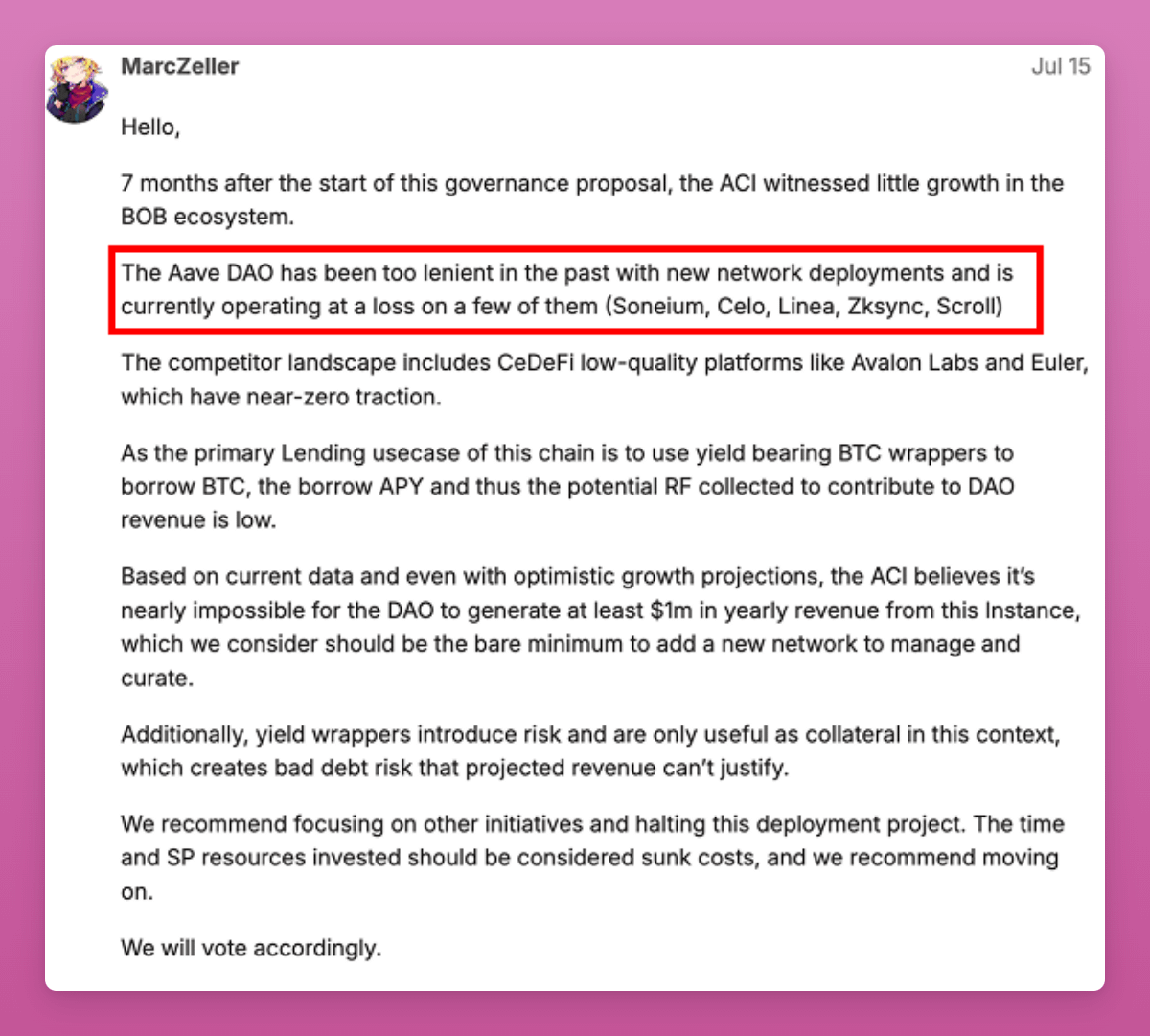
Aave, one of the largest DeFi lending protocols, is currently deployed across about 16 different chains, including a mix of Ethereum L2s and alternative networks. Recent analysis by on-chain researcher Defi Ignas highlights that several of the newer deployments—specifically Soneium, Celo, Linea, zkSync, and Scroll—are operating at a loss, meaning the revenue they generate does not cover the protocol’s operational and risk overhead on those networks. This critique ties Aave’s situation to a broader narrative of “L2 saturation,” where major protocols have aggressively pursued multichain presence, sometimes with limited real usage or fee generation to justify the added complexity and risk surface.
In parallel, Aave governance is actively reassessing its multichain strategy. A recently passed “Focussing the Aave V3 Multichain Strategy” temp-check on Aave’s governance forum proposes tightening criteria for new deployments and winding down some underperforming instances. The proposal calls for exiting zkSync, Metis, and Soneium, increasing the reserve factor on other low-revenue markets such as Polygon, Gnosis, BNB Chain, Optimism, Scroll, Sonic, and Celo, and setting a $2 million annual revenue floor for any future chain deployment. Although a potential deployment on BOB BTC L2 has reportedly cleared an initial “temp check” style vote, the combination of loss-making expansions and stricter new revenue requirements is raising doubts within the community about whether this and similar new deployments will ultimately proceed.
This discussion matters because Aave is a systemic DeFi protocol, currently accounting for roughly half of the DeFi lending market by TVL, so its risk and deployment choices can affect the broader market. Running many low-usage instances increases operational burden, governance complexity, and potential attack surface without commensurate revenue or network effects. The emerging strategy suggests a shift from “deploy everywhere” to a more selective, revenue- and usage-driven approach, which could influence how other major DeFi protocols evaluate future L2 and sidechain integrations.
✨ AI-generated background, compiled from web sources — not editorial content.