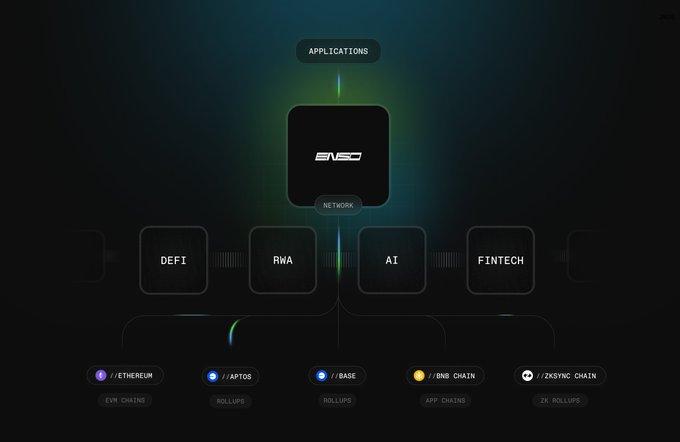
Enso Network, a Polychain- and Multicoin-backed interoperability and “intent” layer for DeFi, has activated its mainnet and launched its ENSO token, positioning itself as “blockchain shortcuts” and “the fastest way to build and launch onchain.” The mainnet is designed as a coordination layer that lets developers read, write, and interact with smart contracts across multiple blockchains from a single integration, abstracting away protocol-specific complexity and manual cross-chain integrations. Alongside mainnet, ENSO has been deployed as the native utility and governance token of the network, used for fees, incentives, and coordination, with initial availability on Ethereum and BNB Chain according to exchange listings and launch announcements.
Enso’s value proposition is to act as an interoperability layer or “intent engine” that unifies fragmented blockchain ecosystems—including rollups, appchains, and L1s—into a shared execution environment where developers specify desired outcomes (intents) rather than coding bespoke integrations for every chain and protocol. By mapping onchain interactions into a common engine and exposing them through “shortcuts” and higher-level abstractions, Enso aims to simplify multi-chain application development, enable chain abstraction, and improve UX for DeFi and other onchain products. The project reports having already processed over $17 billion in onchain volume and integrated with more than 100 projects ahead of this broader mainnet and token rollout, signaling early traction as infrastructure for cross-chain DeFi coordination.
The mainnet and token launch matter because they operationalize Enso’s model as a live L1 coordination layer at a time when DeFi and broader crypto are increasingly fragmented across many chains and rollups. For developers, Enso’s production deployment provides a production-grade way to ship multi-chain applications faster, potentially lowering integration costs and accelerating time-to-market for products such as neobanks, stablecoin platforms, and AI-enhanced DeFi apps. For the ecosystem, the ENSO token formalizes economic incentives around routing, execution, and governance of this interoperability layer, while giving exchanges and other infrastructure providers a standardized asset to integrate as cross-chain activity continues to grow.
✨ AI-generated background, compiled from web sources — not editorial content.