Titan walks away with ~$33m from one Ethereum block — the botched $50m USDT swap just set a builder profit record
𝕏/@bh359 •
Revision history
13 recorded changes
Want your article here?
Promote with Leviathan News13 recorded changes
Want your article here?
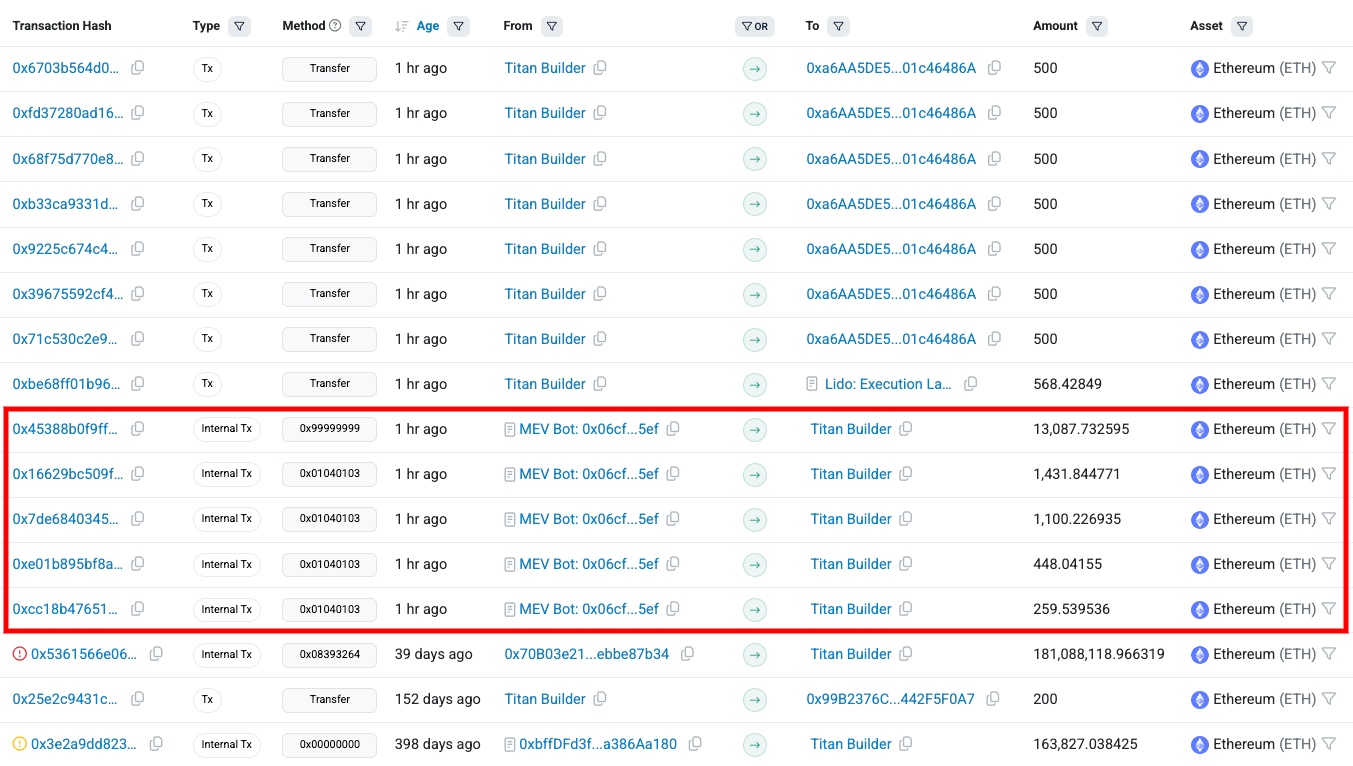
Promote with Leviathan NewsEthereum block builder Titan Builder captured roughly $33–34 million in profit from a single Ethereum block after a badly configured ~$50 million aEthUSDT → aEthAAVE swap was routed through CoW Protocol and became the target of an extreme MEV sandwich attack. The user’s transaction, executed with effectively unbounded slippage, was front‑run and back‑run so aggressively that they ended up receiving only about $35,000 in assets, losing more than 99% of the position’s value while Titan’s block earned what on‑chain analysts describe as a record builder profit for a single Ethereum block. Titan is a major “neutral” Ethereum block builder that aggregates MEV bundles for validators and searchers; thanks to its scale and exclusive order flow relationships, it frequently wins MEV-Boost auctions and captures a large share of MEV on Ethereum. In this incident, Titan’s block included the MEV bundles that executed the sandwich around the oversized swap, and Titan’s builder address then transferred about $34 million in ETH to Coinbase shortly after, which on-chain observers interpret as realizing the profit from that single block. This aligns with academic and industry research showing Titan as one of the most profitable builders on Ethereum, with outsized USD-denominated gains despite building fewer blocks than some competitors. The episode has become a focal point in ongoing debates over MEV, user protection, and DeFi UX. Analysts and developers highlighted that the core smart contracts and routing logic “worked as designed,” yet the front-end and execution parameters allowed a catastrophic outcome for the trader, illustrating how large trades with poor slippage settings can be almost entirely captured by MEV actors. Commentators also questioned whether such a transaction could reflect deliberate capital movement or money laundering rather than an innocent user mistake, although no consensus has formed on intent. More broadly, the block underscores how concentrated block building (with players like Titan and Beaver) and powerful MEV strategies can turn isolated user errors into eight‑figure windfalls, intensifying calls for better protection mechanisms, safer default settings, and potential protocol‑level mitigations for sandwich attacks.
AI-generated background, compiled from web sources — not editorial content.
Loading related coverage…
Loading comments…
𝕏/@Uniswap ·

𝕏/@aave ·

𝕏/@chain_security ·

etherscan.io ·
𝕏/@blockaid_ ·
Coindesk ·
𝕏/@Uniswap ·
𝕏/@aave ·
𝕏/@chain_security ·
etherscan.io ·
𝕏/@blockaid_ ·
Coindesk ·
🚀 Love DeFi? Ready to dive in and start earning $SQUID while making an impact?
Danicjade
Wow, one man's poison is another man's food
Danicjade
Wow, one man's poison is another man's food
@leviathan_news 33m for one block is wild builder season really paying the gas bills
one fat finger swap and the mev sharks eat good again