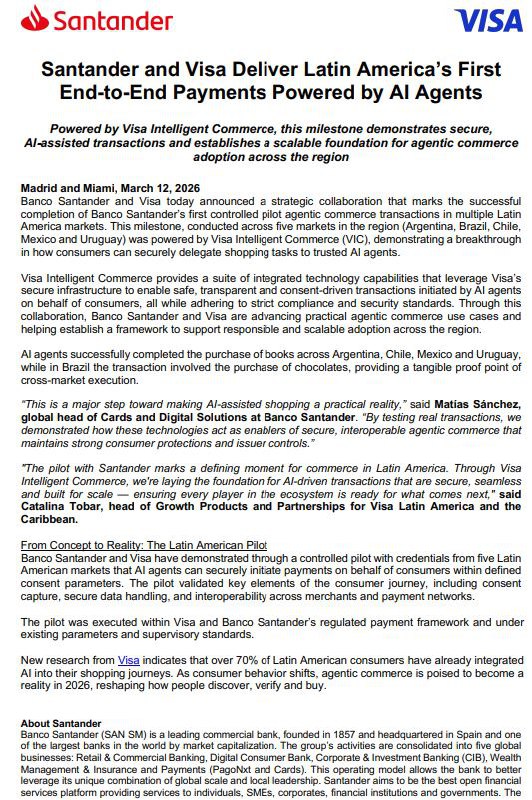
Santander and Visa deliver Latin America’s first end-to-end payments powered by AI agents.
Santander •
Revision history
7 recorded changes
Want your article here?
Promote with Leviathan News7 recorded changes
Want your article here?
Promote with Leviathan NewsBanco Santander and Visa have run a controlled pilot of “agentic” AI-powered payments across five Latin American markets, completing what they describe as the region’s first end-to-end payments executed by AI agents within a regulated card framework. Using Visa’s Intelligent Commerce (VIC) platform, AI agents initiated and completed real purchases on behalf of consumers using Santander-issued credentials in Argentina, Brazil, Chile, Mexico and Uruguay, buying books in four markets and chocolates in Brazil as live test transactions. The agents operated under clearly defined consent parameters, with Visa’s infrastructure handling tokenized payment data so that the AI never directly accessed card details. The pilot focused on validating the full consumer journey for agentic commerce: capturing and recording user consent, enforcing spending and scope limits, ensuring secure data handling, and demonstrating interoperability across different merchants, networks and regulatory regimes in the five countries. Transactions were processed using existing Santander and Visa rails and supervised under current regulatory and compliance standards, positioning AI agents as governed participants inside today’s payment system rather than as an unregulated overlay. For Visa and Santander, this is part of a broader push to move AI agents from experimental demos to practical, production-ready payment flows; just two weeks earlier Santander ran a similar “first” in Europe with Mastercard’s Agent Pay, making it the only bank so far to complete live agentic pilots with both major card networks. The initiative matters because it offers an early, real-world blueprint for how AI agents could handle routine shopping and payments—from product discovery through checkout—without breaking existing security, compliance, and consumer protection rules. For merchants and fintechs, it underscores the need to prepare for AI-native commerce by structuring product data for machine discovery and adapting checkout systems to accept agent-initiated transactions rather than traditional user-driven flows. For regulators and payment networks, the pilot provides operational evidence that agentic commerce can be integrated into current frameworks using consent-based controls, tokenization, and existing dispute and risk mechanisms, potentially accelerating broader adoption of AI-driven payments in Latin America and beyond.
AI-generated background, compiled from web sources — not editorial content.
Loading related coverage…

𝕏/@arjunsethi ·

𝕏/@gregisenberg ·
𝕏/@crossmint_ai ·

𝕏/@OpenWorldsAI ·

𝕏/@circle ·

𝕏/@yield_xyz ·
𝕏/@arjunsethi ·
𝕏/@gregisenberg ·
𝕏/@crossmint_ai ·
𝕏/@OpenWorldsAI ·
𝕏/@circle ·
𝕏/@yield_xyz ·
🚀 Love DeFi? Ready to dive in and start earning $SQUID while making an impact?