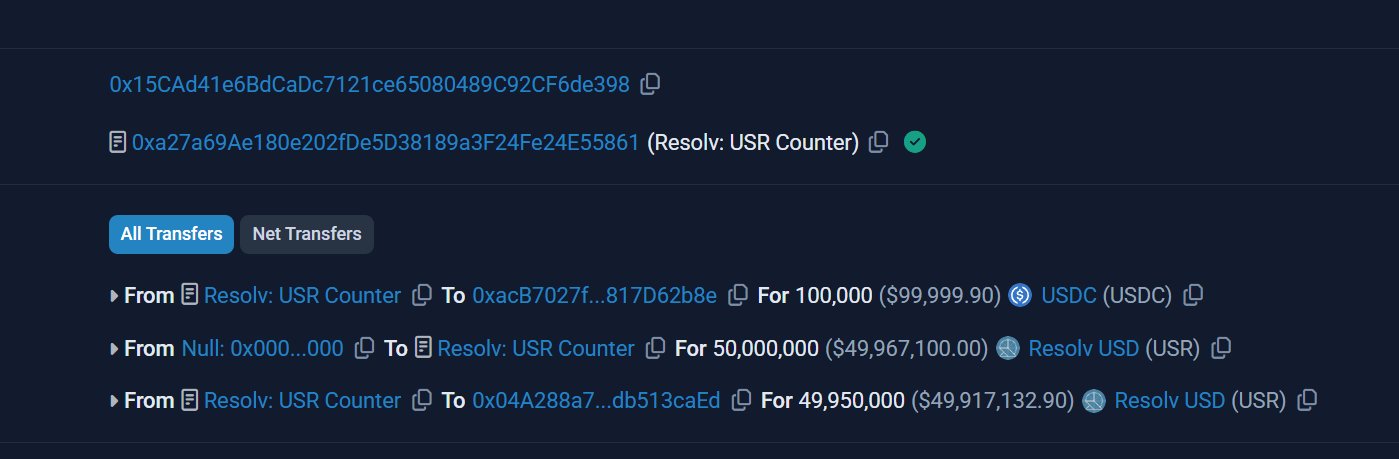
Resolv has been exploited, exploiter minted 50M $USR with 100K $USDC
𝕏/@3yield •
Revision history
2 recorded changes
Want your article here?
Promote with Leviathan News2 recorded changes
Want your article here?
Promote with Leviathan NewsResolv Labs’ USR stablecoin suffered a critical exploit in which an attacker was able to mint tens of millions of unbacked USR tokens against only around $100,000 in USDC, then dump them across DeFi to extract roughly $23–25 million in value. The incident caused USR to sharply depeg from its intended $1 value and forced Resolv to pause protocol operations while investigations and recovery plans began. According to on‑chain data and post‑mortems, the exploit targeted Resolv’s two‑step minting / swap flow for USR, which relied on an off‑chain signer with privileged authority to approve mint amounts. By abusing this design—via a compromised key or backend with special mint permissions—the attacker deposited only about $100K–$300K in USDC but was able to mint roughly 80 million USR, with about 50 million USR created in a single transaction and ~30 million more shortly after. The attacker rapidly converted the freshly minted USR into other assets, routing through protocols such as Curve and various lending and liquidity pools, and ultimately exited mostly in ETH. This sudden oversupply of unbacked USR collapsed the stablecoin’s price—at one point to just a few cents in its main Curve pool—before it partially recovered to trade far below its peg. Resolv publicly confirmed the exploit on X, stating that an attacker had minted 50 million unbacked USR, that protocol functions were paused, and that the collateral pool backing the broader strategy remained intact, with losses concentrated in USR’s issuance and market price rather than in underlying reserves. Security firms and auditors subsequently framed the event as a textbook example of a structural DeFi risk: placing too much trust in off‑chain infrastructure and privileged keys, without robust on‑chain limits on minting and validation between deposit amounts and token issuance. The case is now cited alongside prior incidents at other lending and stablecoin protocols as evidence that unchecked mint authority and weak key management remain systemic vulnerabilities in DeFi.
AI-generated background, compiled from web sources — not editorial content.
𝕏/@ethena ·

𝕏/@BasedOneX ·
𝕏/@KaitoStudio_ ·

Circle ·

𝕏/@injective ·

𝕏/@circle ·
𝕏/@ethena ·
𝕏/@BasedOneX ·
𝕏/@KaitoStudio_ ·
Circle ·
𝕏/@injective ·
𝕏/@circle ·
🚀 Love DeFi? Ready to dive in and start earning $SQUID while making an impact?