Federal Reserve cuts rates to three-year low after fractious meeting. Three top US central bankers object to move in biggest revolt since 2019. The benchmark rate was cut by a quarter point to between 3.5 to 3.75 per cent as widely anticipated by Wall Street. It marked the third reduction in borrowing costs in a row.
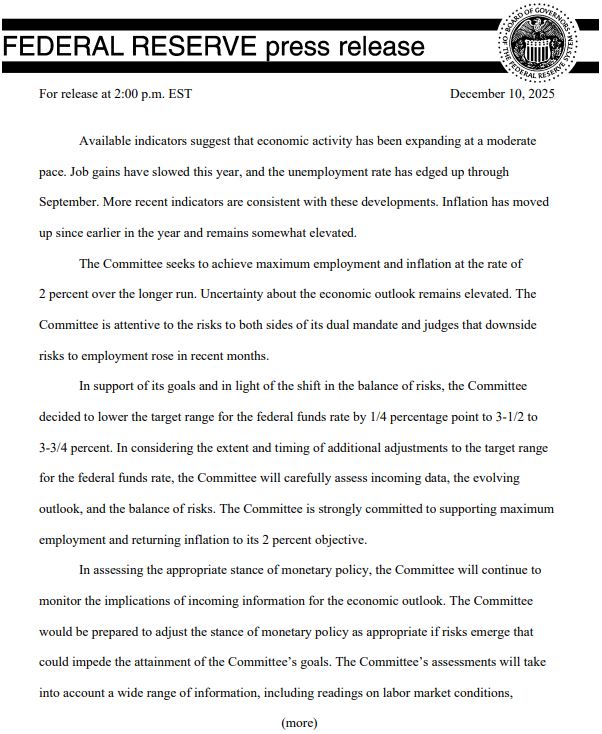
Federal Reserve cuts rates to three-year low after fractious meeting. Three top US central bankers object to move in biggest revolt since 2019.  The benchmark rate was cut by a quarter point to between 3.5 to 3.75 per cent as widely anticipated by Wall Street. It marked the third reduction in borrowing costs in a row.
Federal Reserve
Revision history

18 recorded changes

Want your article here?

Promote with Leviathan News
The Federal Reserve’s 10 December 2025 meeting ended with a quarter‑point cut to the federal funds rate, taking the target range down to 3.50%–3.75%, its lowest level in about three years. This was the third consecutive 25 bp reduction (after cuts in September and October) and was widely expected by markets as the central bank continued an “insurance” easing cycle in response to a softer labor market and persistent economic uncertainty. The decision, however, produced a rare three-way split on the Federal Open Market Committee (FOMC), with one governor arguing for a larger 50 bp cut and two regional Fed presidents preferring to hold rates steady. In its statement, the FOMC noted that overall economic activity was expanding at a “moderate” pace but highlighted that job gains had slowed and the unemployment rate had edged up through September, while inflation had risen from earlier in the year and remained “somewhat elevated.” Policymakers said that downside risks to employment had increased, and that this shift in the risk balance justified another rate cut despite inflation still running above the 2% target. The committee signaled a more cautious outlook for further easing, stressing that the “extent and timing” of additional adjustments would depend on incoming data and the evolving balance of risks, which many analysts interpreted as a sign that the Fed was nearing the end of this cutting cycle. The vote underscored growing internal disagreement over how aggressively to respond to mixed signals from the economy. Chair Jerome Powell and a majority backed the 25 bp cut, while Stephen Miran favored a 50 bp move and Austan Goolsbee and Jeffrey Schmid dissented in favor of no change, producing the largest revolt on a rate decision since 2019. For markets and the broader economy, the move extends a 75 bp total easing in 2025, lowering borrowing costs for households and businesses and reinforcing expectations that policy will remain supportive into 2026, even as the Fed tries to retain flexibility in case inflation or growth deviate from its baseline projections.

AI-generated background, compiled from web sources — not editorial content.

More coverage

Explore the topic

More on Rates

Comments