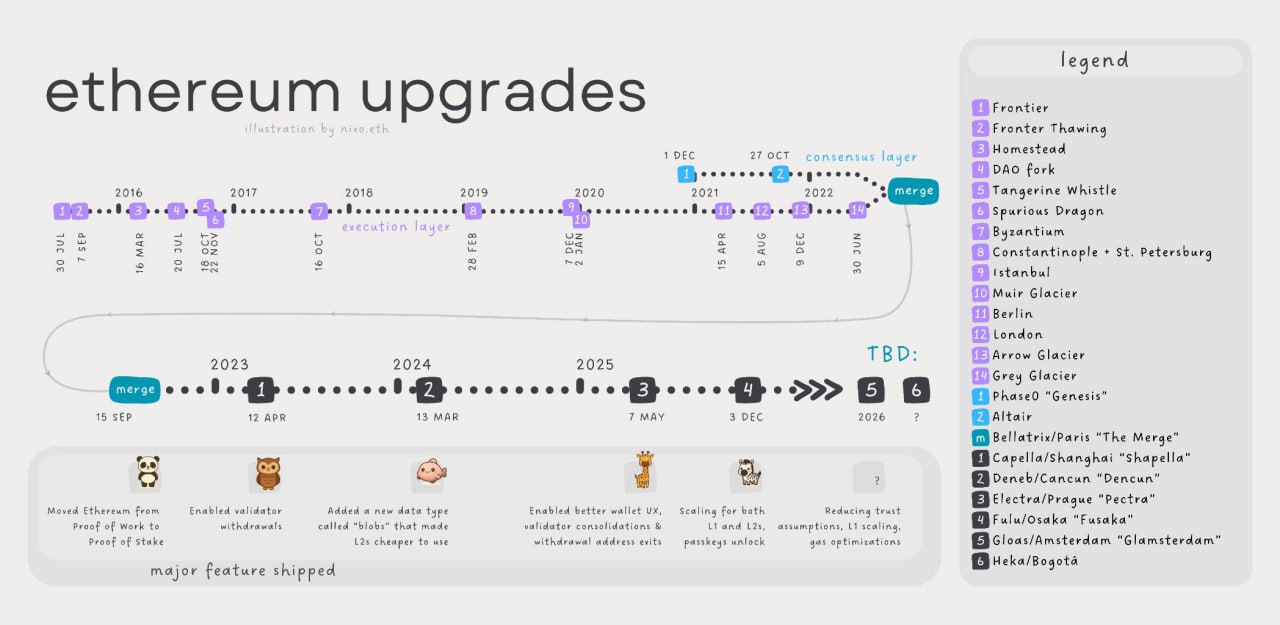
Ethereum’s planned Glamsterdam upgrade is a two-part hard fork spanning both of Ethereum’s core layers, aimed at improving MEV fairness, censorship resistance, and base-layer efficiency, with activation targeted for 2026 though no mainnet date is finalized yet. The upgrade bundles a large set of Ethereum Improvement Proposals under the “Gloas” (consensus layer) and “Amsterdam” (execution layer) forks, with two “headliner” changes: enshrined Proposer-Builder Separation (ePBS, EIP‑7732) and Block‑Level Access Lists (BAL, EIP‑7928).
At the consensus layer, ePBS moves today’s mostly off-chain MEV supply chain (notably MEV‑Boost relays and specialized builders) into the Ethereum protocol itself, formally defining block builders and separating block construction from block proposal. By making builders permissionless and reducing reliance on centralized relays, ePBS is intended to improve the fairness of MEV distribution, reduce centralization pressure on validators, and strengthen censorship resistance during periods of high network demand. Glamsterdam also includes additional consensus-layer changes (such as EIP‑8061 and EIP‑8080) that adjust validator exit and consolidation churn limits, which are particularly relevant for large stakers who need more predictable and scalable exit liquidity.
On the execution layer, Block‑Level Access Lists (EIP‑7928) allow each block to pre‑declare which parts of Ethereum’s state it will touch, enabling more efficient execution and opening the door to parallel transaction processing and higher theoretical throughput on L1. Alongside BAL, a broader package of execution‑layer EIPs targets lower intrinsic gas costs, more predictable gas accounting, and general performance improvements. Together, these changes are framed on the roadmap as a major post‑Merge milestone that intersects “The Surge” and “The Scourge,” aiming to make Ethereum’s base layer both more scalable and more robust against MEV‑driven centralization, while everyday users primarily experience more predictable transaction inclusion and fairer ordering during congestion.
✨ AI-generated background, compiled from web sources — not editorial content.