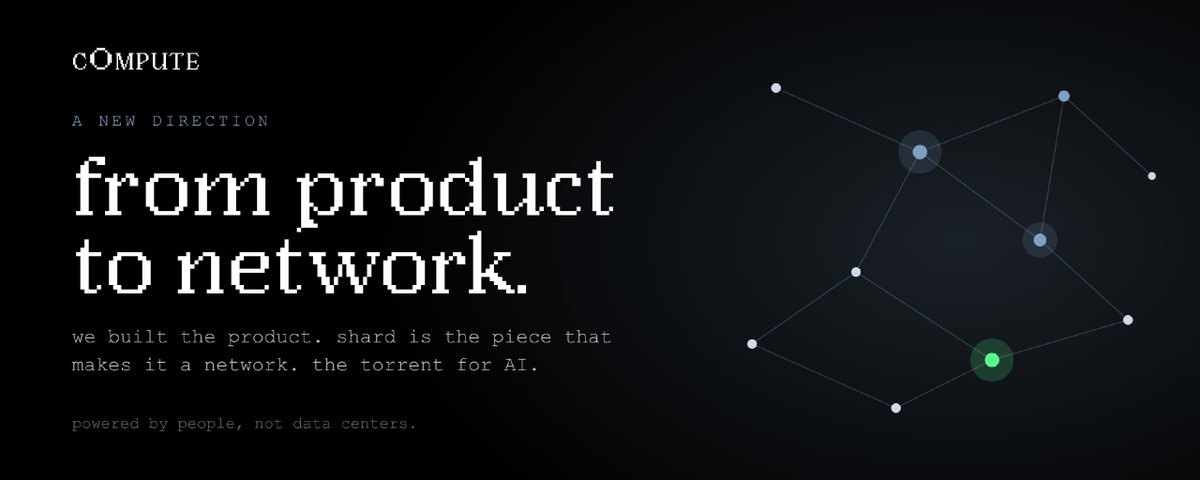
c0mpute, a project focused on decentralized AI compute, has announced Shard, a distributed inference system it claims can run 744-billion-parameter models across a network of GPUs at practical inference speeds. According to the team’s public materials, Shard is designed as a peer-to-peer “shared inference fabric” that treats many independent machines as a single large GPU cluster, coordinating workloads so that very large models can be executed without relying on a centralized cloud provider. The system uses a combination of browser-based “scout” nodes leveraging WebGPU and more powerful verifier nodes, stitched together via a libp2p-based networking layer, with a Rust daemon, Python API, and web UI forming the full stack. This matters because one of the main bottlenecks for decentralized AI has been latency and throughput: distributing inference for large models across many heterogeneous nodes typically introduces so much network overhead, synchronization cost, and unreliability that performance becomes impractical for real-world applications. By claiming usable inference speeds on models in the hundreds of billions of parameters over a distributed GPU network, Shard directly targets this scalability and speed problem, positioning itself in the broader movement to turn idle or fragmented compute (including consumer GPUs and edge devices) into a viable alternative to centralized AI infrastructure. If the performance claims hold up outside controlled demos, Shard would represent a significant technical step for decentralized AI inference networks and could broaden access to state-of-the-art models without requiring access to hyperscale cloud resources.

AI-generated background, compiled from web sources — not editorial content.

More coverage

Explore the topic

More on AI

Comments