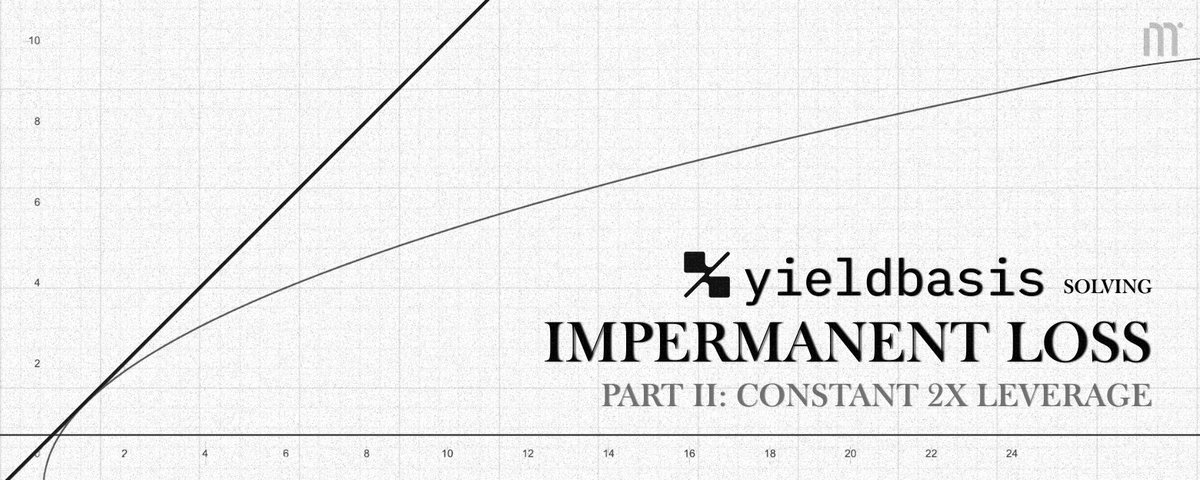
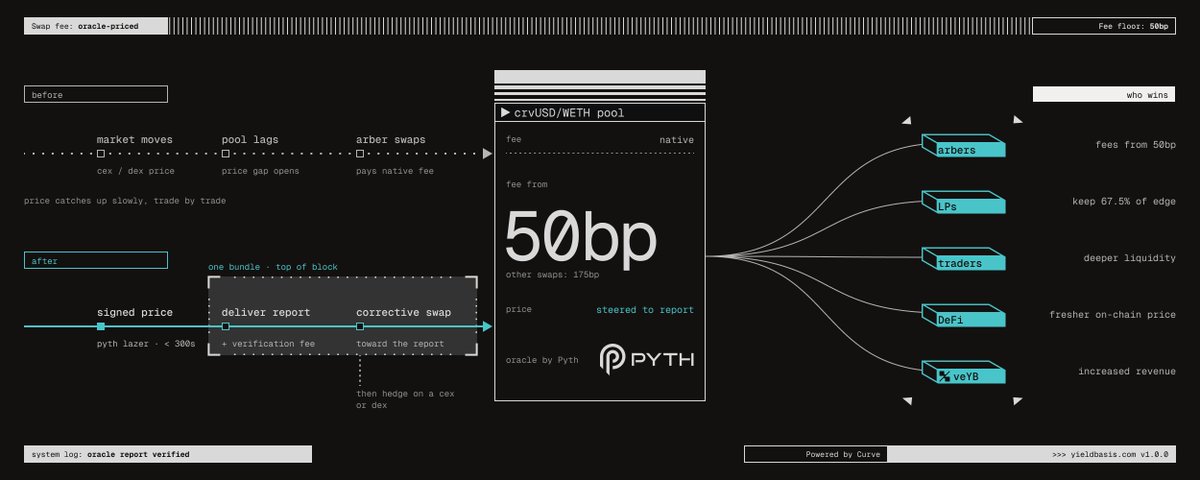
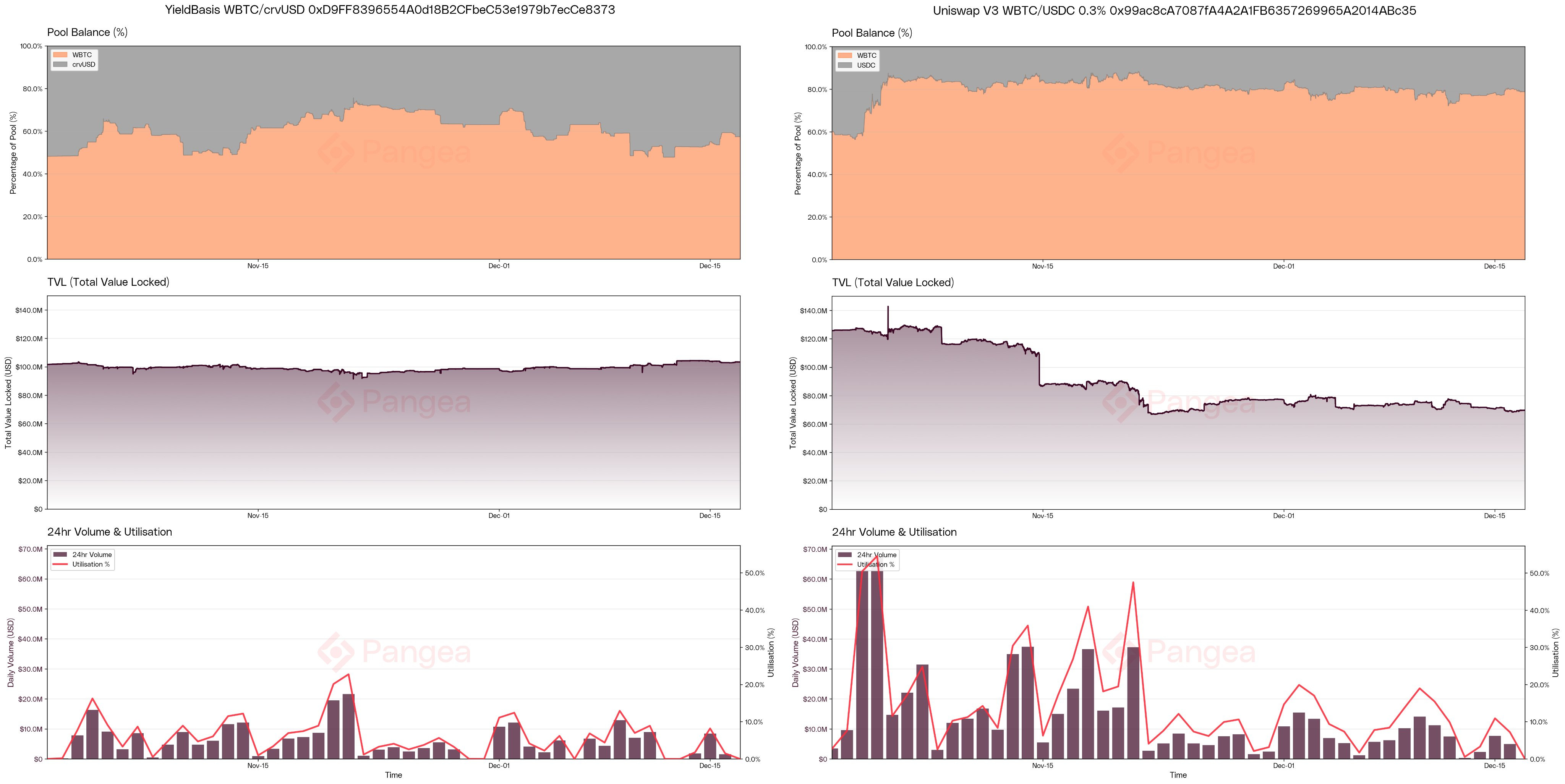
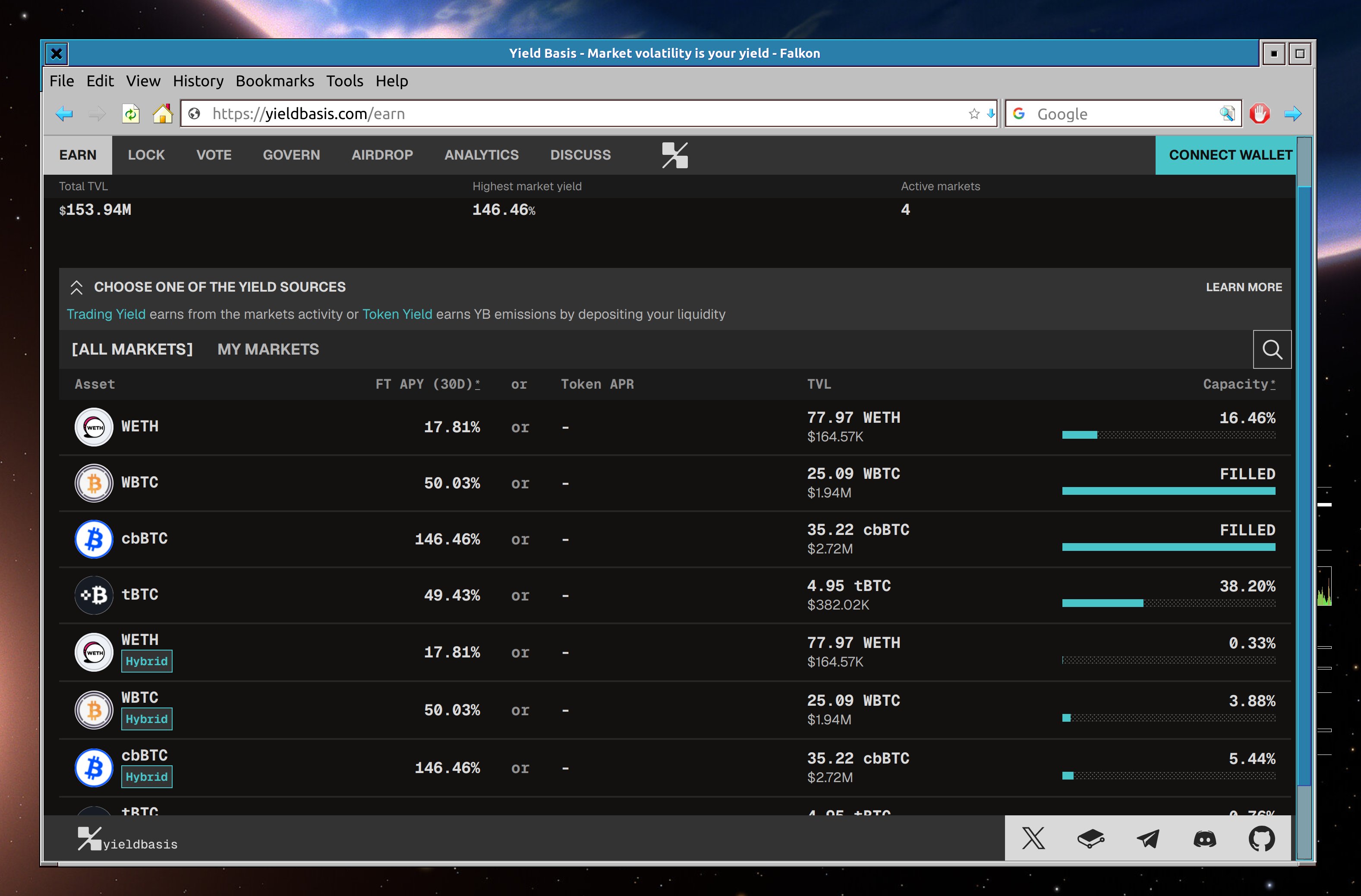
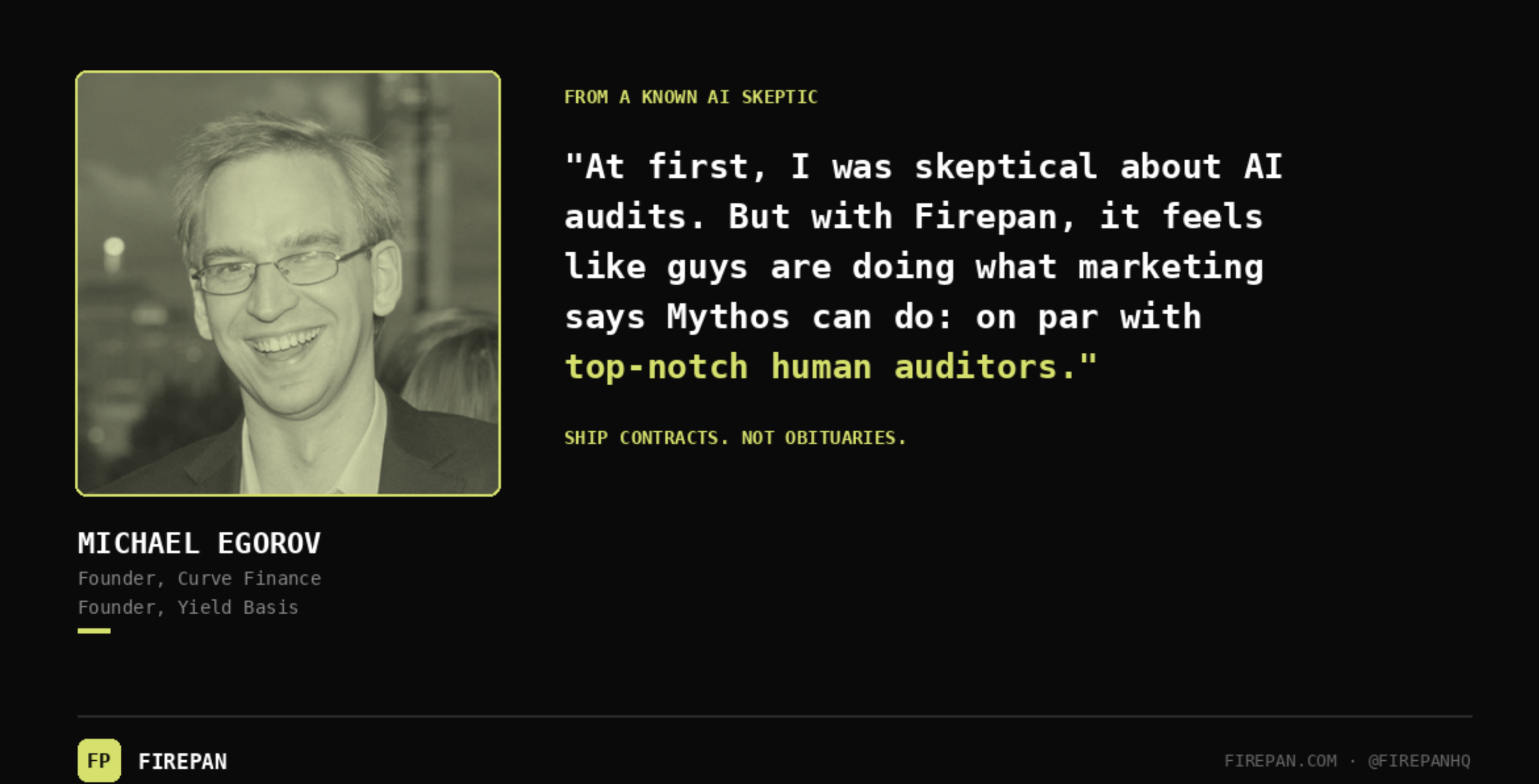
Mirador’s post explains how YieldBasis, a protocol built on Curve, structures a special leveraged AMM so that LPs get effectively linear price exposure to BTC while avoiding traditional AMM impermanent loss, by locking positions into a constantly‑maintained 2× leverage. YieldBasis was designed by Curve Finance founder Michael Egorov to turn a standard BTC–stablecoin constant‑product AMM (e.g., BTC/crvUSD on Curve) into what is effectively a single‑asset, BTC‑only carry trade rather than a two‑asset LP position. When a user deposits BTC, the protocol flash‑borrows an equal USD value of crvUSD, adds both BTC and crvUSD to a Curve pool to mint LP tokens, and then uses those LP tokens as collateral to borrow crvUSD and repay the flash loan, ending with roughly 50% equity / 50% debt → 2× leverage on the BTC side. The LP tokens sit inside a dedicated “LEV‑AMM” that is mathematically engineered so each market maintains a constant 2× compounding leverage ratio, where the AMM invariant is tied to an external oracle price and continuously rebalanced to keep leverage fixed. As Mirador highlights, that constant‑leverage design changes the shape of LP exposure: instead of the usual square‑root price curve of a constant‑product AMM, YieldBasis keeps the position so that it tracks BTC’s price approximately 1:1, making P&L linear in BTC’s price movement while still collecting Curve trading fees. The protocol achieves this by using a rebalancing AMM plus a “virtual pool” that exposes small price discrepancies and incentivizes arbitrageurs to buy or sell against YieldBasis whenever leverage drifts from 2×; these arbitrage trades mint or burn LP and adjust debt so that net BTC exposure remains fully directional. In effect, YieldBasis attempts to make impermanent loss “zero” in the sense that LPs no longer suffer the usual underperformance versus simply holding BTC; instead, they bear leveraged BTC price risk plus funding and rebalance costs, turning AMM LPing into a more traditional basis‑style carry trade.

AI-generated background, compiled from web sources — not editorial content.

More coverage

Explore the topic

Loading related coverage…

Comments

Loading comments…