DeFi lending protocols like Aave, Compound, and Maker currently operate as some of the least efficient “banks” in the US by net interest margin—far behind even average credit unions—highlighting how primitive their lending economics and product design still are despite huge room for improvement.
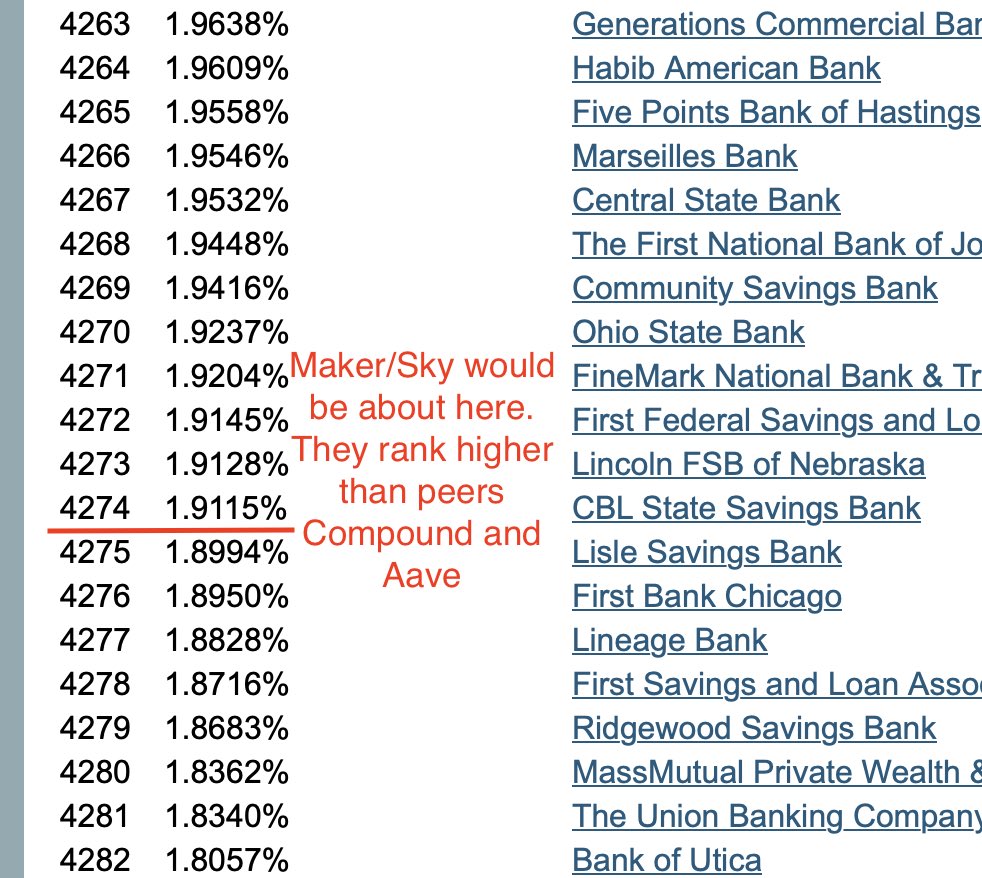
DeFi lending protocols like Aave, Compound, and Maker currently operate as some of the least efficient “banks” in the US by net interest margin—far behind even average credit unions—highlighting how primitive their lending economics and product design still are despite huge room for improvement.
𝕏/@ImperiumPaper
Revision history

2 recorded changes

Want your article here?

Promote with Leviathan News


An analysis circulated by on-chain researcher ImperiumPaper argues that major DeFi lending protocols such as Aave, Compound, and MakerDAO currently operate with very low net interest margins (NIMs) compared with US banks and even credit unions, implying they are among the “least efficient banks” in the US when viewed through a traditional banking metric. The claim is grounded in recent empirical work that adapts the banking concept of NIM—net interest income divided by average earning assets—to DeFi protocols, and finds that Aave V3’s effective margin is extremely thin once protocol incentives, token emissions, and risk profile are accounted for. In traditional finance, NIM is a core profitability metric for banks, measuring the spread between what they pay depositors and what they earn on loans relative to their interest‑earning assets. Applying the same notion to DeFi, protocols like Aave and Compound take in deposits into liquidity pools and issue overcollateralized loans, with interest rates set algorithmically based on pool utilization. Recent research from the Bank of Canada and academic groups shows that, despite large total value locked (with Aave V3 alone holding tens of billions of dollars in deposits in 2026), the net spread retained by the protocol is small, especially after accounting for liquidity mining rewards and the high volatility and liquidation risk borrowers assume. This stands in contrast to US banks and credit unions, which typically sustain materially higher NIMs even under competitive pressure. The thread’s broader point is that DeFi lending market design is still economically primitive relative to its ambitions: variable‑rate, overcollateralized structures dominate; most borrowing is for speculative leverage rather than real‑economy credit; and risk‑adjusted returns to liquidity providers may be low once defaults, liquidations, and opportunity cost are priced in. Ongoing research and new designs—such as fixed‑income automated market makers and more sophisticated rate models—are presented in the literature as attempts to improve capital efficiency, stabilize returns, and narrow the gap between DeFi protocols’ lending economics and those of mature banking institutions.

AI-generated background, compiled from web sources — not editorial content.

More coverage

Explore the topic

More on Aave

Comments