New Deep Dive: How 3Jane Lending Actually Works

Yesterday, we dropped a summary of our interview with 3Jane’s founder Yakovsky. Today, we’re following up with a detailed breakdown of the protocol itself.

🔹 How 3Jane structures undercollateralized credit lines
🔹 On-chain + off-chain credit scoring (Plaid, VantageScore, zkProofs)
🔹 How it compares to Wildcat, Teller, and Maple
🔹 Risks, enforcement mechanisms, and what could go wrong

If you’re trying to understand how 3Jane actually functions under the hood, this is the article you need to read.
New Deep Dive: How 3Jane Lending Actually Works

Yesterday, we dropped a summary of our interview with 3Jane’s founder Yakovsky. Today, we’re following up with a detailed breakdown of the protocol itself.

🔹 How 3Jane structures undercollateralized credit lines
🔹 On-chain + off-chain credit scoring (Plaid, VantageScore, zkProofs)
🔹 How it compares to Wildcat, Teller, and Maple
🔹 Risks, enforcement mechanisms, and what could go wrong

If you’re trying to understand how 3Jane actually functions under the hood, this is the article you need to read.
leviathannews.substack
Revision history

4 recorded changes

Want your article here?

Promote with Leviathan News


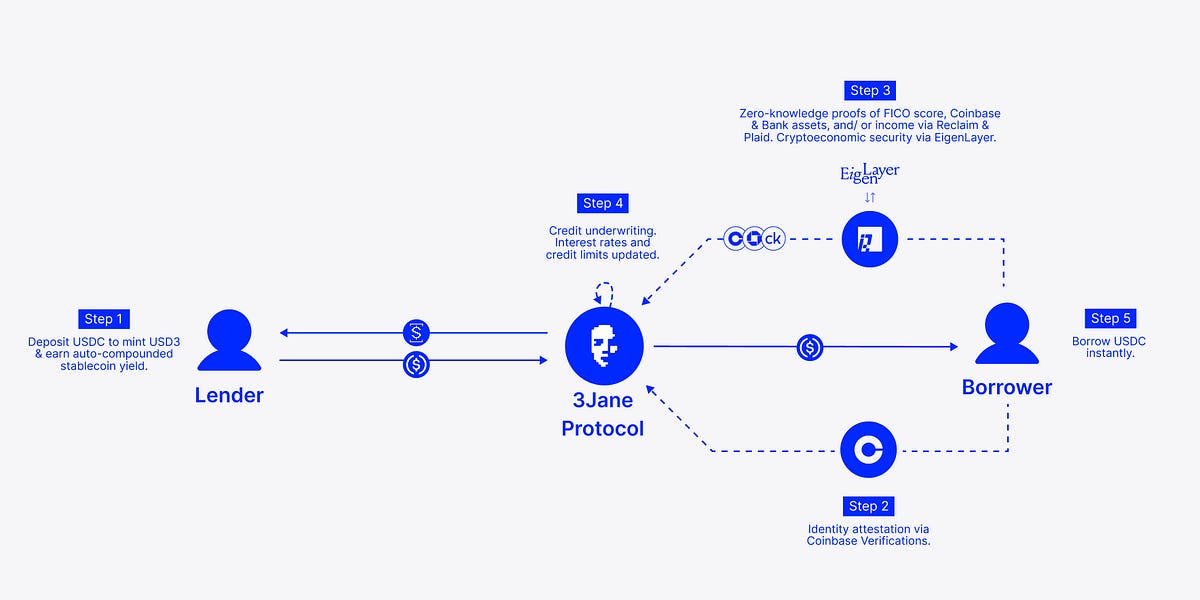
3Jane is a Ethereum-based credit protocol that provides unsecured USDC credit lines instead of the overcollateralized loans common in DeFi. According to its whitepaper and related coverage, the protocol underwrites borrowers using a mix of on-chain address credit scores, off-chain credit data, and verifiable proofs of assets, cash flows, and credit history, with integrations that include Cred Protocol, Blockchain Bureau, and VantageScore 3.0 via zkTLS. The story matters because 3Jane is trying to solve a long-standing DeFi problem: how to extend credit without forcing borrowers to lock up more capital than they borrow. That opens the door to traders, businesses, and even AI agents using capital more efficiently, but it also shifts the core risk from collateral liquidation to repayment enforcement, default management, and reliable credit scoring. 3Jane’s design includes a two-token structure, with USD3 and sUSD3, and a model that relies on off-chain underwriting plus on-chain mechanisms to handle bad debt, including debt collection workflows for defaults. Supporters frame it as a more scalable credit primitive for crypto markets, while the main unresolved question is whether its mix of reputation data, privacy-preserving identity checks, and enforcement can produce durable lending performance at scale.

AI-generated background, compiled from web sources — not editorial content.

More coverage

Explore the topic

More on Lending

Comments