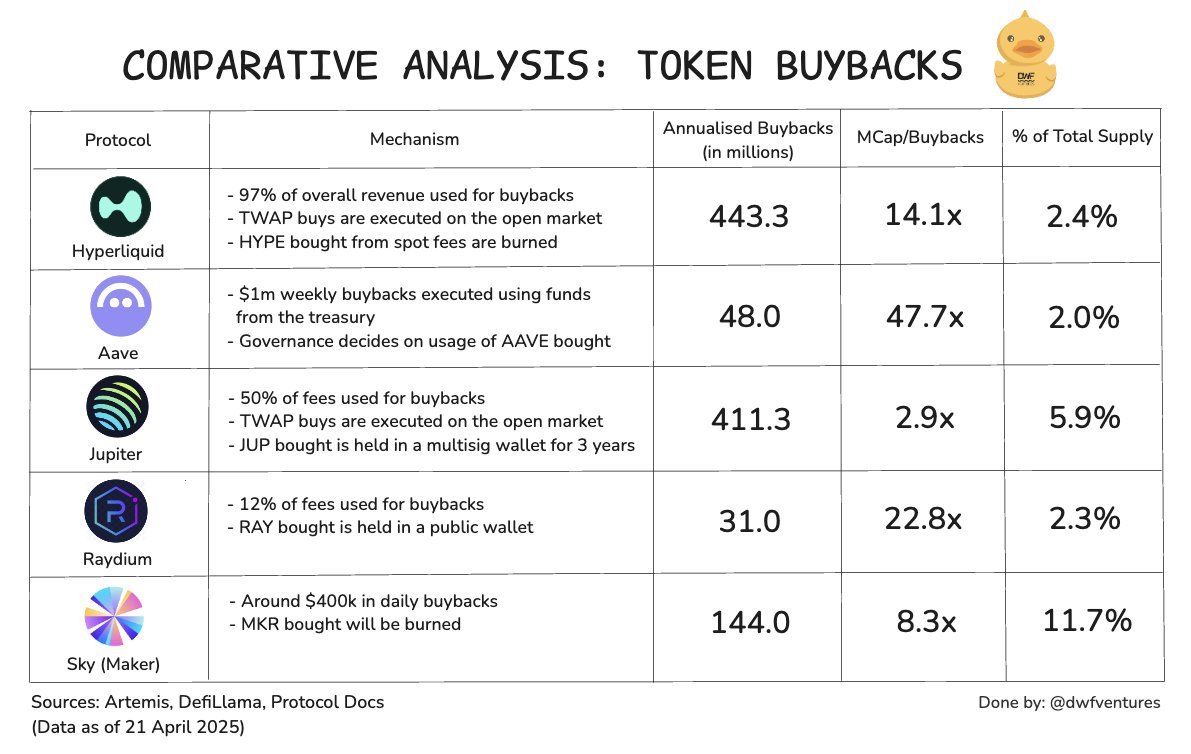
DWF Ventures has highlighted a growing trend in Web3 where profitable protocols are increasingly using token buybacks—repurchasing their own tokens using protocol revenue or treasury funds—as a core part of tokenomics, and is now analyzing whether these programs truly deliver sustainable value to holders. The discussion centers on whether buybacks, often framed as a way to link protocol cash flow to token price, are actually an efficient and effective mechanism for value redistribution compared with alternatives such as direct revenue sharing, staking rewards, or ecosystem investment.
According to a recent DWF Labs research piece, token buybacks have gained momentum particularly among high-revenue protocols that want to reward long-term users, reduce circulating supply, and reinforce alignment between a protocol’s financial performance and its token. These programs can be funded by on-chain fees, protocol profits, or treasury assets, and are sometimes paired with token burns or protocol-owned liquidity strategies to amplify perceived value. Data providers and analysts tracking on-chain activity have identified over 100 projects conducting buybacks in recent months, with several repurchasing tens of millions of dollars’ worth of tokens in a 30‑day window, underscoring how central the mechanism has become to modern tokenomics.
However, DWF’s focus on “whether these strategies actually deliver the results they promise” reflects a broader debate among crypto investors and venture firms. Some research argues that automated or mechanically executed buybacks can be an inefficient way to return value, potentially distorting market structure and providing less benefit than more direct distributions or productive reinvestment in growth. Other venture perspectives note that, unlike in traditional equity markets where buybacks are associated with mature cash‑cow companies, crypto markets often reward earlier, aggressive value-return mechanisms, which can create different risk–reward dynamics for token holders. DWF Ventures’ work fits into this ongoing re‑evaluation of how, and for whom, token buybacks work in practice, as protocols move from speculative phases toward revenue-generating, quasi-“cash-flow” businesses.
✨ AI-generated background, compiled from web sources — not editorial content.