Chainlink expands CCIP, data feeds, and automation support across multiple chains in latest multichain rollout.

New integrations brings CCIP, Data Streams, and Automation to a wave of L2s and alt-layer networks—including ZKsync, Celo, Hyperliquid, and Botanix—reinforcing its role as core infrastructure across modular and zero-knowledge ecosystems.
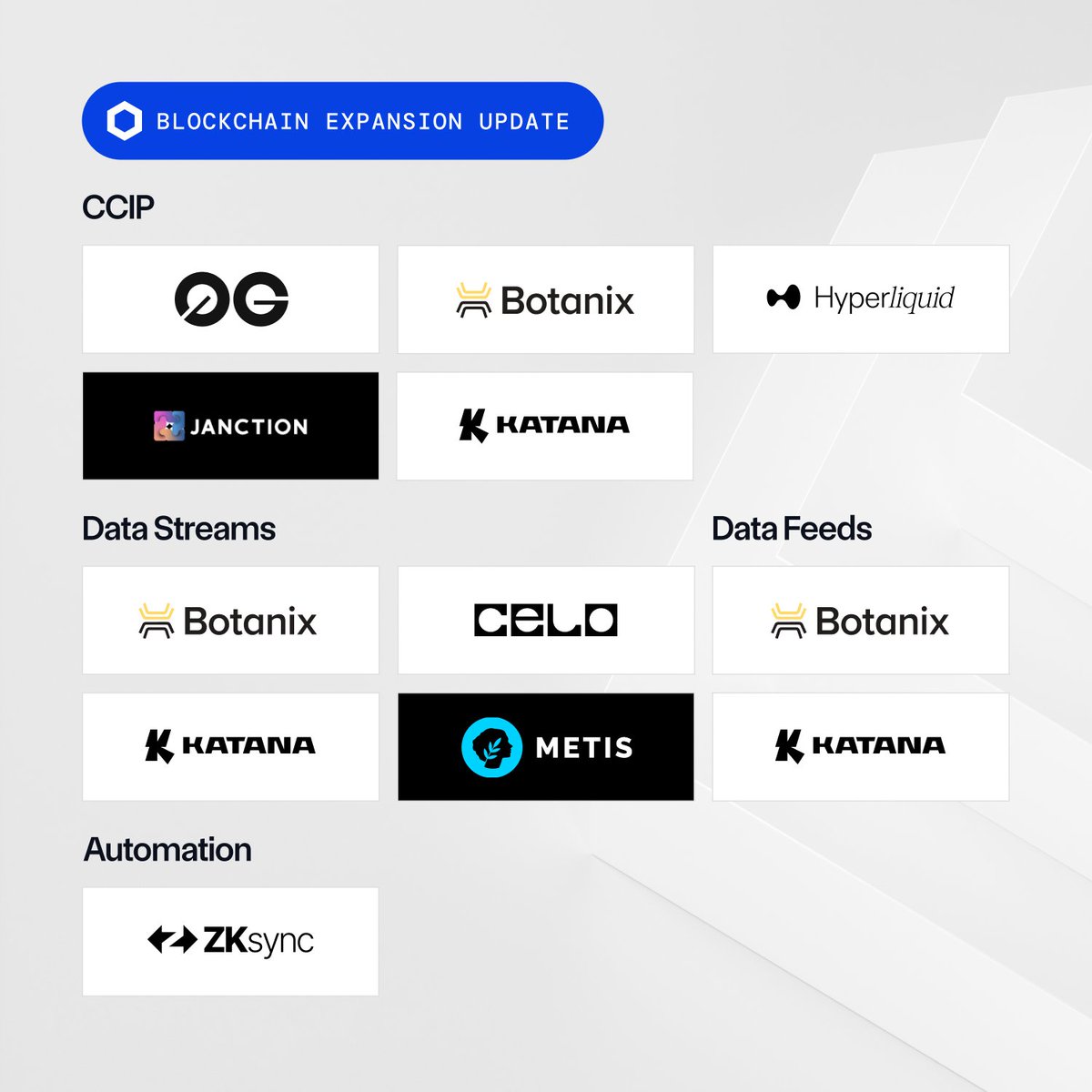
Chainlink expands CCIP, data feeds, and automation support across multiple chains in latest multichain rollout.

New integrations brings CCIP, Data Streams, and Automation to a wave of L2s and alt-layer networks—including ZKsync, Celo, Hyperliquid, and Botanix—reinforcing its role as core infrastructure across modular and zero-knowledge ecosystems.
𝕏/@chainlink
Revision history

13 recorded changes

Want your article here?

Promote with Leviathan News
Chainlink has announced a broad multichain rollout of several core services—CCIP (Cross-Chain Interoperability Protocol), Data Streams/Data Feeds, and Automation—to a new wave of Layer 2 and alternative Layer 1 networks, including ZKsync, Celo, Hyperliquid, and Botanix. This expansion means developers on these ecosystems can now natively access Chainlink’s oracle infrastructure for secure cross-chain messaging and token transfers (via CCIP), low-latency market data (via Data Streams/Data Feeds), and decentralized smart contract automation (via Automation). The move is part of Chainlink’s ongoing strategy to position itself as a common middleware layer across modular and zero-knowledge-centric architectures. By extending these services to additional L2s and alt-layer networks, Chainlink is deepening its role as shared infrastructure across a growing multichain environment. For the integrated chains, this can make it easier to launch DeFi, derivatives, and other onchain applications that depend on reliable external data, automated execution, and secure cross-chain interactions, without each network having to build and maintain this middleware itself. Strategically, it reinforces Chainlink’s position at the center of cross-chain connectivity and data provisioning for ZK-focused and modular ecosystems, potentially increasing developer reliance on its stack as value and activity fragment across many execution layers.

AI-generated background, compiled from web sources — not editorial content.

More coverage

Explore the topic

More on Automation

Comments