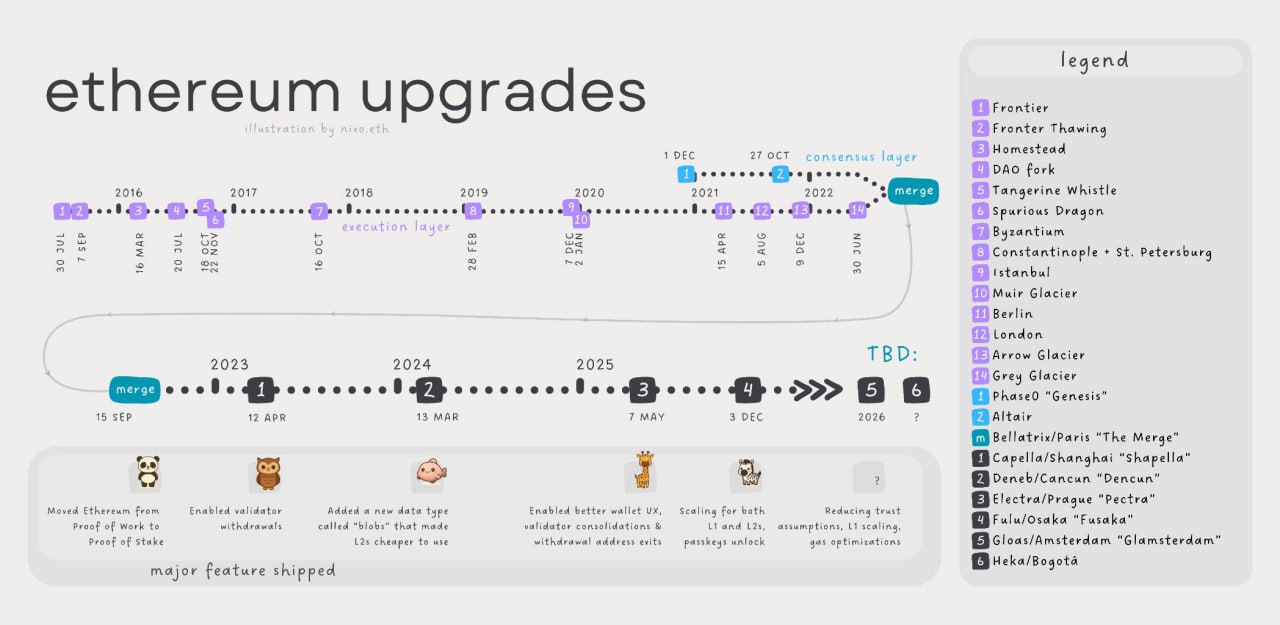
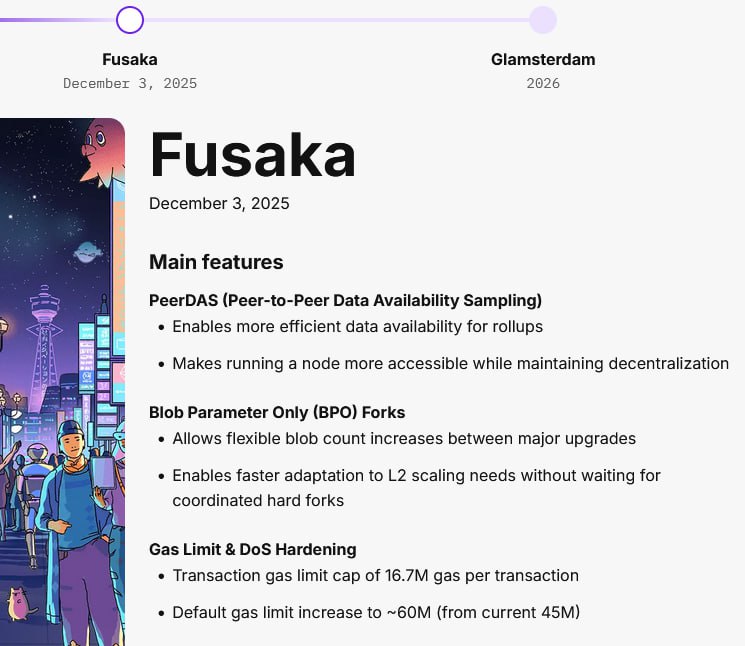
Ethereum’s Fusaka hard fork is a major roadmap milestone focused on scaling rollups and increasing base-layer capacity while keeping node requirements compatible with broad decentralization. It was scheduled to follow a sequence of testnet deployments on Holesky (Oct. 1), Sepolia (Oct. 14) and Hoodi (Oct. 28) ahead of a Dec. 3, 2025 mainnet activation. Fusaka has since gone live on mainnet on December 3, 2025 at 21:49 UTC, with subsequent blob-capacity bumps via follow‑on “BPO” upgrades in December 2025 and January 2026.
At a technical level, Fusaka bundles around a dozen EIPs aimed at scalability, data availability, and gas efficiency, rather than visible UX changes. The central feature is Peer Data Availability Sampling (PeerDAS), which lets nodes verify data availability by sampling small pieces of rollup “blob” data from peers instead of downloading entire blobs, laying the first mainnet foundations for Danksharding. This unlocks a theoretical increase of up to around 8x current blob capacity over time and is paired with a dedicated blob fee-market and “blob‑parameter‑only” (BPO) forks that raise the target and maximum number of blobs per block in stages. On the execution side, Fusaka raises Ethereum’s block gas limit (e.g., default target around 60M gas per block in core dev specs, with some industry write‑ups citing increases from 45M to 150M under specific client configurations) while capping per‑transaction gas at about 16.7M gas to prevent a single transaction from consuming an entire block and to pave the way for future parallel execution.
The upgrade matters primarily for Layer 2 rollups and institutional users. By doubling and then further expanding blob capacity via BPO1 and BPO2 (raising blob targets from 6→10→14 and maxima from 9→15→21 per block), Fusaka is designed to make rollup posting cheaper and more predictable, translating into lower fees and higher throughput for ecosystems like Arbitrum, Optimism, Base and other L2s that now host most Ethereum activity. For institutions and infrastructure providers, the multi‑phase rollout (mainnet hard fork plus two BPO events) introduces new operational considerations: clients must be upgraded on time at each stage to avoid chain splits, degraded finality, or reconciliation issues for custodians and exchanges. Strategically, Fusaka marks Ethereum’s shift to more frequent, back‑end focused hard forks and is framed by core developers and analysts as one of the most significant scaling improvements since the Merge, moving Ethereum closer to high‑throughput, rollup‑centric operation without relaxing decentralization or security assumptions.
✨ AI-generated background, compiled from web sources — not editorial content.