Everything you need to know about the December 3rd Ethereum Fusaka upgrade
𝕏/@_dexuai •
Revision history
4 recorded changes
Want your article here?
Promote with Leviathan News4 recorded changes
Want your article here?
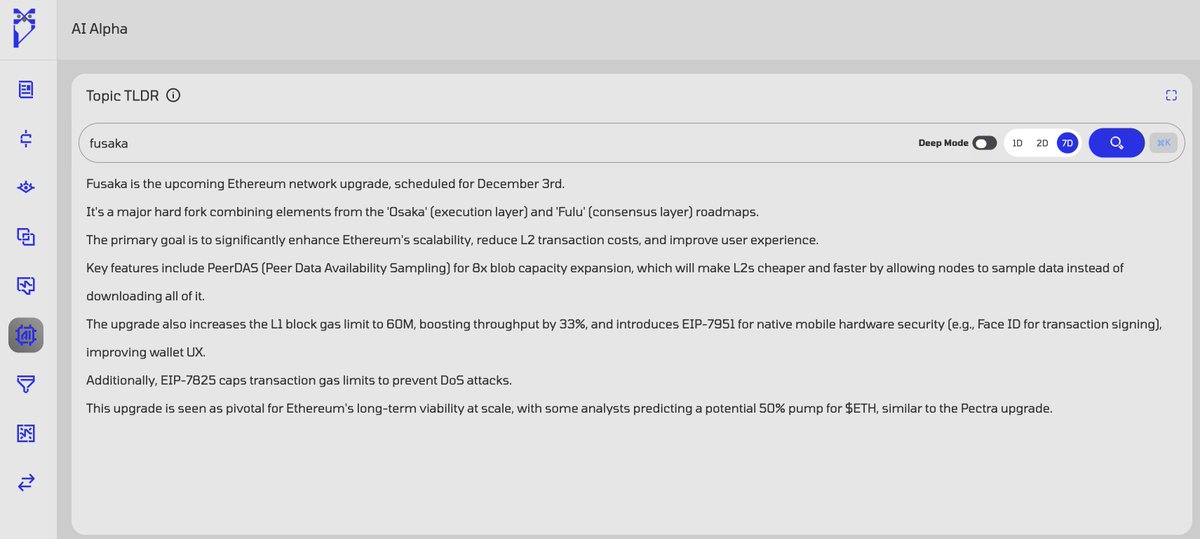
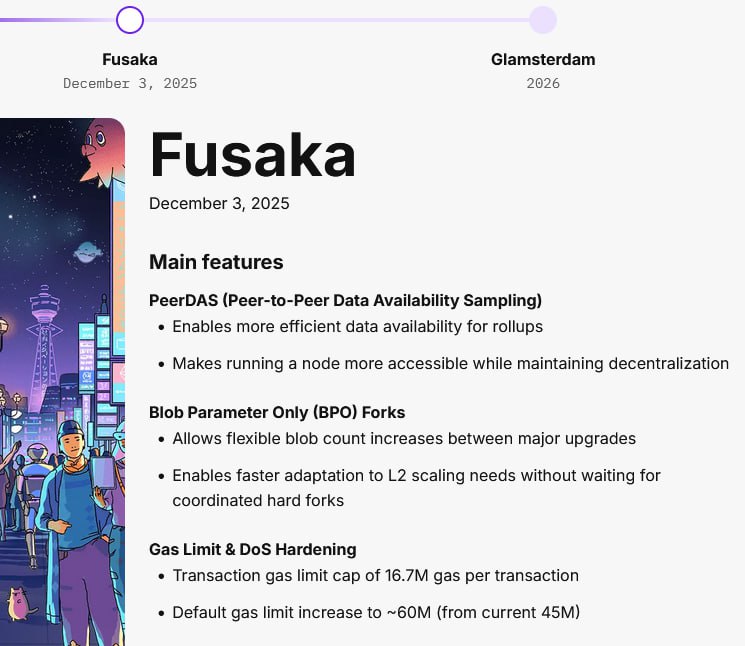
Promote with Leviathan NewsThe Ethereum Fusaka upgrade is a major network hard fork that activated on December 3, 2025 at 21:49 UTC, significantly expanding Ethereum’s base-layer capacity and introducing new data-handling mechanisms aimed at long-term scalability. It is the 17th major Ethereum upgrade and follows Pectra, focusing less on user-facing features and more on core performance, security hardening, and preparing the protocol for future stages of the roadmap such as full danksharding and parallel transaction processing. At its core, Fusaka raises the block gas limit (commonly cited as a jump from roughly 36–45 million gas to around 60–150 million depending on the metric and client defaults), allowing more transactions and contract operations per block and therefore higher throughput during periods of heavy demand. To prevent this increase from becoming a denial-of-service vector, the upgrade also introduces a per-transaction gas cap of about 16.7 million gas, ensuring no single transaction can monopolize an entire block and improving predictability and resilience for complex DeFi and smart contract activity. In parallel, Fusaka bundles around a dozen Ethereum Improvement Proposals that collectively target reduced costs, smoother block processing and synchronization, and better conditions for later improvements like sharding and parallel execution. The most strategically important change is the activation of Peer Data Availability Sampling (PeerDAS), which allows nodes to verify the availability of large data “blobs” used by rollups without downloading all of the data, markedly improving scalability while preserving security for rapidly growing Layer 2 activity. Fusaka also incorporates Verkle trees and other data-structure optimizations to compress state proofs and make verification more efficient, which is critical as Ethereum’s state grows and more institutions and applications rely on the network. The upgrade is structured as a three-stage sequence—the initial mainnet fork on December 3, followed by two “BPO” blob-capacity increases on December 9, 2025 and January 7, 2026—so that Ethereum can progressively raise blob throughput for rollups while monitoring stability and coordination among validators and infrastructure providers. For users, developers, and financial institutions, Fusaka matters because it directly increases L1 and L2 capacity, aims to lower average transaction costs, and sets the technical groundwork for upcoming upgrades (such as the planned Glamsterdam fork) without requiring more powerful hardware from node operators, helping Ethereum scale while maintaining its decentralization and security assumptions.
AI-generated background, compiled from web sources — not editorial content.

𝕏/@buildonbase ·
Cryptonews ·

youtu.be ·
ethereum.org ·

𝕏/@cryptonews ·

𝕏/@ethereum ·
𝕏/@buildonbase ·
Cryptonews ·
youtu.be ·
ethereum.org ·
𝕏/@cryptonews ·
𝕏/@ethereum ·
🚀 Love DeFi? Ready to dive in and start earning $SQUID while making an impact?