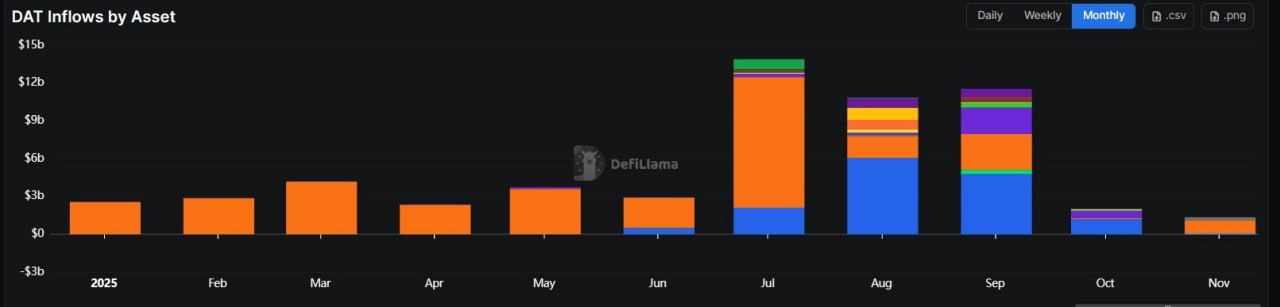
Digital asset treasury (DAT) inflows fell sharply in November 2025, dropping to about $1.32 billion, the weakest month of the year and a marked slowdown from the multi‑billion‑dollar monthly inflows seen earlier in 2025. According to Cointelegraph’s coverage of DefiLlama data, roughly $1.06 billion of November’s net inflows came from Bitcoin-focused treasury firms, while Ether-focused treasuries swung to about $37 million in net outflows, even as some specialized players such as BitMine continued to add ETH to their balance sheets. This pullback coincided with a broader risk‑off shift across digital asset markets and public equities tied to the DAT theme, following the October 10, 2025 market crash and heavy liquidations that punctured the earlier corporate treasury boom. Galaxy Asset Management notes that U.S. spot Bitcoin and Ether ETFs together saw more than $5 billion in outflows in November, their worst month on record, underscoring waning institutional appetite and helping explain why Ether treasuries, in particular, saw net selling. While 2025 overall marked the year digital asset treasuries went mainstream—public companies treating BTC and ETH as core balance‑sheet assets, often for exposure and staking yield—the November data suggest that the most momentum‑driven phase of that boom has cooled, with treasury accumulation becoming more selective and skewed toward Bitcoin. The story matters because DATs have become a proxy for crypto exposure in public markets, and their flows now interact with ETF flows, regulatory developments, and equity valuations in a feedback loop. The November slowdown raises questions about the durability of the corporate treasury model in a choppy macro and regulatory environment: lower rates and clearer U.S. guidance on staking helped fuel earlier inflows, but as crypto prices and DAT company stocks sold off, the capacity and willingness of firms to lever up balance sheets for additional token purchases diminished. The divergence—ongoing Bitcoin accumulation versus Ether outflows despite continued buying by firms like BitMine—also highlights shifting preferences within institutional crypto exposure, with Bitcoin retaining its position as the primary “reserve” asset while Ether’s role as a yield‑bearing infrastructure play faces more cyclical pressure.

AI-generated background, compiled from web sources — not editorial content.

More coverage

Explore the topic

More on Digital Asset Treasury

Comments